Introduction
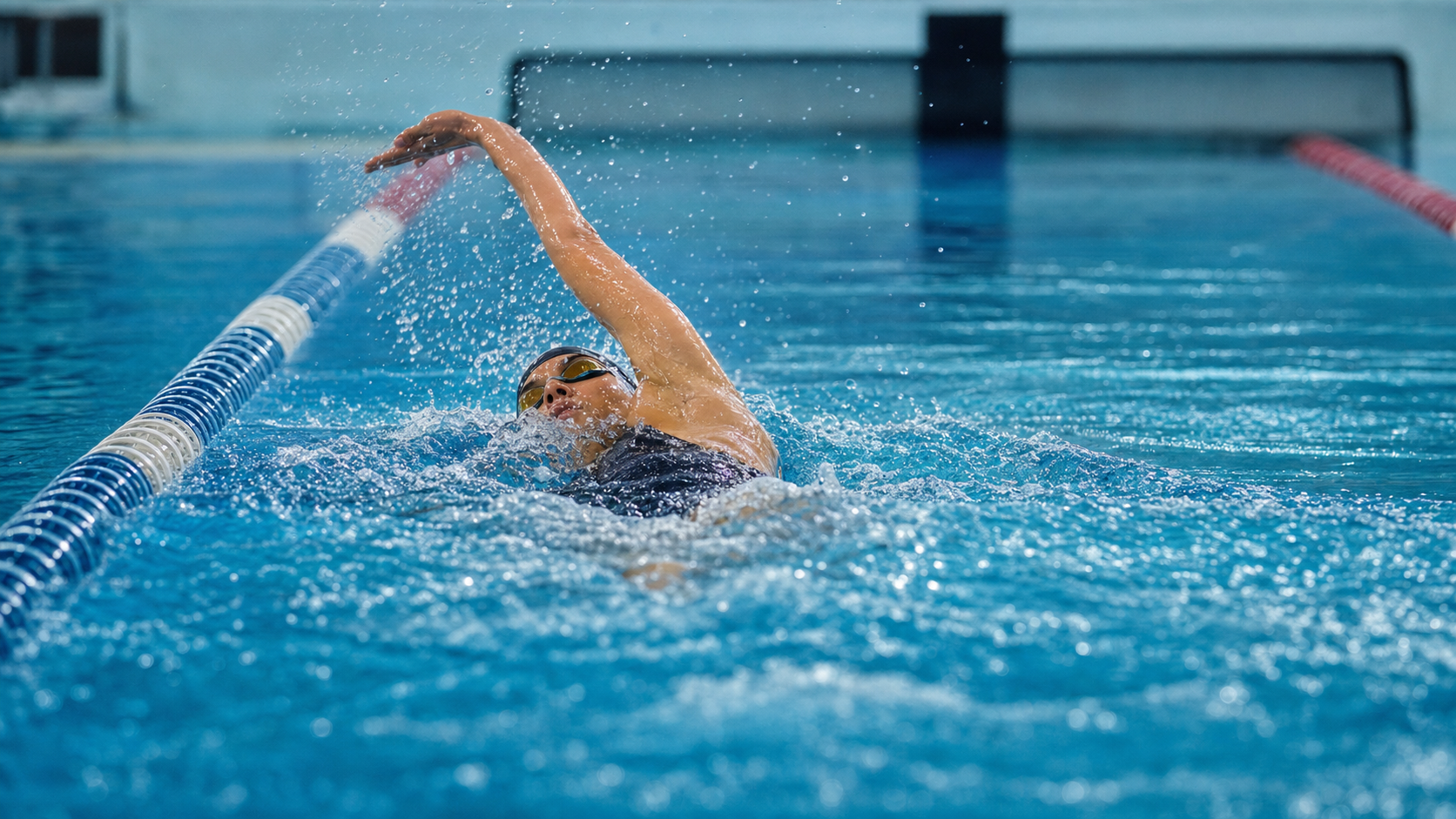
Backstroke is the most unique of the four competitive swimming strokes—the swimmer faces the sky, unable to see the approaching wall or the finish line. This “blind swimming” characteristic makes turn counting an essential core skill that backstroke swimmers must master. Additionally, the backstroke start is in the water (standing on the wall holding the starting grips), the turn technique differs from freestyle, and the finishing touch differs from other strokes. This article provides a comprehensive analysis of backstroke race strategy and technical key points.
Turn Counting: The Most Important Backstroke Technique
Turn counting refers to the swimmer estimating their distance from the wall by counting stroke cycles as they approach, allowing them to initiate the flip turn at the correct moment.
Why is counting necessary?
Since 2009, competitive swimming regulations require “backstroke flags” to be placed 5 meters from each wall. Swimmers begin counting after seeing the flags, and the number of strokes to the wall is fixed, varying by individual and requiring repeated measurement to confirm.
How to determine your count:
| Step | Method |
|---|---|
| Baseline measurement | Swim from the flags to the wall, counting strokes (count left arm or right arm only) |
| Multiple confirmations | Repeat 10+ times, take the most consistent count |
| Speed verification | Reconfirm at race pace (not practice pace) |
| Fatigue adjustment | Stroke length shortens when fatigued, count may increase by 1 |
Most swimmers have a count of 3 to 6 strokes after the flags.
Consequences of counting errors:
- Under-counting (turning too early): Head hits the wall, possible injury, and significant speed loss
- Over-counting (turning too late): Must glide to reach the wall, losing push-off power
Backstroke Turn Technique
The backstroke flip turn includes two types:
Flip Turn from Backstroke:
Modern backstroke racing uses the “continuous roll” technique—after the final stroke, the body rotates to a prone (freestyle) position, performs a freestyle-like flip turn, and finishes with toes pointing upward when pushing off the wall.
Steps:
- Count X strokes after the flags
- Rotate the body during the final stroke (from back to front, rotating left or right depending on the individual)
- Approach the wall with a half freestyle flip
- Push off the wall with both feet, rotating the body back to the supine position after pushing off
- Streamline glide with backstroke dolphin kicks (used by most elite swimmers)
Turn rule notes:
During a backstroke turn, the body must complete the rotation before touching the wall (you cannot touch the wall on your back and then rotate), and the touch must be with one hand (not both). Violations result in disqualification, and officials pay close attention to this detail.
Backstroke Sprinting: Finish Touch Strategy
Backstroke swimmers cannot directly see the finish wall, making the final sprint touch another challenge.
Finish touch counting:
Same principle as turn counting—count strokes from the final set of flags to the finish wall. However, the finish requires a hand touch (not a foot push-off), so the counting method differs slightly.
Final 5-meter strategy:
- After confirming the count, do not slow down to wait for the touch; maintain stroke rate until your fingers hit the wall
- If you detect a distance discrepancy after counting, adjust with the extension of the final stroke (lengthen or shorten the stroke)
- Never look up to confirm during the final strokes (this severely reduces speed)
Mid-Pool Technique Key Points
- Body position: Head tilted slightly forward (not completely level), ears submerged, eyes looking slightly toward the feet rather than straight up
- Hand entry: Enter the water pinky-first (reduces entry drag), entry point slightly outside the head
- Six-beat kick: Standard backstroke kick, toes pointed outward, an extension of a running-like motion
- Body roll: Similar to freestyle, backstroke requires side-to-side body rotation to increase stroke depth and power
Practical Recommendations
- Practice turn counting every session: Regardless of workout volume, perform at least 10 to 15 turn counting repetitions
- Recount in different pools: Flag line positions may vary slightly between pools; always re-measure before competing in an unfamiliar pool
- Counting card: Write your count on the back of your hand or inform your coach before a race for double confirmation
- Backstroke start training: Underwater backstroke dolphin kicks after the start are an important acceleration tool that requires dedicated practice
Conclusion
The competitive appeal of backstroke lies in its unique challenge—unable to see the wall or your opponents, you must rely on precise self-awareness and counting technique to complete the entire race. Mastering turn counting, perfecting the flip turn, and finding that most precise stroke where the finish line is invisible—this is the art of the backstroke swimmer.
Related Reading
西進武嶺 自製新版AI配速表產生器 x 賽前攻略 抱佛腳! 沒有功率計也可以產生配速表嗎?有什麼其他眉角賽前要注意的呢? | 西進武嶺 / 東進武嶺 KOM 攻略 | 公路車 | CT Yeh
4 年前
CT 喇低賽) 武嶺牽車 才是王道 西進牽車四小時內秘訣 攝手位置 如何判斷 防抽筋小秘訣
7 年前
戰略) Zwift Race 如何咬在第一集團 如何評估自己要開多少推力 (請開1.5倍速看)
7 年前
風櫃嘴 衝刺慢動作回放!
8 年前
Insta 360 One 超級防手震技術實測
7 年前
Insta360/DJI做不到的!如何製作「騎士頭頂瓦數特效」單車影片?CycleDash 完整教學 / 超強批次影片數據疊加軟體
12 天前
下次拍照前要查清楚啦🤣 #cycling
7 個月前
抖肩舞 台灣x日本交流版 (台灣 vs 前橋) 赤城山登山賽 coincidance
8 年前