Introduction
The Individual Medley (IM)—butterfly, backstroke, breaststroke, and freestyle swum in sequence—is the most demanding event in competitive swimming in terms of all-around ability. Swimmers must master all four strokes and, more importantly, reallocate their energy in real time during each stroke transition. In Taiwan’s swimming competitions, the 200 IM and 400 IM are the primary stages where well-rounded athletes showcase their strength, and they are also key events for coaches to evaluate a swimmer’s technical versatility.
The Characteristics of the Four Strokes and the Logic Behind the Order
The Olympic-mandated IM order (butterfly → backstroke → breaststroke → freestyle) is not random—this sequence has a physiological rationale:
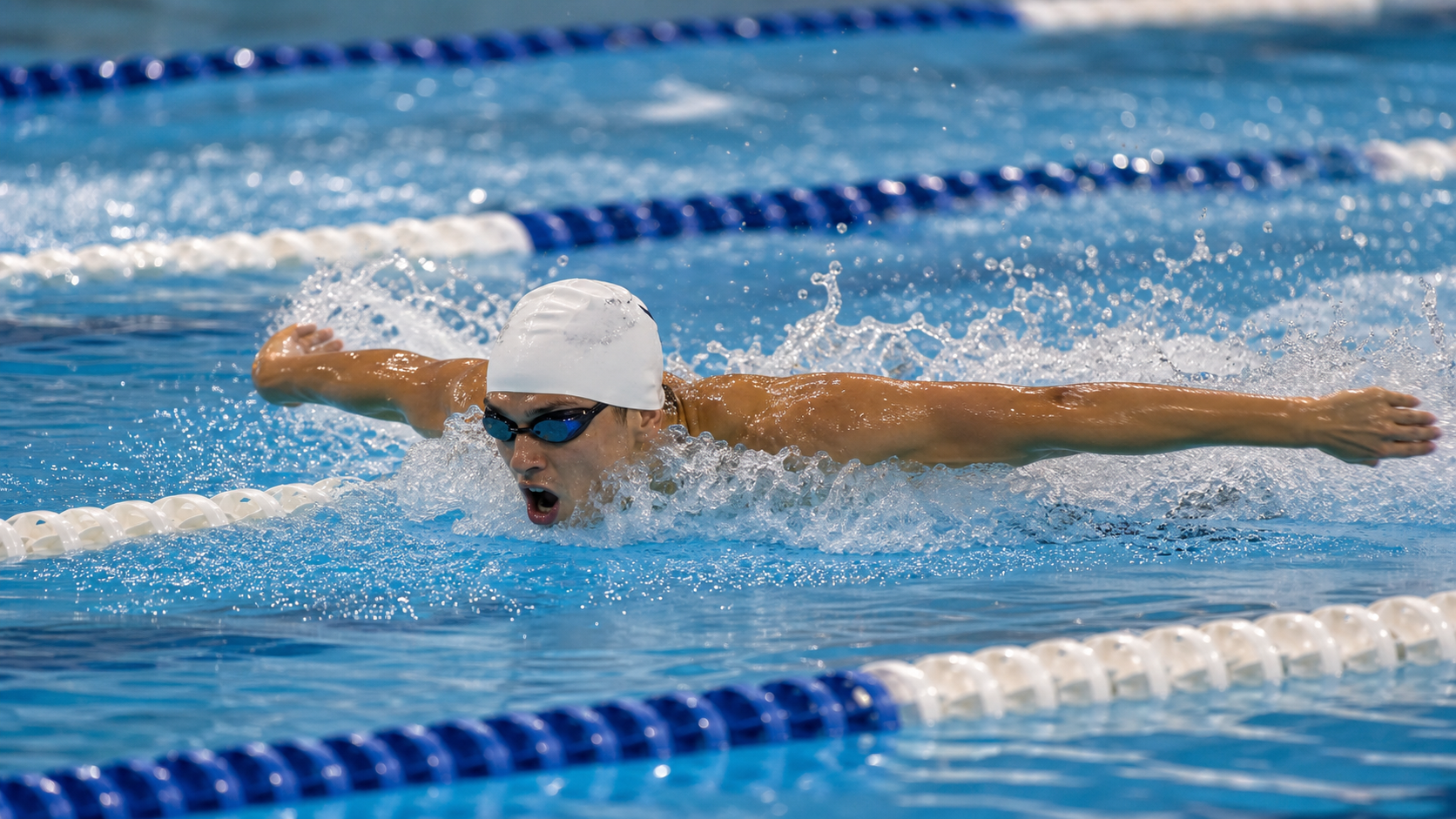
- Butterfly opener: Butterfly demands the most energy, so it is placed first when energy reserves are at their peak
- Backstroke follows: Backstroke is relatively less taxing than butterfly, placed second to allow swimmers to recover from butterfly’s high intensity
- Breaststroke as the penultimate leg: Breaststroke is highly technical, and the glide phase offers a slight breather, but the kick still requires significant strength
- Freestyle to close: Freestyle is the most economical (relative to the other three strokes), allowing swimmers to maintain speed even when most fatigued
Efficiency comparison of the four strokes (based on the same distance):
| Stroke | Relative Energy Cost | Characteristics |
|---|---|---|
| Butterfly | Highest | Full-body coordinated explosive power; most tiring |
| Backstroke | Moderate | Relatively smooth; suitable for recovery |
| Breaststroke | Moderate-high | Kick is demanding but glide saves energy |
| Freestyle | Lowest | Most efficient competitive stroke |
200 IM: Precise Allocation Across Four Sprints
Each leg of the 200 IM is only 50 meters, meaning there is no room for “warming into” the race—every leg must be swum at full effort (but with controlled full effort).
Ideal 200 IM split strategy:
- Butterfly 50m: Swim at 90% effort, saving a little for the backstroke turn transition
- Backstroke 50m: Use the transition to slightly reset your rhythm and maintain a steady stroke rate
- Breaststroke 50m: The 200 IM typically sees the biggest drop in speed during this leg; ensure your kick power does not diminish
- Freestyle 50m: Empty the tank and sprint to the finish at maximum speed
Transition touch rules:
Each stroke must touch the wall in the prescribed manner:
- Butterfly → Backstroke: Touch with both hands simultaneously, then flip onto the back (same as a butterfly turn)
- Backstroke → Breaststroke: Backstroke requires a hand touch, then rotate to a prone position to begin breaststroke
- Breaststroke → Freestyle: Touch with both hands simultaneously, then transition into a freestyle flip turn
400 IM: The Art of Long-Distance Energy Management
The 400 IM (100 meters per leg) is a far more grueling endurance challenge than the 200 IM.
400 IM split strategy:
Butterfly 100m—restraint at the start is key. Many swimmers go out too hard in the 400 IM butterfly leg, causing a total collapse across the final three legs. It is recommended to swim this leg at a pace “4 to 5 seconds slower than your personal best 100 butterfly,” preserving energy for the later legs.
Backstroke 100m—an opportunity for heart rate and breathing recovery. Compared to butterfly, breathing in backstroke is more natural (one breath per stroke), making this leg a rare “recovery window” in the 400 IM, though speed must still be maintained.
Breaststroke 100m—the final technical test. Swimming breaststroke under the fatigue of the first 200m makes it easy to lose outward rotation in the kick and shorten the glide. It is recommended to deliberately maintain a fully extended streamline after each pull during this leg.
Freestyle 100m—full settlement. By the time you enter the freestyle leg, the body is already deeply fatigued, but the breathing freedom of freestyle (one breath every two strokes) allows swimmers to gradually build speed. Increase kick tempo in the final 50m and sprint to the finish.
Mental Adjustment During Transitions
Transitions are not just technical movements; they are also critical psychological checkpoints. Each transition marks the end of one stroke and the beginning of another, and elite swimmers use this moment to mentally “reset”:
- Before touching the wall: Tell yourself “this leg is done”
- After pushing off the wall: “A new 50/100m, a new stroke, a fresh start”
- This mental segmentation helps prevent fatigue from the previous leg from carrying over into the next
Practical Advice
- Balanced training across all four strokes: IM swimmers must avoid neglecting any single stroke; a weak stroke is often the ceiling on performance
- Transition speed training: Dedicate practice to the speed and legality of transition touches; losing 0.5 seconds per transition costs 1.5 seconds over a 400 IM
- Broken IM sets: 200 IM × 4 sets, with each set focusing on a different leg (e.g., the first set focusing only on butterfly technique), is an effective way to improve efficiency
- Taiwan reference standards: National Youth Group A men’s 200 IM is approximately 2:10 to 2:20, women’s approximately 2:22 to 2:35
Conclusion
The Individual Medley is the most comprehensive challenge in competitive swimming and the greatest teacher for both swimmers and coaches—it shows you that success requires completeness, and weaknesses will be exposed without mercy. In Taiwan’s swimming scene, IM specialists are often the most respected type of athlete. Refine each stroke, strategically allocate your energy across every leg, and your IM times will keep improving.
Related Reading
- Energy Distribution in the Individual Medley (IM): Strength Planning Across the Four-Stroke Order
- Energy Distribution in the 200m Medley: Energy Management Across the Four-Stroke Order
- Four-Stroke Transition Strategy in the 200m Individual Medley: The Art of Order Advantage and Pacing
- Race Strategy for Medley Events: Four-Stroke Order and Pacing Allocation
西進武嶺 免費訓練分析服務 Intervals | 練不夠還是練過頭?你哪一種類型選手?AI模型告訴你! | 備戰神器 | 公路車 訓練 | CT Yeh
4 年前
西進武嶺 自製新版AI配速表產生器 x 賽前攻略 抱佛腳! 沒有功率計也可以產生配速表嗎?有什麼其他眉角賽前要注意的呢? | 西進武嶺 / 東進武嶺 KOM 攻略 | 公路車 | CT Yeh
4 年前
live) 超越北高 之一日北高12小時 策略
7 年前
2024桃園團體自由車邀請賽!4K環台賽等級拍攝 全賽事精華!/ 集團大摔車 / 60隊菁英好手衝線 / 公路車 CT Yeh
1 年前
戰略) Zwift Race 如何咬在第一集團 如何評估自己要開多少推力 (請開1.5倍速看)
7 年前
Live) 備戰2019彰化經典百K 賽前攻略 (已完賽請看新影片
7 年前
CT 喇低賽) 武嶺牽車 才是王道 西進牽車四小時內秘訣 攝手位置 如何判斷 防抽筋小秘訣
7 年前
實景訓練台) 彰化經典百K 高強度喵團 90分鐘 跟著一起練功 2019 Indoor workout Changhua Classic 100 Taiwan
7 年前