Introduction
Approximately 3.5 million people in Taiwan suffer from degenerative arthritis, with the knee and hip joints being the most commonly affected areas. Many patients give up exercise due to pain, falling into a vicious cycle of “inactivity → decreased muscle strength → greater joint instability → increased pain.” Swimming, as a typical low-impact exercise, offers an ideal option for joint patients to regain an exercise routine.
How Water Buoyancy Protects Joints
When a person stands in waist-deep water, buoyancy reduces effective body weight by about 50%; at shoulder depth, effective body weight drops to just 10%. This means that a person weighing 70 kg, while swimming, has joints bearing an impact force equivalent to a body weight of just 7 kg. In comparison:
- Walking: Impact force per step is about 1.2 times body weight
- Running: Impact force per step reaches 3–5 times body weight
- Swimming: Nearly zero impact; water resistance replaces gravity as the primary force against which muscles work
This extremely low-impact characteristic makes swimming one of the most commonly recommended forms of exercise by orthopedic surgeons and physical therapists for post-operative joint rehabilitation and arthritis management.
Comparison of Stroke Effects on Joints
Not all strokes are equally friendly to every type of joint problem; choosing the right stroke is crucial.
| Stroke | Primary Joints Used | Suitable For | Cautions |
|---|---|---|---|
| Freestyle | Shoulders, ankles | Knee arthritis, hip problems | Caution for rotator cuff injuries |
| Backstroke | Shoulders, knees (mild) | Lower back pain, neck issues | Careful with shoulder instability |
| Breaststroke | Knees (medial), hips | Shoulder injuries, general fitness | Avoid with medial collateral ligament injuries |
| Butterfly | Shoulders, lower back, knees | Elite training | Not recommended for joint patients |
For those with knee degeneration, freestyle or backstroke is recommended as the primary stroke, avoiding the valgus shear force on the knee produced by the breaststroke kick. For those with rotator cuff injuries, backstroke or breaststroke should be chosen, with a reduced stroke frequency.
How Swimming Strengthens Muscles Around Joints
Joint stability relies on the support of surrounding muscles. While protecting joints, swimming also comprehensively trains the following muscle groups through water resistance:
- Quadriceps and hamstrings: Stabilize the knee joint, reducing abnormal friction between the femur and tibia
- Gluteal muscles: Support the hip joint, dispersing impact force during walking
- Core muscles: Stabilize the spine, reducing pressure on lumbar joints
- Rotator cuff muscles: Control the position of the humeral head within the glenoid fossa, preventing impingement syndrome
A randomized controlled trial on knee arthritis patients showed that after swimming three times per week for eight weeks, participants’ knee pain scores dropped by 35%, walking speed improved by 18%, and inflammatory markers in joint fluid also decreased significantly.
Practical Recommendations
- Early-stage arthritis patients: Choose a heated pool with water temperature of 28–31°C; warm water relaxes muscles and reduces pain upon initial entry
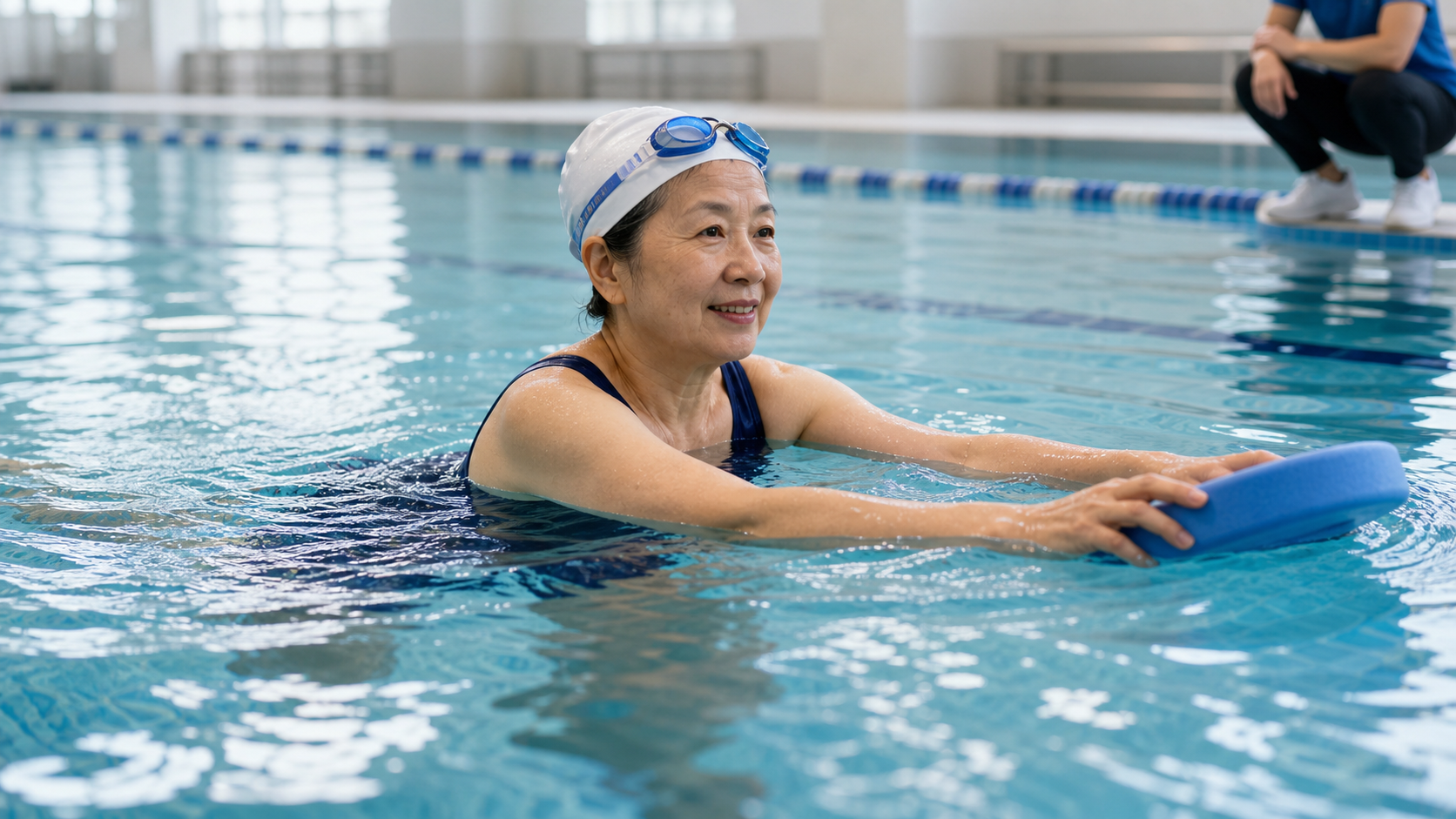
- Those with knee problems: Use freestyle with a kickboard to practice leg movements, avoiding the breaststroke kick
- Post-operative rehabilitation: Enter the water only after the wound has fully healed (usually 6–8 weeks post-surgery), starting with water walking before progressing to swimming
- Use assistive devices: An aqua jogger (waterproof running belt) allows the knee joint to bear zero weight, suitable for the acute inflammatory phase
- Avoid overtraining: Stop when the joint shows signs of inflammation (redness, heat, swelling), and resume after symptoms subside
Conclusion
The protective effect of swimming on joints stems from the physical properties of water, not any special training technique, which makes it accessible to nearly everyone. For many people in Taiwan who struggle with land-based exercise due to excess weight or joint degeneration, swimming offers an excellent path that provides effective training without harming the joints. By choosing the right stroke and appropriate intensity, water exercise will become your most faithful joint guardian.
Related Reading
- Swimming and Arthritis: The Best Low-Impact Exercise Choice
- Joint Protection Through Swimming: Recommendations for Patients with Degenerative Arthritis
- Joint Protection Through Water Training: Aquatic Rehabilitation Programs for Degenerative Arthritis
- The Healing Benefits of Swimming for Arthritis Patients: The Medical Evidence Behind Low-Impact Water Exercise
靠單車減肥35公斤 心得分享與整理
7 年前
[教學] Premiere 影片 手震 修正 教學 防抖 單眼 影像 GoPro 穩定 Video Stabilization
8 年前
抖肩舞 台灣x日本交流版 (台灣 vs 前橋) 赤城山登山賽 coincidance
8 年前
再一組! 全碳幅條 碟煞/無內胎輪組 開箱! 到底好騎嗎? UNAAS X40 | 公路車 | CT Yeh
4 年前
Nepest NOVA 碳條輪組:輕量、空力、舒適一次滿足!/ 公路車 / CT Yeh
7 個月前
碟煞公路車 銑面器 !? 原來銑完差這麼多! 降低蹭碟機率! | TIME 公路車 保養小記錄 | CT Yeh
3 年前
白沙屯媽祖進香在家走!UREVO 坡度自調走步機 / 可連接訓練遊戲APP MyWhoosh / 邊看直播邊走起來 / CT Yeh
11 個月前
CT 喇低賽) 武嶺牽車 才是王道 西進牽車四小時內秘訣 攝手位置 如何判斷 防抽筋小秘訣
7 年前