Introduction
“Swimming is a full-body exercise” is a widely repeated phrase, yet it is often misinterpreted as “swimming can evenly train all muscles.” In reality, different strokes place significantly different demands on specific muscle groups, and swimming provides relatively insufficient stimulation to certain muscles. Long-term, high-volume swim training can lead to muscle imbalances, where certain muscles become overdeveloped while their antagonists remain comparatively weak. Through electromyography (EMG) research, we can now precisely record the activation timing and intensity of each muscle group throughout the swimming cycle—this is a crucial foundation for designing scientific dry-land supplementary training.
Primary Working Muscle Groups by Stroke
Freestyle
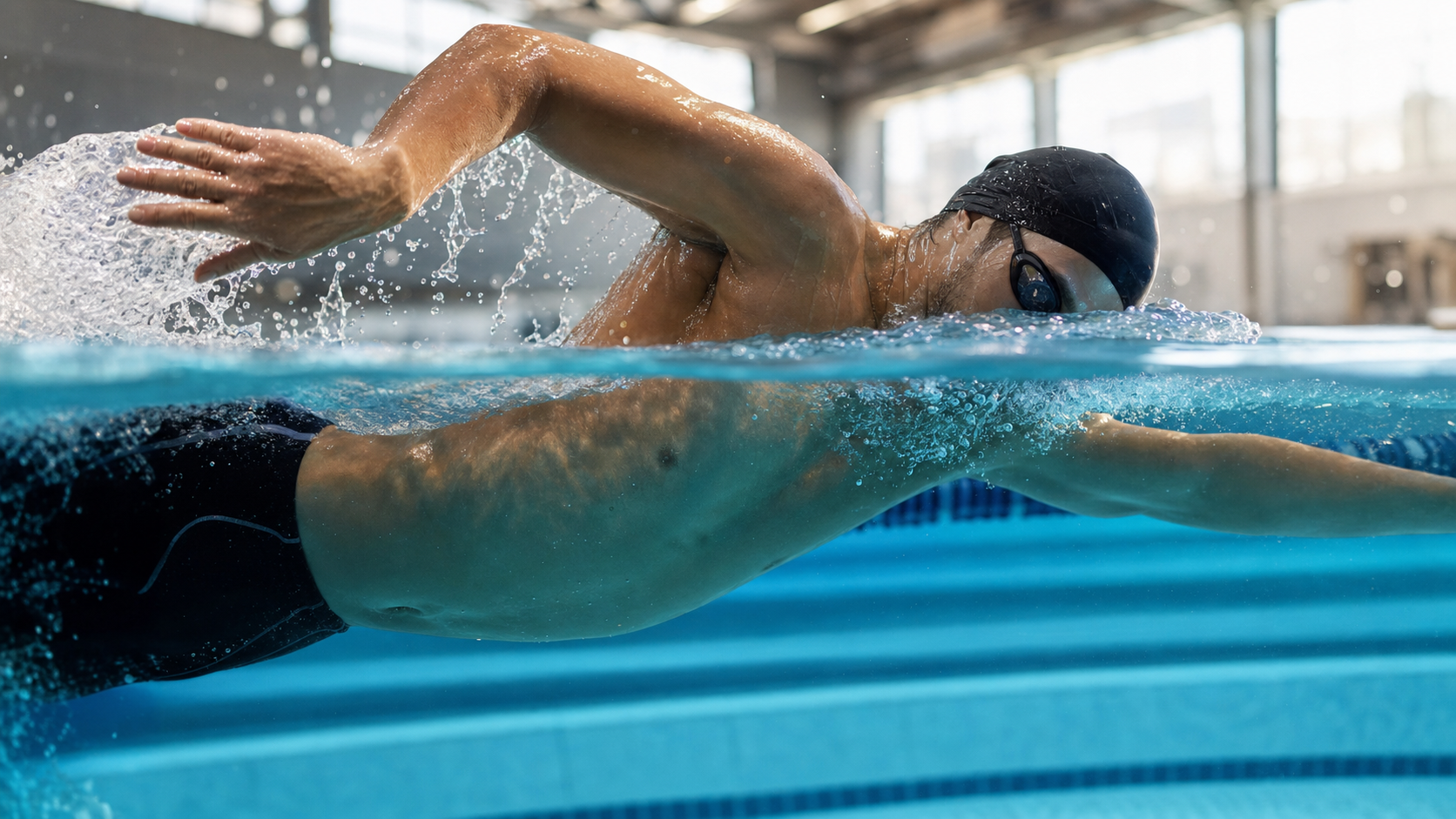
Freestyle is the stroke that most emphasizes upper-body strength and core stability. The primary muscle groups activated include:
Primary propulsive muscles:
- Latissimus Dorsi: The main force-producing muscle during the pull-down phase of the stroke. EMG studies show peak activation reaching 70–85% of maximal voluntary contraction (MVC)
- Pectoralis Major: Works synergistically with the latissimus dorsi in the adduction movement, contributing approximately 30–50% MVC
- Anterior Deltoid: Drives the downward arm press in the early pull phase, with activation at 40–60% MVC
Stabilizer muscles:
- Serratus Anterior: Maintains scapular stability, preventing shoulder impingement
- Transverse Abdominis: Deep core muscle responsible for core stability
- Erector Spinae: Resists the tendency toward lumbar flexion caused by water resistance
Breaststroke
Breaststroke is the only stroke where the legs provide the primary propulsion (accounting for 65–70% of forward thrust):
- Adductors: The primary muscle group for the whip-kick leg action, with activation intensity exceeding that of the same muscles in any other stroke
- Gluteus Maximus: Drives leg extension for propulsion, with EMG showing peak activation up to 85% MVC
- Quadriceps: Extend the knee for the kick, though the activation timing is more brief than in running
- Pectoralis Major: The main force-producing muscle for the arm sweep and catch
Butterfly
Butterfly is the most demanding stroke, placing the greatest requirement on the body’s core:
- Latissimus Dorsi: With both arms pulling simultaneously, peak activation reaches 90–100% MVC—far exceeding freestyle
- Rectus Abdominis and External Obliques: The core drivers of the dolphin kick, these muscles must resist excessive lumbar extension during every stroke cycle
- Gluteus Maximus: The primary propulsive muscle for the downward phase of the dolphin kick
- Soleus and Gastrocnemius: Drive ankle plantar flexion for the kick
Backstroke
Backstroke activates the most posterior shoulder muscles and offers the best shoulder balance among the four strokes:
- Posterior Deltoid: Drives the downward pull after hand entry—an activation pattern almost absent in other strokes
- Rhomboids: Scapular retraction, a uniquely important activation in backstroke
- Lower Trapezius: Stabilizes the scapula, preventing the forward scapular drift commonly seen in backstroke
| Muscle Group | Freestyle | Breaststroke | Butterfly | Backstroke |
|---|---|---|---|---|
| Latissimus Dorsi | ●●●● | ●●● | ●●●●● | ●●●● |
| Pectoralis Major | ●●● | ●●●● | ●●●● | ●● |
| Gluteus Maximus | ●● | ●●●● | ●●●● | ●● |
| Posterior Deltoid | ● | ● | ● | ●●●● |
| Rectus Abdominis | ●● | ●● | ●●●●● | ●● |
(●●●●● = high-intensity activation, ● = low activation)
Muscle Imbalances and Injury Risk in Swimming
Common muscle imbalances seen in long-term freestyle or butterfly swimmers:
- Overdeveloped chest, weak posterior shoulder: Leads to forward-rounded shoulders, increasing the risk of shoulder impingement (Swimmer’s Shoulder)
- Tight latissimus dorsi, weak serratus anterior: Causes scapular winging, compromising stroke efficiency and shoulder stability
- Excessive lumbar extension dominance: A common cause of lower back pain in butterfly and backstroke swimmers
Practical Recommendations
- Two dry-land strength sessions per week: Focus on strengthening the serratus anterior (wall push-ups, bear crawl) and posterior deltoid (band reverse fly), to correct the muscle asymmetries created by swimming
- Freestyle swimmers should incorporate backstroke training: Complete at least 20–30% of weekly swimming volume in backstroke to directly strengthen the posterior deltoid and rhomboids
- Core strengthening for butterfly swimmers: Perform “Dead Bug” and “Bird-Dog” exercises daily, 3 sets × 10 reps each, to strengthen the deep core muscles that protect the lumbar spine during the dolphin kick
- Regular shoulder mobility assessments: Use the single-arm overhead squat or shoulder mobility test (FMS) to verify shoulder range of motion and prevent chronic shoulder injuries
- Breaststroke swimmers should watch their medial knee: The external-rotation whip-kick places chronic stress on the medial collateral ligament (MCL) and medial meniscus. The estimated incidence of Breaststroker’s Knee among Taiwanese high school swimmers is approximately 20–25%, so regular strengthening of the quadriceps and hip external rotators is essential
Conclusion
A deeper understanding of muscle activation patterns in swimming allows coaches and athletes to precisely identify which muscle groups need additional strengthening and which areas carry injury risk. In swim training, in-water technique work and dry-land strength training are two inseparable wings—neglecting either makes it difficult for the body to reach its full potential. Scientific knowledge of muscle groups is the key step in evolving from “just swimming” to “precisely training the swimmer.”
Related Reading
- Muscle Adaptations in Swimming: Prioritizing the Latissimus Dorsi, Deltoids, and Core
- Muscle Activation Sequence in Swimming: Coordination of the Shoulders, Latissimus Dorsi, and Triceps
- Muscle Recruitment in Swimming: Analysis of Primary and Accessory Muscles in the Freestyle Pull
- Strength Exercises for Swimmers: Pull-Ups, Shoulder Stability, and Core
西進武嶺 免費訓練分析服務 Intervals | 練不夠還是練過頭?你哪一種類型選手?AI模型告訴你! | 備戰神器 | 公路車 訓練 | CT Yeh
4 年前
一日北高/長距離團騎 常見問題補充篇 / 組團或跟團的眉角 / 壯車友容易被瘦車友慢性拉爆 / 原來屁股痛可能是這個原因...? / 風場配速法 / 公路車 / CT Yeh
2 年前
一起升級!海鷗盃LSD團練...JJSC Zone2招待 騎到手抖 / 公路車 / CT Yeh
2 天前
戰略) Zwift Race 如何咬在第一集團 如何評估自己要開多少推力 (請開1.5倍速看)
7 年前
CT暗黑廚房) 車友必備 宇宙無敵鮮蚵湯 幫助訓練恢復 天然食補 好市多 超肥鮮蚵 破PR
7 年前
福隆鐵人團練隨拍
8 年前
CT 喇低賽) 武嶺牽車 才是王道 西進牽車四小時內秘訣 攝手位置 如何判斷 防抽筋小秘訣
7 年前
單車 梅山36灣 坡度介紹 路段介紹 空拍 (相關遊記影片,請參考說明或我的頻道喔,歡迎訂閱)
6 年前