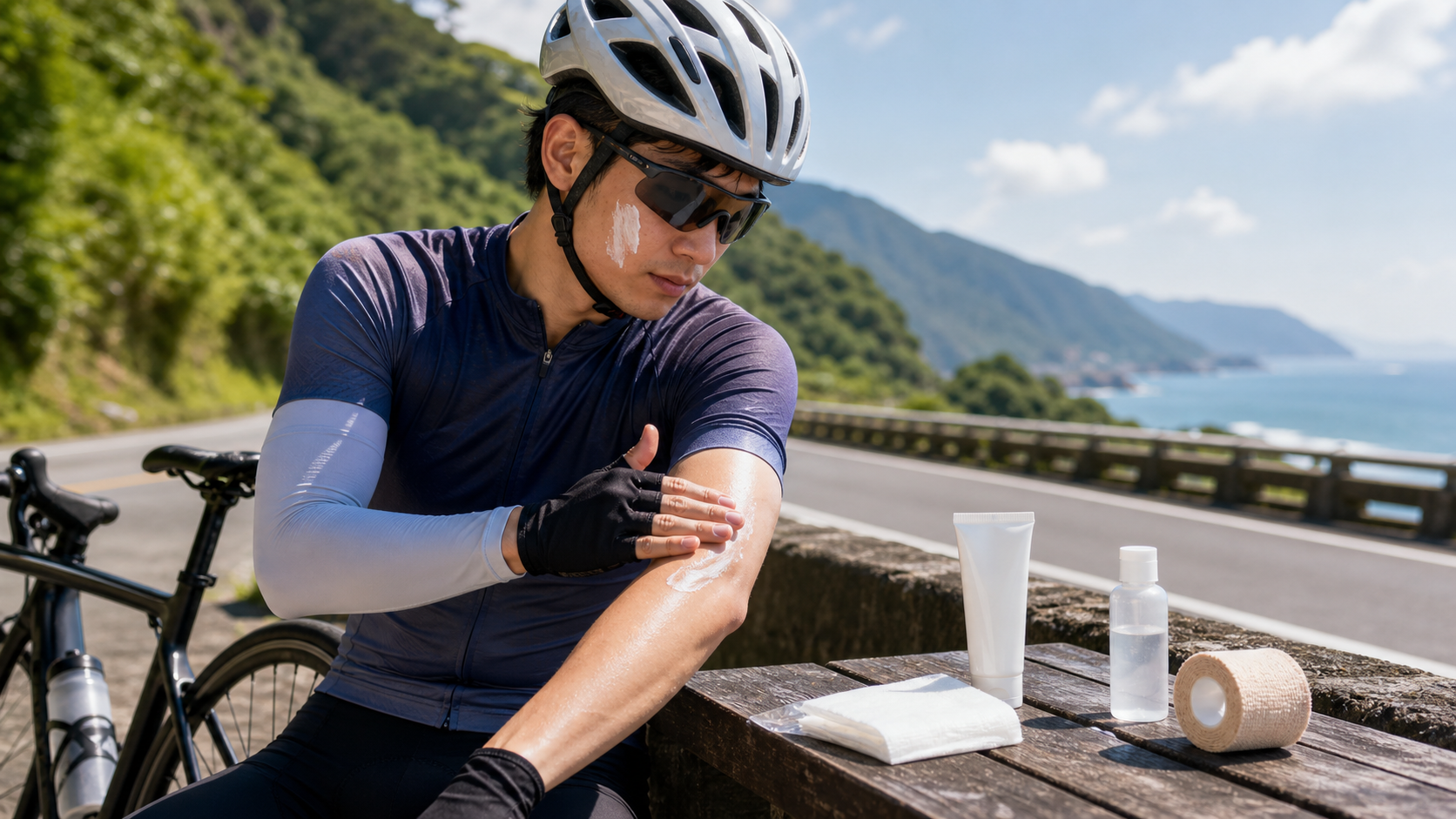
Introduction
A cyclist’s skin faces multiple challenges on every ride: intense UV radiation, wind-induced dryness, erosion from sweat and salt, plus the tearing injuries from road contact in a crash. Taiwan is located in the subtropics, where the UV Index in summer frequently exceeds 11 (extreme). Without adequate protection, cyclists may accumulate damage over the years, leading to photoaging, hyperpigmentation, and even an increased risk of skin cancer.
The Challenges of Sun Protection for Cycling in Taiwan
Taiwan’s geography and climate make sun protection a mandatory part of cycling:
| Season | Average UV Index | Main Challenges | Recommended Protection Level |
|---|---|---|---|
| Summer (Jun–Aug) | 10–13 (extreme to hazardous) | Intense direct sunlight, heavy sweating in high heat | SPF 50+, PA++++ |
| Spring/Autumn (Mar–May, Sep–Nov) | 7–9 (high) | UV easily overlooked on cloudy days | SPF 30–50 |
| Winter (Dec–Feb) | 4–6 (moderate) | Cloudy in northern Taiwan, but still strong in the south | SPF 30 |
It is particularly important to note that cyclists face dual UV exposure: radiation coming directly from the sun, plus UV reflected off the ground (asphalt pavement). Reflected UV from the ground can amount to 10–20% of direct radiation, which is why the area under the nose, the chin, and the front of the neck are especially prone to tanning.
Choosing a Sunscreen Product
Special requirements for cycling sunscreen:
- Water resistance (Water Resistant 80 min or more): heavy sweating quickly dilutes ordinary sunscreens
- Non-greasy texture: greasiness prevents sweat from evaporating, increasing the stuffy heat, and may also run into the eyes
- Fragrance-free: fragrance becomes more irritating when skin is sweaty and may trigger allergic contact dermatitis
- Chemical vs. physical sunscreen: physical sunscreens (zinc oxide, titanium dioxide) are recommended for sports; they are more stable and less likely to break down from sweat
Reapplication strategy:
- Apply 20–30 minutes before departure to allow the sunscreen to form a proper protective film
- Reapply every 2 hours (every 90 minutes when sweating heavily)
- Reapply during stops or rest breaks, never while riding
First Aid and Care for Road Rash
Road rash (commonly called “crash skin” in Chinese) is the most common injury after a cycling fall. Proper first aid is critical for wound healing and reducing the risk of infection.
Grading and Treatment of Road Rash
First degree (epidermal abrasion):
- Affects only the epidermis; appears red and swollen, possibly with minor oozing of blood
- Treatment: rinse with clean water for 5–10 minutes → gently clean with antibacterial soap → rinse again with saline solution → apply a thin layer of antibiotic ointment → cover with a non-adherent dressing
Second degree (dermis exposed):
- Affects the dermis; clear or bloody blisters appear, with severe pain
- Treatment: same cleaning process as above → apply a moist wound healing dressing (e.g., hydrocolloid dressing, Moist Wound Healing dressing) → change dressing daily, avoiding the wound drying out and forming a scab
Third degree (subcutaneous tissue exposed):
- Deep laceration with visible fatty tissue; pain may be reduced due to nerve damage
- Immediate medical attention is required; professional debridement and possible skin grafting are needed
Key Points for Cleaning Road Rash
- Do not use hydrogen peroxide: although it bubbles, hydrogen peroxide damages granulation tissue and delays healing
- Do not scrub vigorously: rinse with running water rather than forcefully cleaning with cotton swabs, to avoid worsening tissue damage
- Remove grit: use sterile tweezers or gentle rinsing to remove embedded gravel; seek medical attention if it cannot be removed
- Tetanus prevention: if you have not had a tetanus vaccine within the last 5 years, it is recommended to get a booster
Long-Term Skin Care
Daily post-ride care:
- Clean the skin within 30 minutes after a ride to avoid prolonged irritation from sweat and salt
- After showering, apply a fragrance-free moisturizing lotion, especially on the shins and front of the thighs, as the repetitive pedaling motion tends to dry out the skin
- For the face, use restorative moisturizers containing hyaluronic acid or ceramides to repair skin barrier damage caused by sunscreen and sweat
Protective gear:
- Arm sleeves: provide physical protection with UPF 50+ while also offering a cooling effect; one of the best options for summer cycling in Taiwan
- Cycling skull cap under the helmet: protects the scalp from the sun while absorbing sweat
- Balaclava-style sun mask: can be used on heavily polluted roads in the north, providing both sun protection and filtration
Practical Advice
Annual skin checks for cyclists in Taiwan:
- It is recommended to have a full-body melanoma screening at a dermatologist once a year (especially for those who spend years doing outdoor activities)
- Watch moles using the “ABCDE rule”: Asymmetry, Border irregularity, Color variation, Diameter over 6 mm, Evolving → if any criteria are met, see a doctor promptly
- Lip sun protection is often overlooked: use a lip balm with SPF 30 or higher
Conclusion
The skin is the body’s largest organ and the “front line” every cyclist exposes on every ride. Taiwan’s climate makes sun protection part of cycling gear, and proper road rash first aid knowledge can greatly reduce the risk of infection and speed up recovery. Starting today, add sunscreen to your pre-ride routine checklist, so that every ride not only trains your body but also properly protects the skin that protects you.
Related Reading
- Skin Health for Cyclists: A Guide to Sun Protection, Chafing, and Saddle Sore Care in Taiwan
- Sunburn and Skin Protection for Cyclists: Sunscreen Advice for Long Summer Rides in Taiwan
- Sun Damage from Long-Distance Cycling: Sun Protection Strategies and UV Exposure Calculations
- Sun Protection Strategies for Cycling: UV Protection and Essential Knowledge for Summer Riding in Taiwan
碟煞公路車 銑面器 !? 原來銑完差這麼多! 降低蹭碟機率! | TIME 公路車 保養小記錄 | CT Yeh
3 年前
單車 一日北高 ( 雙城 ) 肥宅雙人瘋狂行 紀錄片 REACTO
10 年前
#Canyon Aeroad 公路車 三年騎乘 #心得 | 出保方式 | 購買價格計算 | 同場加映累積三年大保養慘況
6 年前
一日北高/長距離團騎 常見問題補充篇 / 組團或跟團的眉角 / 壯車友容易被瘦車友慢性拉爆 / 原來屁股痛可能是這個原因...? / 風場配速法 / 公路車 / CT Yeh
2 年前
騎單車去大屯山賞雪! 助航台滑冰 全記錄 | 台北R友大集合 | 下雪打雪仗囉 | 4K超高畫質
5 年前
再快都跟的上!? 單車跟隨攝影機之王 HOVERAir X1 PROMAX 全面實測 / 唯一!8K畫質&自行車專用模式和跟蹤信標&前後避障 / DJI Neo 可參考/ 公路車 / CT Yeh
1 年前
公路車 | 塔塔加驚險員工旅遊 | 還好手腳快沒被抓交替!
5 年前
一日北高常見問題大集合 | 攻略 | 路線 | 訓練 | 補給 | 自行車 單車 | 一日雙城 | 雙塔 | TWB北高360 | 屁股痛
6 年前