Introduction
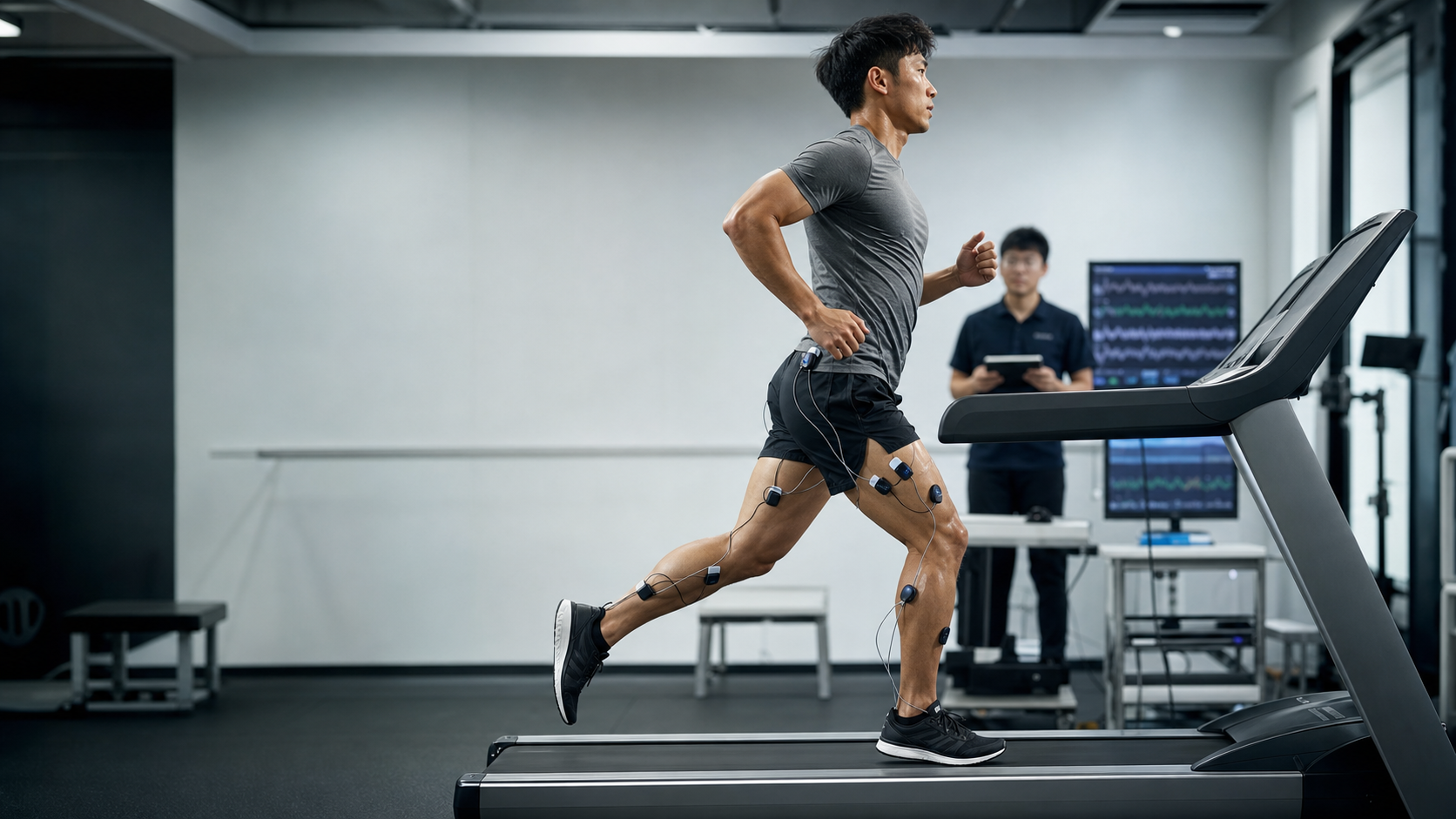
If you could see with your own eyes exactly which muscles fire, and how hard, at every moment while running, training efficiency would be completely revolutionized. Electromyography (EMG) technology is precisely such a “muscle translator”—by detecting electrical activity signals in muscles, it converts the deep neuromuscular operations invisible to the naked eye into quantifiable scientific data. In recent years, sports science research has extensively used EMG to analyze muscle activation patterns in running, revealing many counterintuitive and important findings with profound implications for running training and injury prevention.
The Running Gait Cycle and Muscle Activation Timing
One running gait cycle is divided into two major phases: the stance phase (approximately 40% of the cycle) and the swing phase (approximately 60% of the cycle). EMG research has revealed the precise activation timing of each major muscle:
| Muscle | Primary Activation Period | Function |
|---|---|---|
| Quadriceps | 50ms before foot strike + early stance | Deceleration and shock absorption + knee joint stability |
| Gluteus Maximus | 50ms before foot strike + early stance | Hip extension (core of propulsion) |
| Hamstrings | Late swing + early stance | Braking protection + assists hip extension |
| Gastrocnemius | Mid-to-late stance | Propulsive acceleration |
| Soleus | Entire stance phase | Ankle joint stability + tendon energy storage |
| Tibialis Anterior | Swing phase + before foot strike | Ankle dorsiflexion (toe lift) |
Key finding: Many major muscles begin activating before foot strike (pre-activation). This pre-activation mechanism allows tendons to be pre-loaded with tension, preparing for elastic energy storage at the moment of ground contact—a crucial mechanism for running efficiency.
The Secrets of Running Efficiency Revealed by EMG
The most important EMG findings from research:
The critical role of the gluteus maximus: EMG studies consistently show that elite runners exhibit significantly higher gluteus maximus activation intensity than recreational runners. Gluteal weakness (common among sedentary Taiwanese office workers) leads to compensatory overuse of the hamstrings and lower back, and is one of the primary causes of knee pain and lower back pain.
The faster you run, the less co-activation: During slow running, multiple muscles activate simultaneously (antagonists and agonists contracting together), wasting unnecessary energy. As running speed and training level increase, unnecessary co-activation decreases and the nervous system becomes more “precise.”
EMG differences between rearfoot striking and forefoot striking:
- Rearfoot striking: The tibialis anterior requires high activation at foot strike to control foot descent (eccentric contraction), dissipating more energy
- Forefoot striking: Gastrocnemius and soleus activation intensity is higher, but eccentric control energy loss at foot strike is lower
The effect of fatigue on activation patterns: EMG from the latter half of marathons shows significantly decreased gluteus maximus activation and increased compensatory activation of muscles around the knee—this is the direct physiological explanation for “late-marathon knee pain.”
Training Recommendations Derived from EMG Research
Applications for Taiwanese runners:
- Gluteal strengthening is the top priority: Squats, deadlifts, glute bridges, clamshells, and similar exercises directly strengthen the most critical running muscles identified in EMG research
- Neuromuscular efficiency training: Interval running and explosive running drills (strides) improve muscle activation precision at high speeds, reducing unnecessary co-activation
- Pistol squats: Simulate the single-leg loading of the running stance phase; EMG shows the gluteus maximus activation pattern in this movement closely resembles running
- Pre-activation awareness training: In sprint and acceleration drills, consciously “prepare the legs” before landing to cultivate the neuromuscular habit of pre-activation
- Fatigue monitoring: When you feel like you’re “running with your knees” rather than “running with your glutes” in the later stages of a run, that is a subjective signal of gluteal fatigue and an indication that gluteal endurance training needs reinforcement
Practical Advice
Applying EMG concepts to daily training:
- Pre-run activation routine (Warm-up Activation): Lateral band walks, glute bridges × 20 reps to activate the neuromuscular connection of the gluteus maximus and improve activation efficiency during running
- Feel the glutes working: Occasionally and deliberately “squeeze the glutes” while running to confirm the gluteus maximus is participating in the push-off motion
- Listen to your footsteps: Quiet footsteps mean impact is being effectively absorbed by muscles; loud “thudding” landings are a signal that the glutes and hamstrings are losing control
- Targeted post-run recovery: EMG shows the most fatigued muscles after long runs are the soleus and gluteus maximus, so focus recovery efforts on these two areas
Conclusion
EMG research transforms running from a sensation-driven activity into a precision motor system that can be quantified, analyzed, and optimized. For Taiwanese runners, the most important takeaway from EMG is this: adequate gluteus maximus activation is the foundational basis for efficient, low-injury running. Every gluteal strengthening session is a direct optimization of the most critical neuromuscular blueprint in your running.
Related Reading
- EMG Analysis of Muscle Activation in Cycling: The Science of Muscle Coordination During Pedaling
- Cycling EMG Analysis: Primary Muscle Group Activation Patterns Across Different Pedaling Positions
- EMG Analysis of Cycling Climbing Training: Muscle Activation Research at 4% vs 8% vs 12% Gradients
- Running Ground Contact Time Reduction Training: Research on Neuromuscular Adaptation Mechanisms with Increased Cadence
西進武嶺 免費訓練分析服務 Intervals | 練不夠還是練過頭?你哪一種類型選手?AI模型告訴你! | 備戰神器 | 公路車 訓練 | CT Yeh
4 年前
Garmin Edge 1050 旗艦車錶 全台首測!/ 環法冠軍指定 / 對比Edge 1040改進哪些? / 公路車 / CT Yeh
2 年前
單車AI教練!全新 ChatGPT4o 幫你分析訓練成果!排武嶺課表,分析騎車姿勢! 太神了! / 公路車 / CT Yeh / feat. 緯緯
2 年前
#公路車 #Fitting 靠人工智慧APP 幫你調整單車
6 年前
實景訓練台) 彰化經典百K 高強度喵團 90分鐘 跟著一起練功 2019 Indoor workout Changhua Classic 100 Taiwan
7 年前
白沙屯媽祖進香在家走!UREVO 坡度自調走步機 / 可連接訓練遊戲APP MyWhoosh / 邊看直播邊走起來 / CT Yeh
11 個月前
Garmin Edge 540/840 Solar 台灣首發開箱!完整車錶功能 道路實測 / ClimbPro 爬坡提示超級牛 / 強大續航實測 / 公路車 / CT Yeh
3 年前
FTL 與 SYB 車隊專訪 西進武嶺 實用攻略分享! 2小時 如何練?!你不知道的眉角!新手準備武嶺必看 EP1 | 實力派女車友 | 精華版 | 公路車 | CTYeh
4 年前