The Medical Significance of Road Bike Fitting: Injury Prevention Benefits of Posture Adjustment
Introduction
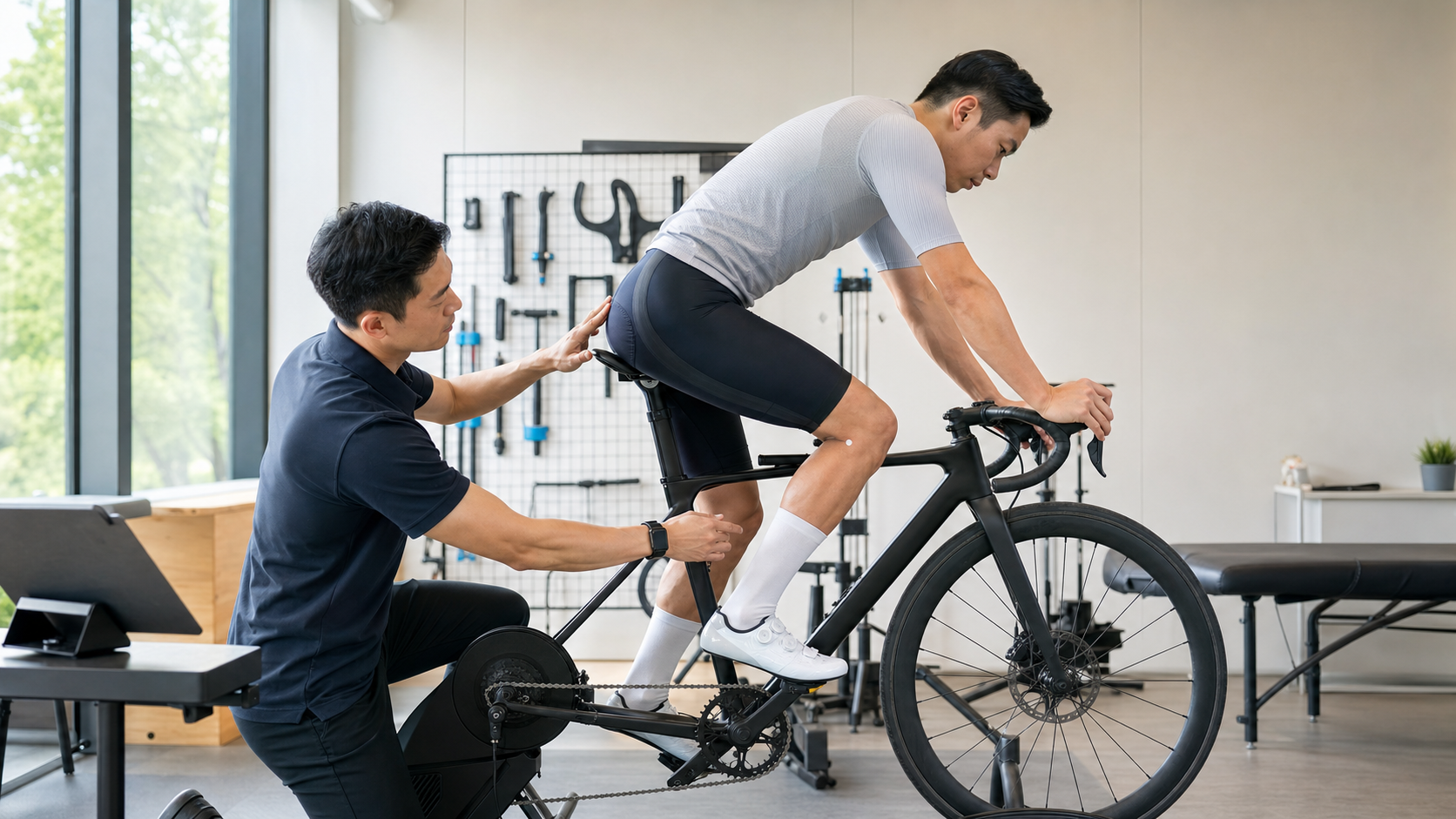
In Taiwan, more and more bike shops are offering “Bike Fit” services, but many riders still regard it as exclusive to competitive athletes, or an optional expense. In fact, the medical significance of Bike Fit goes far beyond improved comfort: it is a systematic process of evaluating riding posture that can predict and prevent most cycling-related injuries, including knee pain, lower back pain, neck and shoulder pain, and nerve compression symptoms. Research shows that professional Bike Fit intervention can reduce the incidence of cycling-related injuries by 45–65%.
The Core Scientific Foundation of Bike Fit
The Concept of the Kinetic Chain
When cycling, the path of force transmission is a complete “Kinetic Chain”: from the brain sending commands → hip flexors and gluteal muscles contracting → force transmitted through the pelvis, thighs, knee joints, and lower legs to the pedals → converted into driving force. Misalignment at any link reduces force transmission efficiency while increasing compensatory load on specific joints.
| Bike Fit Parameter | Anatomical Structures Affected | Common Injuries from Incorrect Settings |
|---|---|---|
| Saddle Height | Knee flexion/extension angle, hip range of motion | Patellar tendinitis (too low), IT Band syndrome (too high) |
| Saddle Fore/Aft Position | Knee joint torque, pelvic tilt angle | Anterior knee pain (too far forward), lower back pain (too far back) |
| Handlebar Height | Cervical spine forward tilt angle, core engagement level | Neck and shoulder pain (too low), hand numbness |
| Handlebar Width | Scapular stability, chest expansion | Subacromial impingement, arm numbness |
| Crank Length | Hip range of motion, pedaling efficiency | Hip impingement (too long), power loss (too short) |
| Cleat Angle | Knee rotational torque, ankle alignment | Lateral knee pain (excessive internal rotation), anterior knee pain |
Static vs. Dynamic Bike Fit
Static Bike Fit involves taking angle measurements while the rider is stationary on the bike. It is the traditional method and can quickly correct obvious setup errors.
Dynamic Bike Fit (using Retül, Dartfish, or Trek Precision Fit systems) uses infrared motion capture or high-speed cameras to analyze joint angles and movement patterns in real time while the rider pedals normally. Dynamic analysis can capture problems that static assessment cannot detect, such as:
- Lateral pelvic shift at the bottom of the pedal stroke (common in riders with leg length discrepancies)
- Knee adduction/abduction (Valgus/Varus) movement patterns
- Excessive foot pronation (Overpronation)
- Scapular winging
The Medical Significance of Key Adjustment Items
Saddle Height: The Single Most Important Parameter
There are several methods for measuring saddle height, but the one with the strongest medical evidence is the Holmes Method (also known as the knee flexion angle method):
- At the bottom of the pedal stroke, knee flexion angle should be 25–35°
- Flexion angle < 25° (saddle too low) → increased patellar cartilage pressure, higher risk of patellar tendinitis
- Flexion angle > 35° (saddle too high) → pelvic lateral shift, higher risk of IT Band and sciatic nerve compression
Cleat Setup: The Overlooked Foot Alignment
Cleat angle directly affects the rotational torque on the knee joint throughout the entire pedal stroke. Common issues among Taiwanese riders:
- Cleat positioned too far forward (ball of foot not centered over the pedal axle): causes ankle instability and increases strain on the Achilles tendon
- Insufficient float: forces the knee to pedal at a fixed rotation angle, unable to accommodate the rider’s natural Q-angle
- Left-right asymmetry: some riders have different natural toe-out angles between their feet; if cleats are set identically, one side will inevitably bear abnormal torque
Crank Length and Hip Joint Health
Overly long cranks (e.g., 175 mm or longer) force significant hip flexion at the top of the pedal stroke (12 o’clock position). If the rider has limited hip range of motion (such as femoroacetabular impingement, FAI), this causes repeated friction on the articular cartilage. For riders under 175 cm tall, using a 172.5 mm or shorter crank can help reduce the risk of hip impingement.
When Should You Get a Bike Fit?
Strongly recommended situations:
- After purchasing a new bike (especially road bikes and TT bikes)
- When any repetitive pain (knee, lower back, neck and shoulders) persists for more than 2 weeks
- Training riders who ride more than 10 hours per week
- After significant body weight changes (more than 5 kg)
- After replacing key components (such as stem, saddle, cranks)
Cost and expectations:
In Taiwan, professional dynamic Bike Fit services currently cost approximately NT$2,000–6,000, with service duration of 2–3 hours. The cost includes full-body movement functional assessment, dynamic riding analysis, adjustment recommendations, and a written report.
Practical Recommendations
Self-assessment indicators:
- Take a side-view photo at the bottom of the pedal stroke; at the lowest pedal position, the knee should be directly above the ankle joint (±2 cm)
- Observe the knee trajectory from the front while riding; it should move vertically up and down without obvious lateral swaying
- After a ride, note which area feels uncomfortable first—this is often the area that Bike Fit should address as a priority
Follow-up after Bike Fit:
After adjustments are completed, it is recommended to do a 2–4 week adaptation period of riding under the new setup (no more than 2 hours per session), allowing muscles and tendons to gradually adapt to the new movement patterns and avoiding new injuries caused by sudden changes.
Conclusion
Bike Fit is one of the most cost-effective health investments in cycling. A high-quality dynamic Bike Fit not only improves riding comfort and efficiency, but more importantly, it provides a personalized “cycling health blueprint” that helps Taiwanese riders maintain their physical integrity over thousands of accumulated kilometers. Don’t wait until pain appears to get assessed—treat Bike Fit as part of your annual health maintenance and protect your cycling career at its foundation.
Related Reading
- The Science of Cycling Posture Bike Fit: From Biomechanics to Power Maximization
- Bike Fit Basics: Why Does Riding Hurt? The Importance of Posture Adjustment
- The Fit Science of Road Bikes: Saddle Height, Reach, and Pivot Point Adjustments
- The Biomechanics of Bike Fit: Saddle Height, Fore/Aft Position, and Knee Trajectory
#公路車 #Fitting 靠人工智慧APP 幫你調整單車
6 年前
靠單車減肥35公斤 心得分享與整理
7 年前
單車 一日北高 ( 雙城 ) 肥宅雙人瘋狂行 紀錄片 REACTO
10 年前
單車胎壓觀察到的有趣現象,SRAM Quarq TyreWiz 2.0 無內胎胎壓計 / 裝了有哪些幫助? / Tubeless / 公路車 / CT Yeh
1 年前
Fitting訓練兩用功率車 ! Thinkrider ST900 完整實測!/ 坡度升降 / 鄰居測試/ smart bike/公路車/ CT Yeh
2 年前
單車AI教練!全新 ChatGPT4o 幫你分析訓練成果!排武嶺課表,分析騎車姿勢! 太神了! / 公路車 / CT Yeh / feat. 緯緯
2 年前
一日北高常見問題大集合 | 攻略 | 路線 | 訓練 | 補給 | 自行車 單車 | 一日雙城 | 雙塔 | TWB北高360 | 屁股痛
6 年前
一日北高/長距離團騎 常見問題補充篇 / 組團或跟團的眉角 / 壯車友容易被瘦車友慢性拉爆 / 原來屁股痛可能是這個原因...? / 風場配速法 / 公路車 / CT Yeh
2 年前