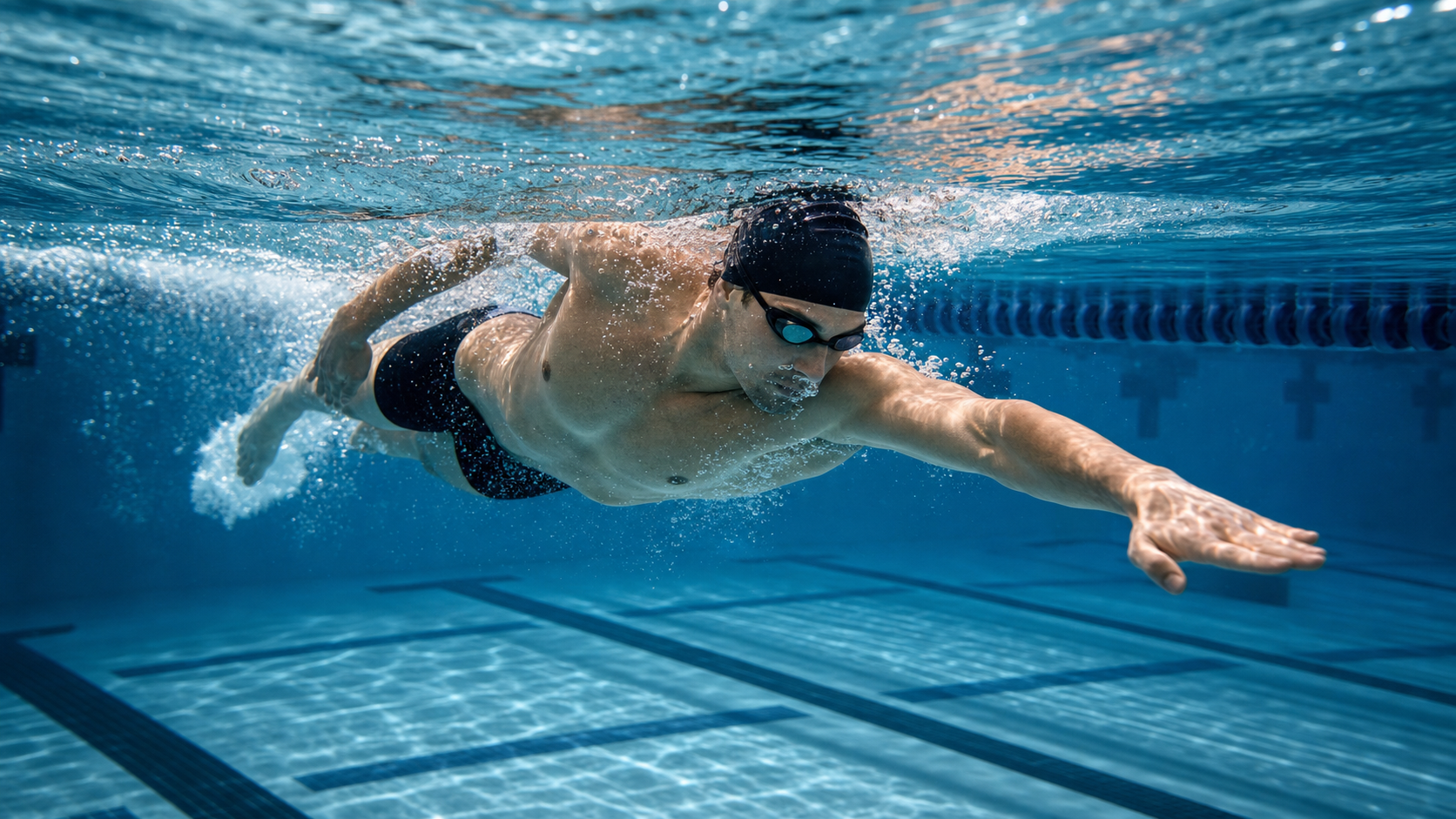
Introduction
“Swimming is all about pulling with your arms and kicking with your legs” — this intuitive belief is a blind spot for most beginner swimmers. In fact, biomechanics research clearly shows that the transmission path of swimming propulsion originates at the core, travels through the shoulder joint to the arm, or from the hip to the leg, with the core muscles acting as the critical “force transmission axis” along the way. An unstable core is like connecting an engine to the wheels with a rubber band — a huge amount of force is lost in transmission.
The Anatomical Structure of Core Muscles in Swimming
The core muscles involved in swimming can be divided into two layers:
The Deep Stabilization System (Local Stabilizers)
- Multifidus: Stabilizes individual spinal segments and prevents excessive lumbar rotation during body roll
- Transversus Abdominis: Regulates intra-abdominal pressure and provides “cylindrical” rigid support for the trunk
- Pelvic Floor Muscles: Contract in coordination with the transversus abdominis to stabilize the lumbo-pelvic region
The Superficial Power System (Global Movers)
- Rectus Abdominis + Obliques: Drive body roll and control rotation
- Latissimus Dorsi: Serves the dual function of core stabilization and propulsive pulling force
- Gluteus Maximus + Gluteus Medius: The initiation point for the kick, and key to maintaining a horizontal body position
- Erector Spinae: Prevents excessive lumbar extension during swimming (a common cause of lower back pain)
The Role of the Core in Each Stroke
| Stroke | Primary Core Function | Symptoms of a Weak Core |
|---|---|---|
| Freestyle | Controls the magnitude of body roll and prevents lumbar twisting | “Snaking” through the water, hips swaying side to side |
| Butterfly | Initiates and controls the undulating wave motion | Excessive head lifting, sinking hips, unstable rhythm |
| Breaststroke | Maintains a streamlined glide and controls knee adduction | Sagging hips during the glide phase, deviated kick direction |
| Backstroke | Prevents the hips from sinking (the most common problem) | Hips sinking in the water, weak kick |
Research has found that swimmers with lower core stability lose 12–18% more energy per stroke (measured in the fore-aft direction of propulsion) than swimmers with a strong core — a gap that becomes especially pronounced in long-distance swimming.
A Scientifically Designed Core Training Program
Land-Based Core Training (2–3 times per week)
Layer One: Activating the Deep Stabilizing Muscles (10–15 minutes per session)
- Diaphragmatic breathing + abdominal bracing: Lie on your back, inhale deeply to expand the abdomen, then exhale and brace — hold for 10 seconds x 10 repetitions
- Bird Dog: On hands and knees, extend the opposite arm and leg while keeping the lumbar spine from rotating — 3 sets x 10 repetitions
- Glute Bridge: Lie on your back with knees bent, lift the hips one side or both sides at a time, emphasizing gluteus maximus activation — 3 sets x 15 repetitions
Layer Two: Strengthening Dynamic Core Power
- Side Plank: Strengthens the obliques, combined with rotational variations — 30–60 seconds per side x 3 sets
- Inverted Row: Simulates the latissimus dorsi’s pulling action during the stroke, emphasizing scapular stability
- Hanging Leg Raise: Targets the hip flexors and lower rectus abdominis, mimicking the initiation pattern of the kick
In-Water Core Integration Training
- No-Arms Kicking with Streamline: Hands stacked and arms extended, relying entirely on the core to maintain a horizontal body position while kicking — the most direct in-water core test
- Catch-Up Drill: Slow down the stroke rhythm so the body spends more time in the streamlined position, requiring continuous core support
- In-Water Rotation Drill: While swimming freestyle, deliberately increase body roll to 60–70° to feel the control exerted by the obliques, then return to a standard 40–50°
Core Training and Swimming Injury Prevention
Among swimming training injuries recorded in Taiwan, swimmer’s shoulder (shoulder impingement syndrome) and chronic lower back pain rank as the top two, and both are directly linked to insufficient core strength:
- Weak core → sinking hips → excessive lumbar extension → lower back pain
- Weak core → unstable body position → the shoulder joint compensates for stability → shoulder impingement
Strengthening the core is not just about training for speed — it is a foundational investment in long-term health.
Practical Recommendations
- Test before you train: Swim 25 meters of no-arms streamline kicking and observe whether you can keep your hips from sinking the whole way. If your hips start sinking before you reach 25 meters, your core endurance needs work.
- 5 minutes of daily core activation: Add 5 minutes of deep muscle activation (diaphragmatic breathing + Bird Dog) to your warm-up before swimming to significantly improve the quality of your in-water movement.
- Build the butterfly wave from the core: When learning butterfly, first practice the “dolphin spinal wave” on land (lying prone, initiating a wave from the thoracic spine through the lumbar spine) before moving into the water, to avoid compensating with the neck.
- Avoid core weakening from “swimming without training”: Although swimming does train the core to some degree, the buoyancy of water greatly reduces the core’s need to resist gravity, so swimming alone cannot achieve complete core strengthening.
- Integrate breathing training: Coordinating core contraction with breathing (maintaining core tension even while inhaling) is an advanced skill that can be gradually developed through conscious practice of synchronizing your exhale rhythm with core contraction while swimming.
Conclusion
The core muscles are the invisible engine of swimming performance — they determine how efficiently the energy from every stroke is transferred, and they protect a swimmer’s spine and shoulder joints from chronic injury. For swimmers training in Taiwan, systematically incorporating core training into your weekly program, and understanding the specific function of the core in each stroke, will bring about breakthroughs in technique that are hard to believe — taking your swimming from “struggling to pull water” to a state of “integrated whole-body force generation.”
Related Reading
- Core Training for Swimming: The Direct Impact of Land-Based Core Strengthening on In-Water Streamline
- Strength Moves for Swimmers: Pull-Ups, Shoulder Stability, and Core
- Swimming and Core Toning: The Benefits of Consistent Swimming for Your Waistline
- Core Training for Swimming: The Dialectic Between Rotational Power and Spinal Stability
[教學] Premiere 影片 手震 修正 教學 防抖 單眼 影像 GoPro 穩定 Video Stabilization
8 年前
CT 喇低賽) 武嶺牽車 才是王道 西進牽車四小時內秘訣 攝手位置 如何判斷 防抽筋小秘訣
7 年前
一起升級!海鷗盃LSD團練...JJSC Zone2招待 騎到手抖 / 公路車 / CT Yeh
1 天前
西進武嶺 免費訓練分析服務 Intervals | 練不夠還是練過頭?你哪一種類型選手?AI模型告訴你! | 備戰神器 | 公路車 訓練 | CT Yeh
4 年前
西進武嶺 自製新版AI配速表產生器 x 賽前攻略 抱佛腳! 沒有功率計也可以產生配速表嗎?有什麼其他眉角賽前要注意的呢? | 西進武嶺 / 東進武嶺 KOM 攻略 | 公路車 | CT Yeh
4 年前
一日北高/長距離團騎 常見問題補充篇 / 組團或跟團的眉角 / 壯車友容易被瘦車友慢性拉爆 / 原來屁股痛可能是這個原因...? / 風場配速法 / 公路車 / CT Yeh
2 年前
福隆鐵人團練隨拍
8 年前
鉅齒紋輪組!? ControlTech MEG-T50 EVO 碳纖維幅條輪組/ 功率對比實驗 / 公路車 / CT Yeh
2 年前