Introduction
After a full day of riding, you notice numbness and weakness in your ring and little fingers—this symptom is quite common among long-distance cyclists in Taiwan, especially after completing island-wide tours, Provincial Highway 3, or the Taipei-Kaohsiung Ironman-style rides. This phenomenon has a professional name: Cyclist’s Palsy, which is essentially neuritis caused by sustained compression of the ulnar nerve near the pisiform bone in the wrist.
This article will systematically introduce the mechanism and management of this injury, helping Taiwanese cyclists maintain healthy hand function after long-distance challenges.
Anatomical Pathway of the Ulnar Nerve
The ulnar nerve originates from the cervical spine (C8-T1), descends along the inner side of the upper arm, passes through the ulnar groove at the elbow, enters the forearm, and finally traverses the Guyon’s Canal (the tunnel between the pisiform and hamate bones) at the wrist, innervating sensation in the ring and little fingers, as well as motor function of multiple small muscles in the hand.
When cycling, the wrist grips the handlebar in a semi-flexed, ulnar-deviated position, with the pisiform bone pressing directly against the handlebar. Repeated vibration and sustained compression lead to inflammation of the nerve within Guyon’s Canal.
Compression Sites and Corresponding Symptoms
| Compression Site | Symptom Characteristics |
|---|---|
| Guyon’s Canal entrance | Numbness in ring and little fingers + weakness of small hand muscles |
| Deep Guyon’s Canal | Hand weakness only, no sensory abnormalities |
| Ulnar groove at the elbow | Worsens with elbow flexion; forearm symptoms may also occur |
Symptom Recognition and Assessment
Typical Symptoms
- Numbness and tingling in the ring finger (ulnar half) and little finger
- Occurs during riding, sometimes extending to the inner forearm
- Weakness when spreading and closing fingers, reduced pinch strength
- Difficulty using chopsticks or writing (interosseous muscle weakness)
- Light tapping over the lateral pisiform bone produces an electric tingling sensation radiating to the little finger (positive Tinel’s Sign)
- In severe cases, “claw hand” deformity—ring and little fingers remain mildly flexed and cannot extend
Distinguishing from Other Hand Problems
- Carpal Tunnel Syndrome: Numbness in the thumb, index, and middle fingers (median nerve distribution), not the little finger side
- Cervical Radiculopathy: Symptoms radiate from the neck; changing head position can affect symptoms
- Cubital Tunnel Syndrome: Worsens with elbow flexion; the site of involvement is the elbow rather than the wrist
If symptoms persist for more than 2 weeks or muscle weakness develops, nerve conduction velocity (NCV) and electromyography (EMG) studies are recommended.
Bike Fit Optimization
Handlebar Height and Reach
Handlebar that is too low or reach that is too long forces the wrist to bear more upper-body weight. Raising the handlebar and shortening the stem to achieve a more upright torso is the fundamental way to relieve pressure.
Handlebar Material and Bar Tape
- Carbon fiber handlebars: Limited vibration absorption; should be paired with silicone or high-density foam tape
- Bar Tape: Choose silicone or EVA tape with a thickness of 3 mm or more to significantly reduce road vibration transmission
- Grips (mountain bikes): Choose grips with ergonomic contours (such as the Ergon series) to distribute pressure on the heel of the palm
Tire Pressure
Road cyclists often over-inflate their tires. Reducing pressure by 10–20 PSI can effectively reduce vibration, providing protection for both the wrist and the ulnar nerve.
Gloves and Protective Gear
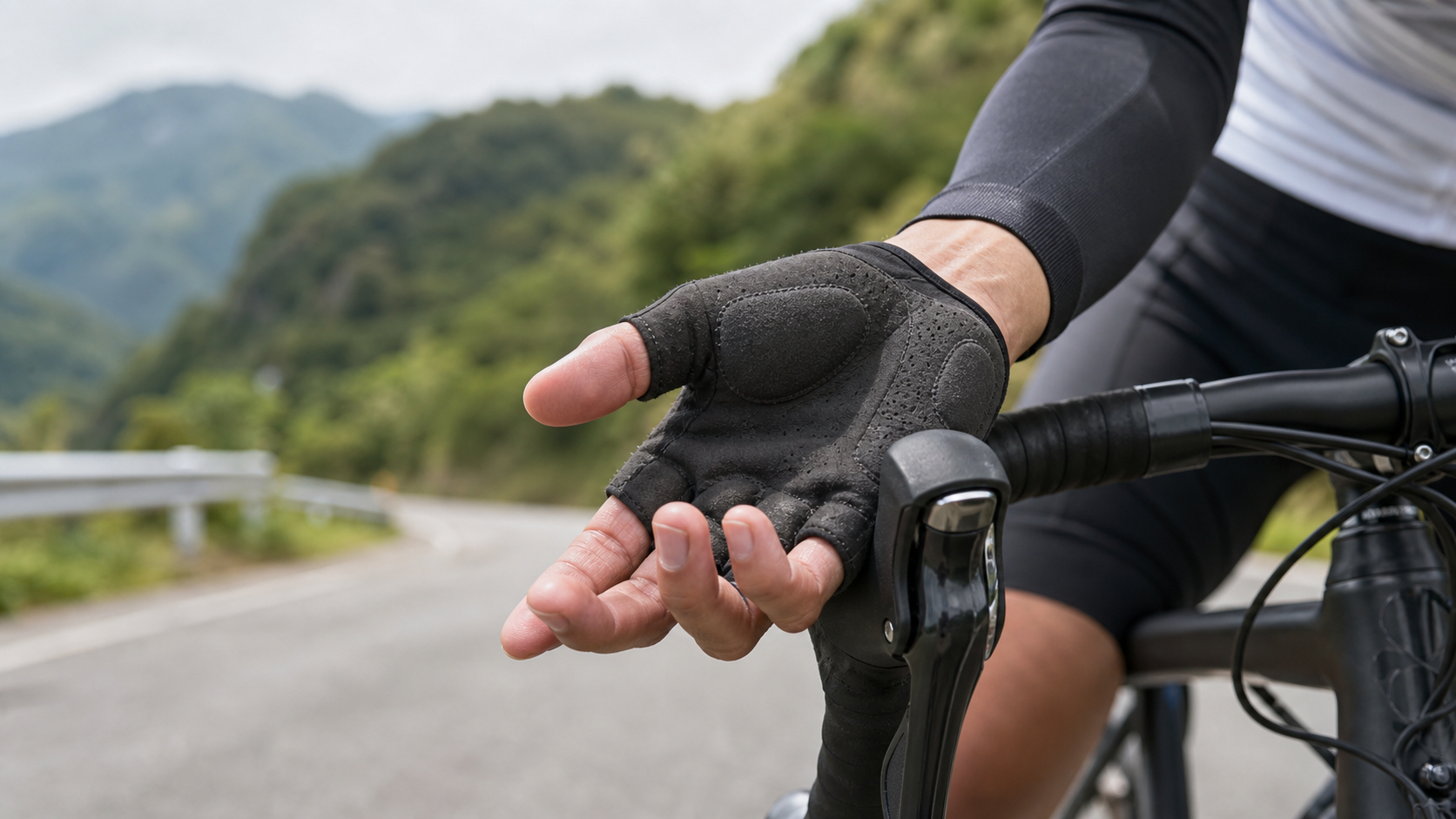
Cycling gloves are the most direct protective equipment against ulnar nerve compression:
- Choose gloves with thickened gel padding in the pisiform area (outer edge of the palm)
- Avoid gloves that are too thick and compromise shifting control; find a balance between protection and dexterity
- For long rides, elastic wrist supports can be worn for additional support
Acute Phase Management and Rehabilitation Training
Acute Phase (When Symptoms Occur)
- Pause riding or change hand position to avoid continued irritation
- Wear a neutral-position wrist splint (at night) to prevent ulnar deviation compression
- Apply local ice; use anti-inflammatory medication as prescribed
Rehabilitation Phase (After Symptoms Subside)
- Nerve Gliding: With the arm extended, perform slow, cyclic wrist flexion-extension movements to help the nerve glide freely within the tunnel. 10 repetitions in each direction, 2 sets daily
- Forearm Rotation Training: Hold a light weight and perform pronation/supination movements to rebuild forearm muscle function
- Progressive Grip Strength Training: Use a grip strengthener, progressing from light to heavy, to rebuild hand strength
- Forearm Extensor Stretch: With the arm extended, use the other hand to press the wrist downward, hold for 30 seconds, 3 sets daily
Practical Advice
- During long rides, change hand position at least once every hour to distribute pressure
- Worn bar tape loses significant protective capacity; replace it regularly (once every six months to a year)
- Pay special attention to wrist protection on Taiwan’s mountain roads or cobblestone sections
- Do not participate in long-distance challenge events until symptoms have fully resolved
- If symptoms also occur during daily activities outside of cycling, consider the possibility of cubital tunnel syndrome and seek medical attention
Conclusion
Although ulnar neuritis is troublesome, in most cases, with proper bike fit, appropriate protective gear, and timely rest, symptoms can fully resolve within weeks to months. Early detection and timely adjustment are the most effective strategies for saying goodbye to wrist pain. Every beautiful cycling route in Taiwan deserves to be welcomed with healthy hands.
Related Reading
- Cyclist’s Palsy: Causes and Prevention of Ulnar and Median Nerve Compression
- Numb Hands While Riding? Understanding Common Causes and Adjustments for Ulnar and Median Nerve Compression in Cyclists
- Cycling Wrist and Elbow Numbness: Causes of Nerve Compression and Handlebar Height Adjustment
- Causes and Solutions for Cyclist’s Palsy: Differentiating Ulnar Nerve Compression vs. Median Nerve Compression
Canyon 公路車斷把手 五年老車特規還能修嗎? 維修保養全記錄 feat. 501單車監理站 | 公路車 | CT Yeh
4 年前
高雄綠園道鐵路自行車道 / 外地人能輕鬆駕馭 還是整路崩潰? / 2025 全線開通 春節實地探索一次!(附GPS連結)/ 公路車 / CT Yeh
1 年前
超開放的自行車錶!可以玩遊戲裝APP!?/ SRAM合併的 Hammerhead Karoo深入開箱!/ 即時爬坡偵測 / 全球導航地圖 / Garmin Bryton / CT Yeh
1 年前
大武山20%魔王陡坡【JJSC南台灣遊騎Day2】!屁股真的要裂開了...凡士林抹滿也沒用?神秘金教堂還有超便宜夜市
3 個月前
2024 如來神掌 百人約騎挑戰!feat. 秘境單車社團 / 神人們太可怕 / 全程錄影 x 完整坡度解析 / 公路車 / CT Yeh
2 年前
2026 車錶排行榜!誰是最多車友正在使用?練家子最愛哪款?🏆 (2萬名車友數據) / 公路車 / CT Yeh
5 個月前
CT 喇低賽) 武嶺牽車 才是王道 西進牽車四小時內秘訣 攝手位置 如何判斷 防抽筋小秘訣
7 年前
多到選擇障礙... 換個單車把帶想一個小時 / BTP / 編織&軟木特有材質超吸睛! / 公路車 / CT Yeh
1 年前