Introduction
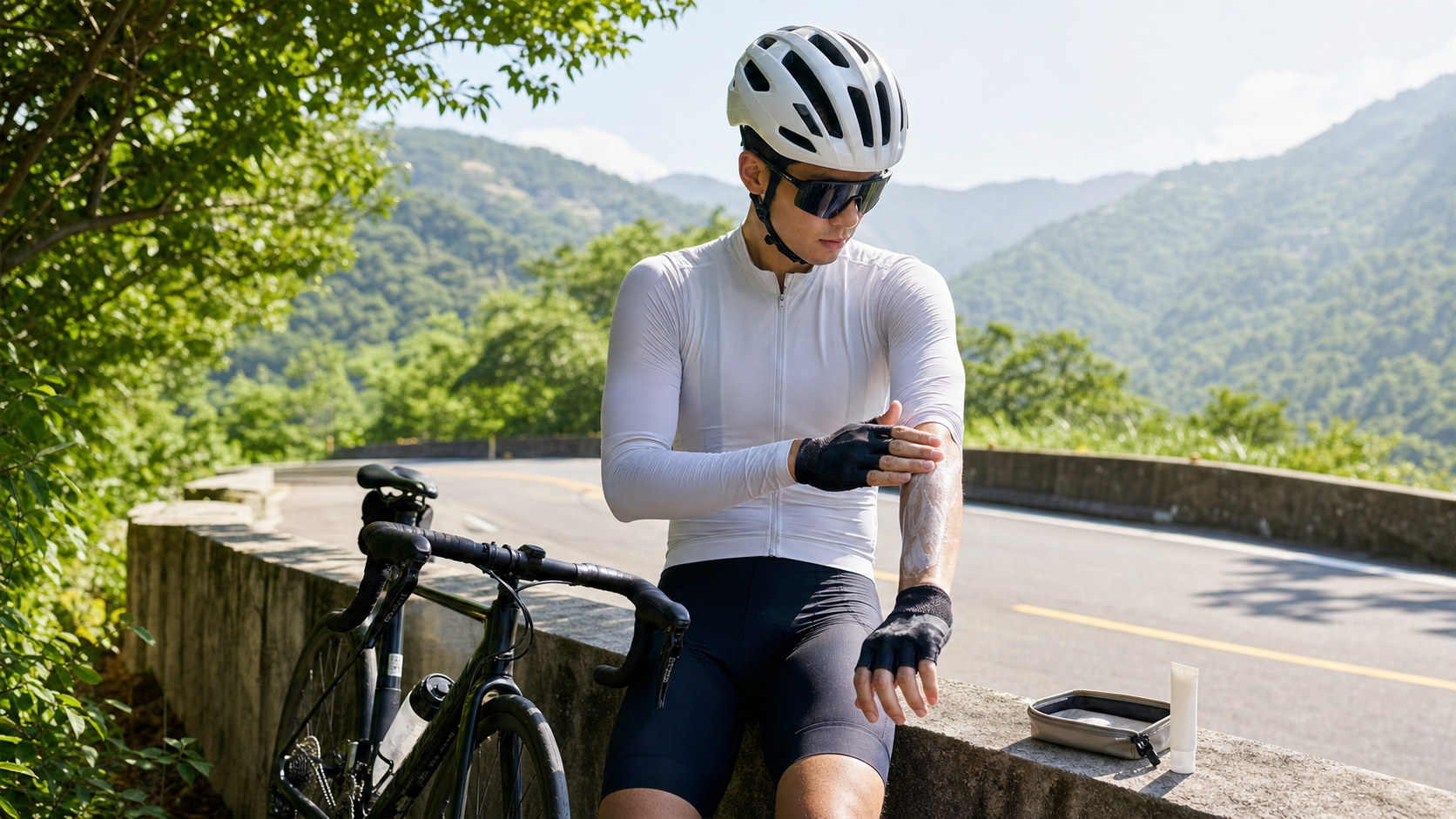
Taiwan’s summer UV index frequently exceeds 10 (extreme risk level), and the wind generated while riding strips away sunscreen while leaving the sun behind, putting cyclists’ skin under severe strain. Beyond sun protection, chafing, friction injuries, and saddle sores from long-distance riding, as well as heat rash and fungal infections caused by Taiwan’s humid and hot environment, are all skin issues cyclists must understand and properly manage.
This article provides a complete skin health guide for cyclists in Taiwan, from UV protection to wound care.
The UV Threat Facing Cyclists in Taiwan
Multiple Factors Compound Sun Exposure Risk
Located in the subtropics, Taiwan has high UV intensity year-round, and the specific conditions of cycling make sun protection even more challenging:
- Riding times often fall between 9 a.m. and 4 p.m., when sunlight is strongest
- Wind from high-speed riding accelerates sunscreen evaporation and physical wear
- Heavy sweating continuously dilutes and washes away sunscreen ingredients
- UV intensity increases by approximately 10–12% for every 1,000 meters of elevation gain (significant at Wuling’s 3,275-meter altitude)
- Asphalt reflects UV, adding exposure from below
Sunscreen Product Selection Criteria
| Sunscreen Specification | Recommended Standard for Cyclists |
|---|---|
| SPF | At least SPF 50, SPF 50+ recommended |
| PA Rating | PA+++ or higher (for UVA protection) |
| Water Resistance | Water-resistant or sweat-resistant (Water Resistant 80 min) |
| Texture | Light lotion or spray, avoid greasy formulas |
Application Tips:
- Apply 20–30 minutes before departure
- Reapply every 2 hours (shorten to 90 minutes after heavy sweating)
- Back of the neck, ears, and sides of the nose are high-risk areas often forgotten
- Use a lip balm with SPF for the lips
Physical Sun Protection: The Most Durable Defense
- Long-sleeve jerseys (UPF 40+): Cover the arms for the most lasting protection
- Arm sleeves: A summer alternative that balances breathability
- Fingerless gloves with back coverage: Protect the backs of hands from severe sunburn
Friction Injuries and Chafing Care
Inner Thigh Chafing
The inner thighs repeatedly rub against cycling shorts during the pedaling motion, most commonly occurring in high heat, over long distances, or when shorts do not fit properly.
Prevention:
- Wear well-fitted cycling-specific bib shorts
- Apply chamois cream or petroleum jelly to friction-prone areas
- Choose moisture-wicking fabrics; avoid cotton shorts
Care: For minor chafing, clean with water, let air dry, and apply a soothing ointment (Vaseline or Sudocrem). Do not pop blisters; allow them to absorb naturally.
Toe and Heel Friction Injuries
- Ensure cycling shoes fit properly (with slight room for the toes)
- Wear seamless cycling-specific socks
- Apply protective pads or blister bandages (Second Skin) to friction-prone areas before long rides
Saddle Sore Prevention
Prolonged time on a hard saddle can cause pressure sores on the sit bones, tailbone, and perineal area due to sustained compression—a problem most commonly seen among Taiwan round-island cyclists.
Prevention:
- Choose a saddle with appropriate softness and width; avoid race-oriented hard saddles for long distances
- Wash cycling shorts immediately after every ride; replace them when the padding degrades
- Stand and pedal every 30–45 minutes to restore blood flow to compressed areas
Wound Care by Severity:
- Mild: Clean, apply antibiotic ointment, and keep the area dry
- Moderate: Take 2–3 days off the bike and use hydrocolloid moist dressings
- Severe (deep tissue damage, infection): Seek medical attention
Taiwan-Specific Skin Challenges
Heat Rash and Prickly Heat
Taiwan’s humid summer heat can block sweat gland openings, leading to heat rash:
- Most common on the forehead under the helmet, back of the neck, and collar area
- Prevention: Choose a well-ventilated helmet and shower and change clothes promptly after riding
- Treatment: Keep the area dry, use talcum powder, or apply mint water for severe cases
Skin Cancer Risk for Long-Term Cyclists
Cumulative UV exposure significantly increases the risk of skin cancer. Cyclists over 40 with 10+ years of riding experience are advised to:
- Undergo an annual full-body melanoma screening with a dermatologist
- Watch for ABCDE changes in pigmented spots (Asymmetry, irregular Borders, uneven Color, increasing Diameter, Evolving morphology)
- Pay special attention to long-exposed areas such as the neck, ears, and nose bridge
Practical Tips
- Establish a fixed “5-minute pre-ride skincare routine”: sunscreen + petroleum jelly + lip balm
- Riding along Taiwan’s east coast (sea breeze + reflection) calls for more frequent sunscreen reapplication
- Reapply sunscreen during rest stops at supply stations; don’t wait until you see redness
- Night riding requires no sun protection, but friction injury prevention still applies
- Test chamois cream during training first to confirm compatibility; avoid first-time use on a long ride
Conclusion
The skin is the body’s largest organ and the first line of defense cyclists face against the environment on every ride. Taiwan’s intense sun, humidity, and long-distance challenges make skin health especially important. Add sunscreen to your gear checklist, understand proper care for chafing and saddle sores, and let every ride not only build fitness but also protect the skin that silently guards you.
Related Reading
- Skin Protection for Cyclists: Sunscreen, Road Rash, and Skin Care
- Sunburn and Skin Protection for Cyclists: Sunscreen Advice for Long Summer Rides in Taiwan
- Sun Protection Strategies for Cyclists: Protective Measures Under Taiwan’s UV
- Sun Damage from Long-Distance Cycling: Sunscreen Strategies and UV Exposure Calculation
碟煞公路車 銑面器 !? 原來銑完差這麼多! 降低蹭碟機率! | TIME 公路車 保養小記錄 | CT Yeh
3 年前
台中大雪山 膏王領騎 震到都沒畫面了 公路車
5 年前
單車 一日北高 ( 雙城 ) 肥宅雙人瘋狂行 紀錄片 REACTO
10 年前
2023自行車展!與環台賽選手一同表演賽 / 全自動AI Fitting?/ TIME新車發表/神秘充電桌等 精華分享 VLOG | CT Yeh | 公路車
3 年前
一日北高/長距離團騎 常見問題補充篇 / 組團或跟團的眉角 / 壯車友容易被瘦車友慢性拉爆 / 原來屁股痛可能是這個原因...? / 風場配速法 / 公路車 / CT Yeh
2 年前
再快都跟的上!? 單車跟隨攝影機之王 HOVERAir X1 PROMAX 全面實測 / 唯一!8K畫質&自行車專用模式和跟蹤信標&前後避障 / DJI Neo 可參考/ 公路車 / CT Yeh
1 年前
#Canyon Aeroad 公路車 三年騎乘 #心得 | 出保方式 | 購買價格計算 | 同場加映累積三年大保養慘況
6 年前
太平山單車員工旅遊 | 這樣玩CP值最高!| 公路車
5 年前