Introduction
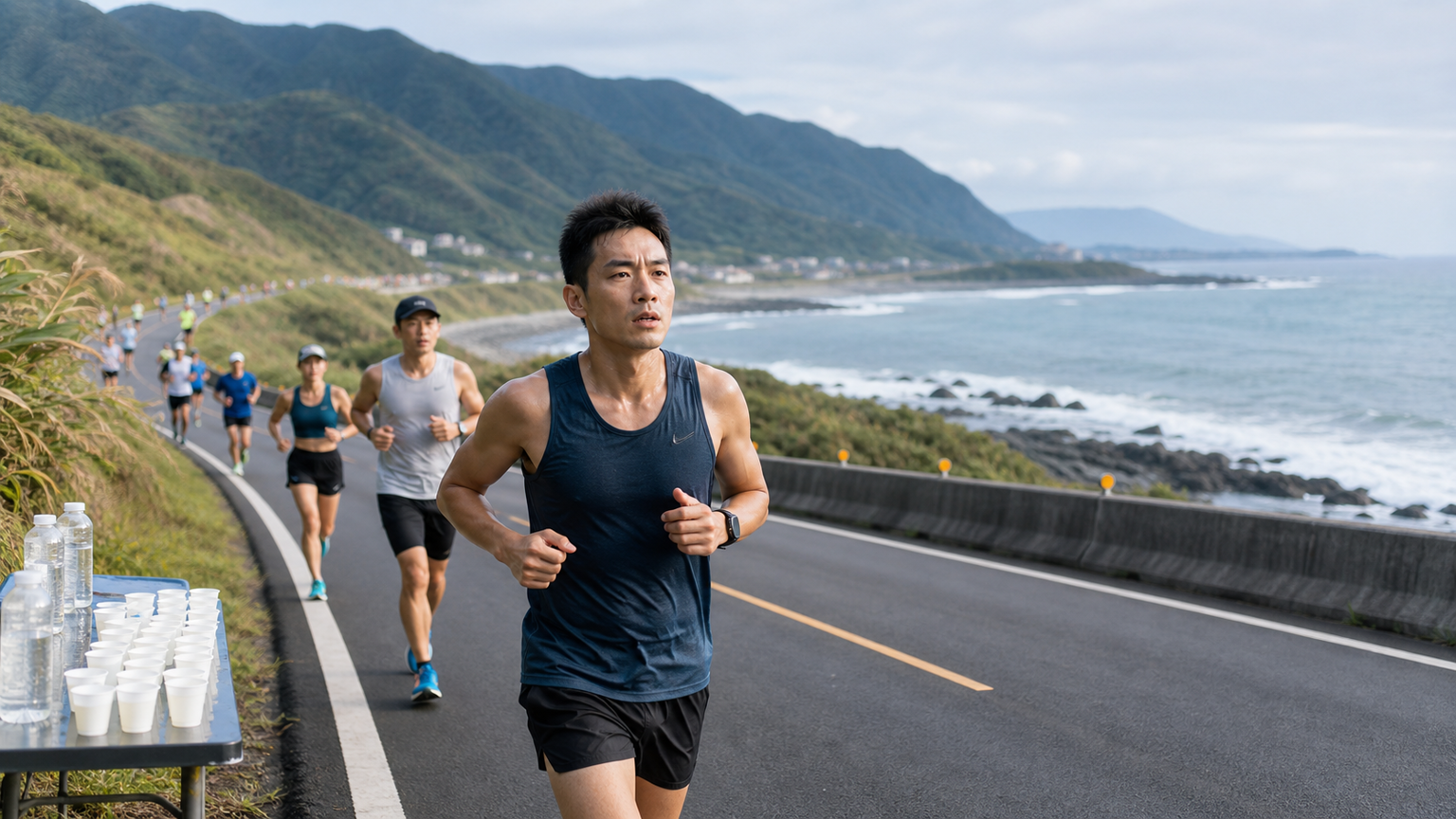
The Wan Jin Shi Marathon is often hailed as “Taiwan’s Most Beautiful Marathon.” The course stretches along Provincial Highway 2 on the northern coast, with the deep blue Pacific on one side and the lush green slopes of the Datun Mountain Range on the other. However, this route is no scenic stroll—the relentless rolling hills and shifting sea winds make Wan Jin Shi one of the most challenging city marathons in Taiwan.
Detailed Course Terrain Analysis
The Wan Jin Shi Marathon covers approximately 42.195 kilometers with a cumulative elevation gain of over 300 meters. While no single climb is particularly long, the continuous rolling sections take a heavy toll on runners’ cardiovascular systems and leg muscles.
| Section | Distance | Elevation Change | Difficulty |
|---|---|---|---|
| Jinshan Start to Huanggang | 0–8K | Slight rolling, +30m | Low |
| Huanggang to Yeliu | 8–18K | Continuous rolling hills, +120m | High |
| Yeliu to Shimen | 18–30K | Relatively flat, +60m | Medium |
| Shimen to Laomei | 30–38K | Final critical climbs, +90m | Very High |
| Laomei to Finish | 38–42K | Slight downhill to finish | Low |
The most critical section is the 30–38 km stretch—this is where the biggest climbs appear at the exact moment when runners are at their weakest, causing many to “hit the wall” here. It is recommended to incorporate specific training for late-race climbing during your preparation.
Dealing with Sea Winds and Weather
The Wan Jin Shi Marathon is typically held in March, when northern Taiwan is still under the influence of the northeast monsoon. Temperatures range from 12–18°C, but the sea wind makes it feel significantly colder. Key considerations:
- Headwind/Tailwind Sections: The outbound leg (Jinshan toward Shimen) usually faces headwinds, while the return leg has tailwinds; don’t waste too much energy fighting the wind in the first half
- Clothing Advice: A lightweight windproof layer (such as a windbreaker vest) over a short-sleeve shirt; avoid pure cotton materials that become heavy when soaked with sweat
- Sun Exposure: There is little shade along the coastal sections, and the March morning sun is already quite strong; apply sunscreen and wear a cap
- Rain Contingency: The chance of rain at Wan Jin Shi is not insignificant; plan ahead with waterproof shoe covers or a strategy for changing into dry shoes
Pacing Strategy: Energy Management on Rolling Terrain
On an undulating course, it is more scientific to plan with “equal effort” rather than “equal pace”—that is, allowing a slightly slower pace on uphills while maintaining the same heart rate, and letting the pace naturally quicken on downhills without sprinting.
Suggested strategy for a Sub-4 goal:
- Heart Rate Control: Maintain 72–75% of max heart rate in the first half; avoid exceeding 80% during early climbs
- Uphill Technique: Shorten your stride, increase cadence, use active arm swing for assistance, and avoid hunching over or dropping your head
- Downhill Technique: Land on the forefoot, keep knees slightly bent, control your speed, and protect your quadriceps
- After 30K: If your legs still have strength, you can hold steady or even pick up the pace here; if they feel heavy, maintaining your pace is more important than forcing a speed-up
Nutrition Plan
Aid stations at Wan Jin Shi are relatively frequent, roughly every 3 kilometers, but the solid food options are more abundant than at the Taipei Marathon, with local Taiwanese offerings like braised eggs and salted plums commonly found along the route.
- First 20K: Focus on water and electrolyte drinks, refueling at every station
- 20–35K: Take one energy gel every 7 kilometers, paired with a cup of water; you may also try the on-course solid food
- After 35K: Refuel based on how you feel; don’t force yourself to eat to avoid stomach discomfort
It is strongly recommended to carry your own electrolyte capsules. The strong coastal winds cause rapid sweat evaporation and accelerated electrolyte loss, making the risk of cramping higher than at typical city races.
Practical Tips
- Stay overnight in Jinshan or Shimen the day before the race to shorten your travel distance and avoid the fatigue of a long early-morning drive
- Your training should include “long-hill interval” sessions, such as practicing continuous climbs on Yangshan or Pingsi mountain roads
- Pacing yourself in the early stages is more important here than in any other race; most Wan Jin Shi runners regret “starting too fast in the first half”
- The temperature at the start is low; wear a disposable raincoat or an extra warm layer while waiting, then shed it after the gun goes off
Conclusion
The appeal of the Wan Jin Shi Marathon lies precisely in its challenge—battling the hills and wind against a backdrop of sea and sky, the sense of accomplishment upon finishing far exceeds that of typical city races. Master the terrain, manage your energy well, and you will run a time you can be proud of on Taiwan’s most beautiful marathon course.
Related Reading
- Wan Jin Shi Marathon Guide: Handling Elevation and Weather on the Coastal Scenic Route
- Wan Jin Shi Marathon: Complete Guide to North Coast Coastal Scenery and Wind Speed Challenges
- Wan Jin Shi Marathon Guide: Wind Direction Strategy and Aid Station Distribution on the Coastal Course
- Wan Jin Shi Marathon: Complete Guide to Pace Adjustment and Aid Station Layout in Strong Coastal Winds
半日 小台灣 極限單車路線挑戰實錄
7 年前
台北闊瀨陡坡 騎旅 / 日本單車雜誌編輯車友臨時加入!/ 髮香才是最強的 / feat. 北迴歸線小隊 / 公路車 CT Yeh
6 個月前
大武山20%魔王陡坡【JJSC南台灣遊騎Day2】!屁股真的要裂開了...凡士林抹滿也沒用?神秘金教堂還有超便宜夜市
3 個月前
大武山後門26%歡樂陡坡!JJSC南台灣單車行Day2 / 被颱風追著跑 / 公路車 / CT Yeh
2 年前
萬年峽谷! 30% 超激陡坡 里佳部落DAY2 還是很硬! | 公路車 | CT Yeh
3 年前
水金九不厭五分 10度寒流冷到不願停!feat. 卡卡 / 公路車 / CT Yeh
6 個月前
4K單車實境) 舊陽金P字道 第1P 仰德大道至小油坑 誤跟武嶺神人們 被拉爆爽飛天 Taiwan Cycling Climb Route Recommend
7 年前
單車 一日北高 ( 雙城 ) 肥宅雙人瘋狂行 紀錄片 REACTO
10 年前