Introduction
Among ultramarathons, the 24-hour timed race is one of the most unique formats—runners loop a course within a set time, with total distance determining the winner, rather than finishing time over a fixed distance. In recent years, Taiwan has hosted numerous such events, including races in Taroko, Taichung, and track loop races in various counties and cities, attracting a growing number of endurance sports enthusiasts to take on the challenge. To set a personal best mileage within 24 hours, the level of preparation required far exceeds that of a standard marathon.
Training Planning: Core Principles for Ultramarathon Preparation
The preparation period for a 24-hour race should ideally last at least 20–24 weeks, with training volume gradually building to 80–120 kilometers per week, while incorporating the following specific workouts:
| Training Item | Frequency | Purpose |
|---|---|---|
| Long Slow Distance (LSD) | Once per week, progressing to 40–60K | Build aerobic base and fat-burning efficiency |
| Back-to-Back Long Runs | Two consecutive days on weekends, 25–35K each | Simulate fatigue accumulation in the latter stages of the race |
| Night Training | 2–3 times per month, 2–4 AM | Familiarize with the body’s responses to nighttime exercise |
| Run-Walk Intervals | Once per week | Practice the rhythm of switching between running and walking strategies during the race |
| Strength Training | Twice per week | Strengthen the core, glutes, and calves to prevent injuries |
During the preparation period, you must deliberately practice “running under fatigue”—don’t wait until you’re fully recovered before every training session. This allows the body to adapt to the prolonged fatigue state of the race.
Pre-Race Preparation: Gear and Nutrition Planning
Ultramarathon gear requirements are far more complex than those of a standard marathon:
Essential Gear Checklist:
- At least two pairs of racing shoes (for mid-race changes)—feet swell after prolonged running, so leave half a size of extra room
- Multiple sets of running clothing, changed every 6–8 hours to prevent skin chafing
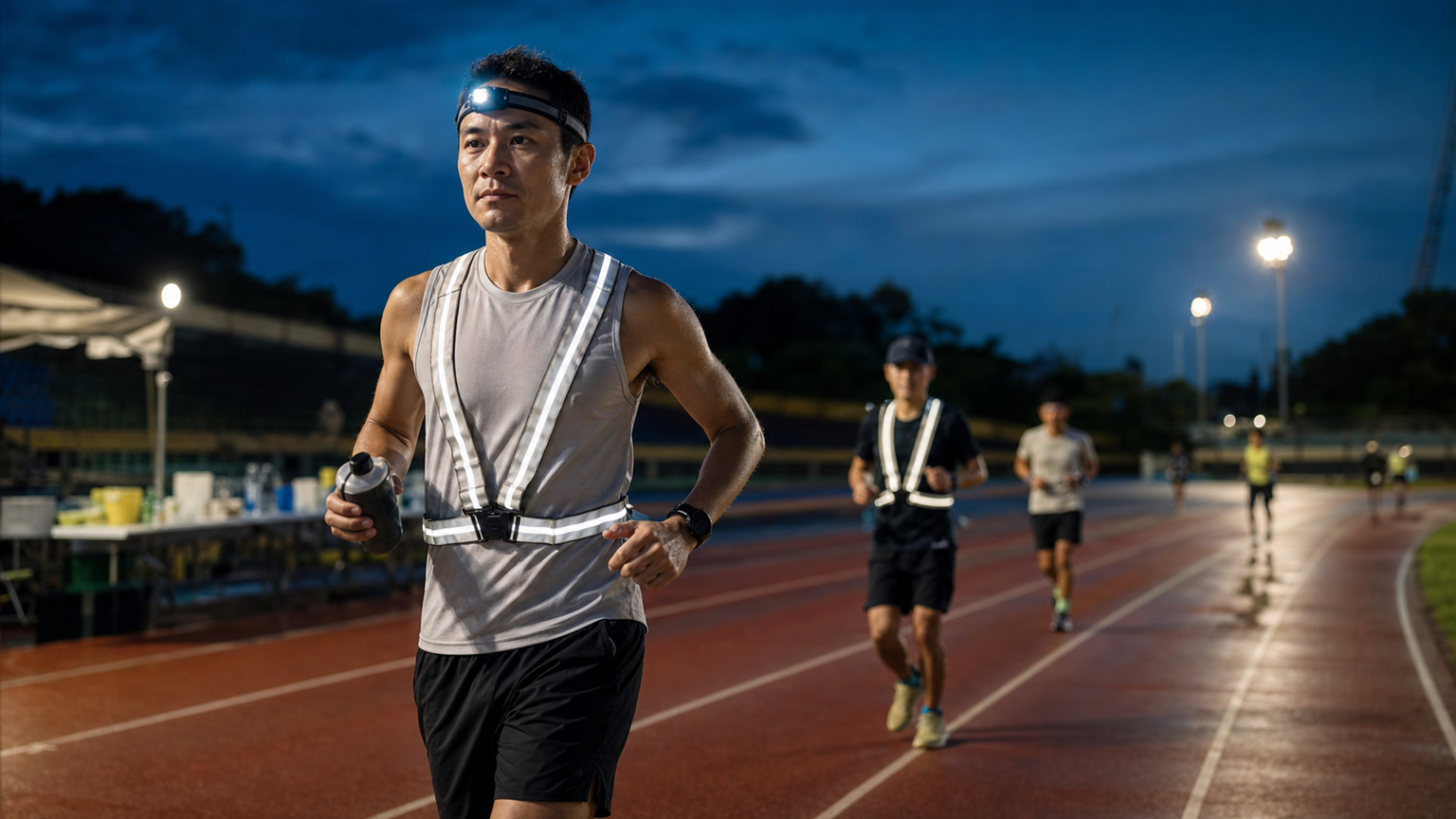
- Headlamp (with spare batteries) and reflective vest
- Personal aid station supplies: energy gels, salt tablets, real food (sweet potatoes, rice balls, bananas)
- First-aid items: petroleum jelly (anti-chafing), kinesiology tape, blister patches
Nutrition Timing Plan:
- Consume 200–300 calories per hour (adjusted based on intensity)
- Replenish fluids every 20–30 minutes, including electrolytes
- Consume “real food” every 3–4 hours to maintain a sense of fullness
- Take salt tablets every 1–2 hours to prevent hyponatremia
In-Race Strategy: Managing the 24 Hours in Phases
Phase 1 (Hours 0–8): Conservative Start
Runners often start too fast due to excitement and cooler weather—this is the most common fatal mistake in 24-hour races. During the first 8 hours, maintain a pace slightly slower than your comfortable pace, using a conversational intensity as the benchmark. Record your time each lap, and if you find yourself ahead of plan, actively slow down.
Phase 2 (Hours 8–16): Nighttime Management
Nighttime is the most difficult period of an ultramarathon, as the body’s circadian rhythm peaks sleepiness between 2–4 AM. Coping strategies:
- Schedule a 20–30 minute “strategic power nap”—research shows that running efficiency improves significantly after a brief rest
- Consume caffeine (coffee or caffeine gels) around midnight to delay drowsiness
- Change into dry clothing; the psychological freshness can effectively boost morale
Phase 3 (Hours 16–24): Final Push
With 8 hours remaining, decide whether to increase your pace based on remaining energy. If your accumulated mileage is on track, maintaining a steady rhythm is sufficient; if you want to push for more distance, try a gradual acceleration in the final 2 hours.
Mental Strategies: Thinking Tools to Transcend Fatigue
Completing an ultramarathon is 70% mental:
- Segment Goals: Don’t think about 24 hours—instead, think “just 5 more kilometers” or “make it to the next aid station”
- Rituals: Perform fixed actions during each aid stop (such as changing shoes, changing clothes, taking a selfie) to reset your mental state
- Support System: Inform family or friends of your plan; their encouragement during the race has a significant effect
- Mindful Running: Focus on your breath and footsteps, without anticipating future pain
Practical Advice
- For loop races, use a GPS watch to record each lap time rather than relying on feel
- Rest fully in the week before the race; avoid any high-intensity training
- Prepare a weather contingency plan: Taiwan ultramarathons often encounter sudden temperature drops or unexpected rain
- Having a pacer can significantly improve performance in the latter stages—if race rules allow, make good use of one
Conclusion
The 24-hour ultramarathon is the ultimate test of human endurance, but it is not an unattainable dream. With systematic preparation training, meticulous in-race strategy planning, and strong mental resilience, more and more Taiwanese runners are finding meaning in pushing past their limits in this extreme sport.
Related Reading
- Long-Term Planning for Ultramarathon Preparation: Mileage Accumulation Strategies Over 6+ Months
- Ultramarathon Basics: Transitioning from Marathon to 50K/100K Training
- Ultramarathon Pre-Race Preparation: Complete Guide to Gear Checklist and Training Cycles for Taiwan’s 100K Races
- Training Strategies and Race Execution for 24-Hour Endurance Events
Live) 備戰2019彰化經典百K 賽前攻略 (已完賽請看新影片
7 年前
一日北高前的高裝檢 | 北高 360 | 挑戰11小時的裝備 | 一日雙塔 | 補給
6 年前
西進武嶺 免費訓練分析服務 Intervals | 練不夠還是練過頭?你哪一種類型選手?AI模型告訴你! | 備戰神器 | 公路車 訓練 | CT Yeh
4 年前
2019 夏季KOM 5小 完賽心得 準備攻略 東進武嶺 夏季登山王之路 Taiwan KOM Challenge
7 年前
一日北高 11小時 賽後心得分享篇 | TWB北高360 | 一日雙城 | 單車 | 公路車
6 年前
實景訓練台) 彰化經典百K 高強度喵團 90分鐘 跟著一起練功 2019 Indoor workout Changhua Classic 100 Taiwan
7 年前
單車 一日北高 ( 雙城 ) 肥宅雙人瘋狂行 紀錄片 REACTO
10 年前
2024 彰化經典百K 參賽直播 / 黃亭茵集團 / 公路車 / CT Yeh
2 年前