Introduction
Running events in Taiwan span all four seasons, from the Taipei Marathon in late autumn and early winter, to the Wanchin Shih in spring, to various summer road races across the island. Runners face vastly different weather conditions. Even harder to predict, winter races can suddenly warm up, or autumn marathons may take place under the influence of a typhoon’s outer circulation. When facing uncontrollable weather, learning to “adjust strategy based on the weather” often yields better results and greater safety than “stubbornly executing the original plan.”
Hot Weather Strategy (Temperatures Above 25°C)
Heat is one of the most impactful weather factors for marathon runners. Research shows that for every 1°C rise in temperature, marathon finish times increase by an average of 1–3 minutes; when temperatures exceed 25°C, some runners’ performance can drop by 10–15%.
Pre-Race Preparation
- Heat Acclimatization Training: If the race is in summer, performing heat acclimatization training 10–14 days before the race (moderate-intensity running for 45–60 minutes in hot conditions) can significantly improve the body’s heat tolerance
- Pre-Cooling Strategy: Drinking ice water or beverages with ice 30 minutes before the start can lower core body temperature and delay heat-induced fatigue
- Clothing Choices: Light-colored, lightweight, moisture-wicking, quick-dry fabrics; avoid dark-colored clothing
In-Race Adjustments
| Strategy | Description |
|---|---|
| Slow Down Your Pace | Adjust target pace based on temperature; slow down 10–20 seconds per kilometer at 25°C |
| Active Cooling | Pour ice water or use sponges from aid stations on your head and neck to quickly lower perceived temperature |
| Increase Hydration Frequency | Every 1.5–2 kilometers, don’t wait until you’re thirsty to drink |
| Watch for Heat Injury Warning Signs | Stopped sweating, dizziness, and nausea are precursors to heatstroke; stop racing immediately and seek help |
Rainy Weather Strategy
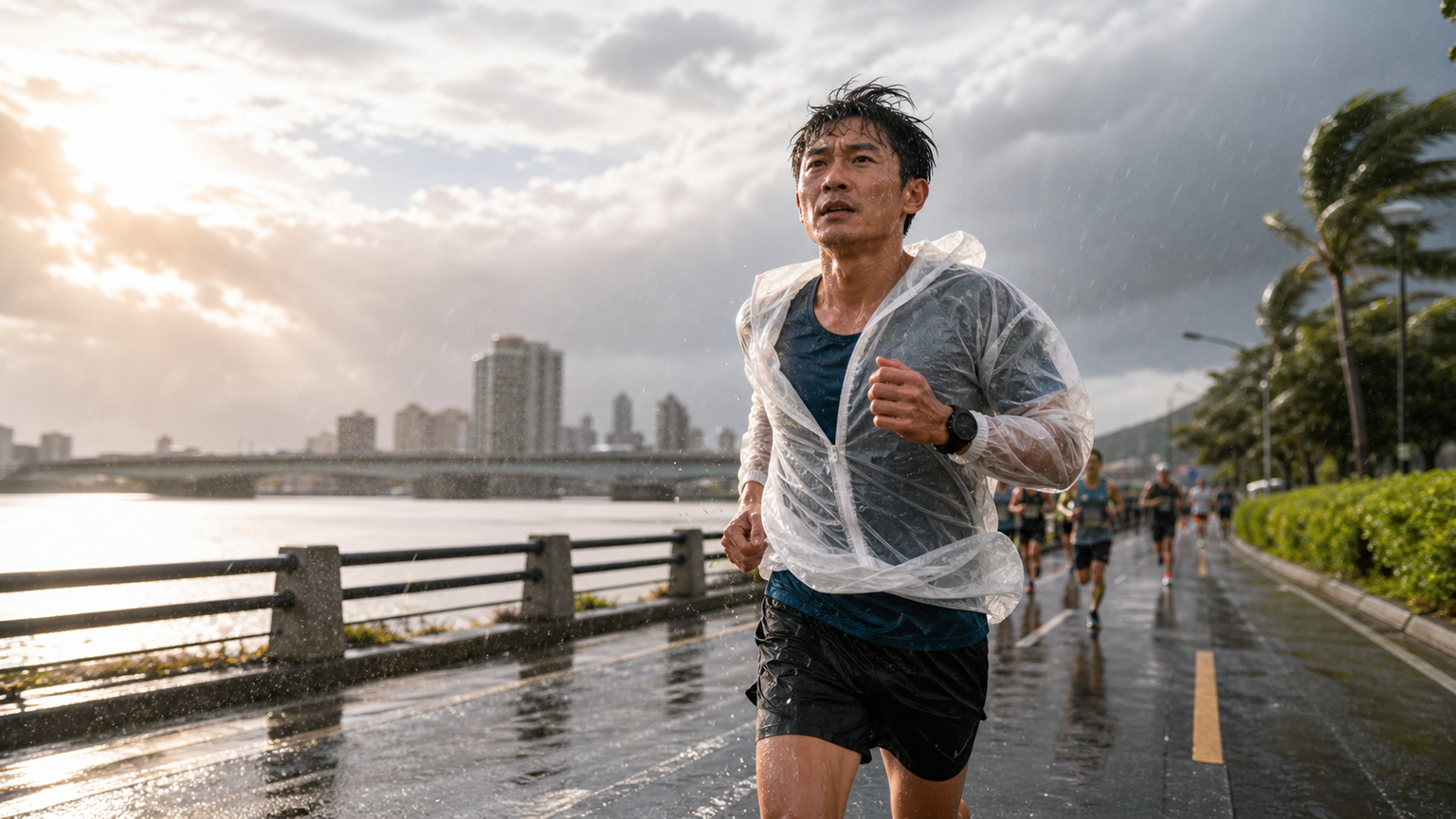
Frontal rainfall is common during Taiwan’s autumn and winter racing season. Running in the rain presents its own unique challenges:
Cold Rain (Temperatures Below 12°C)
Cold combined with soaked clothing can cause rapid body heat loss, creating a risk of hypothermia:
- Clothing Strategy:
- First Layer: Tight-fitting moisture-wicking base layer (no cotton)
- Second Layer: Lightweight windproof and waterproof jacket (Gore-Tex or similar material)
- Gloves and a hat effectively retain body heat but can be removed after warming up
- Waiting at the Start: Bring a cheap rain poncho or a large trash bag to wear while waiting for the start, then discard it after the gun goes off
- Foot Protection: Wear running shoes with tread (for wet-surface grip), and avoid stepping in puddles (wet feet are prone to blisters)
Warm Rain (Temperatures Above 20°C)
Warm rain is actually good running weather—it provides excellent cooling and reduces the risk of heatstroke. In this case, the strategy should be a lightweight (disposable) waterproof jacket or simply running without one; don’t overdress and cause overheating.
Strong Wind Strategy
Taiwan’s autumn and winter northeast monsoon and crosswinds at coastal races are common challenges for runners. Research shows that a 12 km/h headwind can slow marathon pace by about 10 seconds per kilometer, yet runners often underestimate the impact of wind.
Countermeasures
- Draft to Save Energy: On headwind sections, follow the runner ahead (maintaining a 1–2 meter distance) to use the “drafting effect” and save up to 6–7% of energy expenditure
- Ease Up into the Wind, Reap the Reward with the Wind: Be deliberately conservative on the outbound leg into a headwind, and let your pace naturally increase on the return leg with a tailwind, rather than chasing the same pace in both directions
- Lower Your Center of Gravity: Lean slightly forward into a headwind to reduce your frontal area
- Arm Drive: Active arm swinging can provide additional propulsion when wind resistance increases
Psychological Coping with Unexpected Weather
No matter how well prepared you are, if extreme unexpected weather occurs on race day, the most important thing is mental flexibility:
- Accept in advance the possibility that “today’s performance may not be good,” and shift the race goal from “beating a PB” to “finishing safely”
- When you hear weather forecasts on the roadside or over the broadcast, proactively adjust your pacing plan; don’t stubbornly stick to the original strategy
- In extreme heat (above 30°C with high humidity) or thunderstorm conditions, prioritize health and safety. If the organizer doesn’t cancel the race, runners can independently decide to withdraw
Pace Adjustment Recommendations by Weather
| Weather Conditions | Pace Adjustment Recommendations | Notes |
|---|---|---|
| 15–20°C Sunny | Standard pace | Ideal racing conditions |
| 20–25°C | Slow by 5–10 sec/km | Increase hydration |
| 25–30°C | Slow by 10–20 sec/km | Consider adjusting goals |
| Above 30°C | Slow by 20–40 sec/km | Prioritize finishing safely |
| Strong headwind | Slow by 5–15 sec/km | Use drafting strategy |
| Cold rain (below 10°C) | Essentially unchanged | Watch out for hypothermia prevention |
Practical Tips
- Start tracking the weather forecast three days before the race; don’t just look at temperature, but also humidity, wind speed, and chance of precipitation
- Keep a rain poncho, warm layer, hat, and other emergency gear ready on your phone; pack a set of dry clothes in your gear bag
- For hot races, consider wearing a sun visor and carrying an aluminum foil emergency blanket (for warmth after finishing)
- Tell family and friends cheering along the course to carry spare clothing that can be exchanged at designated aid points
Conclusion
When facing the weather, the only thing runners can control is their own response—gear choices, pace adjustments, and mental flexibility. Incorporating “weather response strategies” into race preparation, rather than building all plans on the assumption of ideal weather, is the mindset of a mature runner. Whether in sun, rain, wind, or cold, every finish is a story to be proud of.
Related Reading
- Race Day Weather Psychology: Mindset Adjustment Strategies for Heat and Rain
- Marathon Weather Strategy: Optimal Temperature and Pace Adjustments for Hot Races
- Full Marathon Special Weather Response: Adjustments for Taiwan’s Plum Rain Season and Post-Typhoon Races
- Pace Adjustments in Hot Weather: How Many Seconds to Slow Down for Every 1°C Rise
一日北高前的高裝檢 | 北高 360 | 挑戰11小時的裝備 | 一日雙塔 | 補給
6 年前
一日北高/長距離團騎 常見問題補充篇 / 組團或跟團的眉角 / 壯車友容易被瘦車友慢性拉爆 / 原來屁股痛可能是這個原因...? / 風場配速法 / 公路車 / CT Yeh
2 年前
單車 一日北高 ( 雙城 ) 肥宅雙人瘋狂行 紀錄片 REACTO
10 年前
一日北高前的西濱集訓 | 跟著11小時軍團 | 300W踩不動的大逆風 | 輪車破風差幾瓦?
6 年前
TBA 北高360 逆風爆熱再送空汙 苦行挑戰賽全記錄 4K沈浸式臨空畫質| 公路車 | CT Yeh
3 年前
下雨天就是要改車 #ceramicspeed #bike
1 年前
#公路車 #Fitting 靠人工智慧APP 幫你調整單車
6 年前
雨戰! 西進武嶺員工旅遊 加料 各路段大數據分析 | 同事端出5公斤的公路車來挑戰!? EP1
4 年前