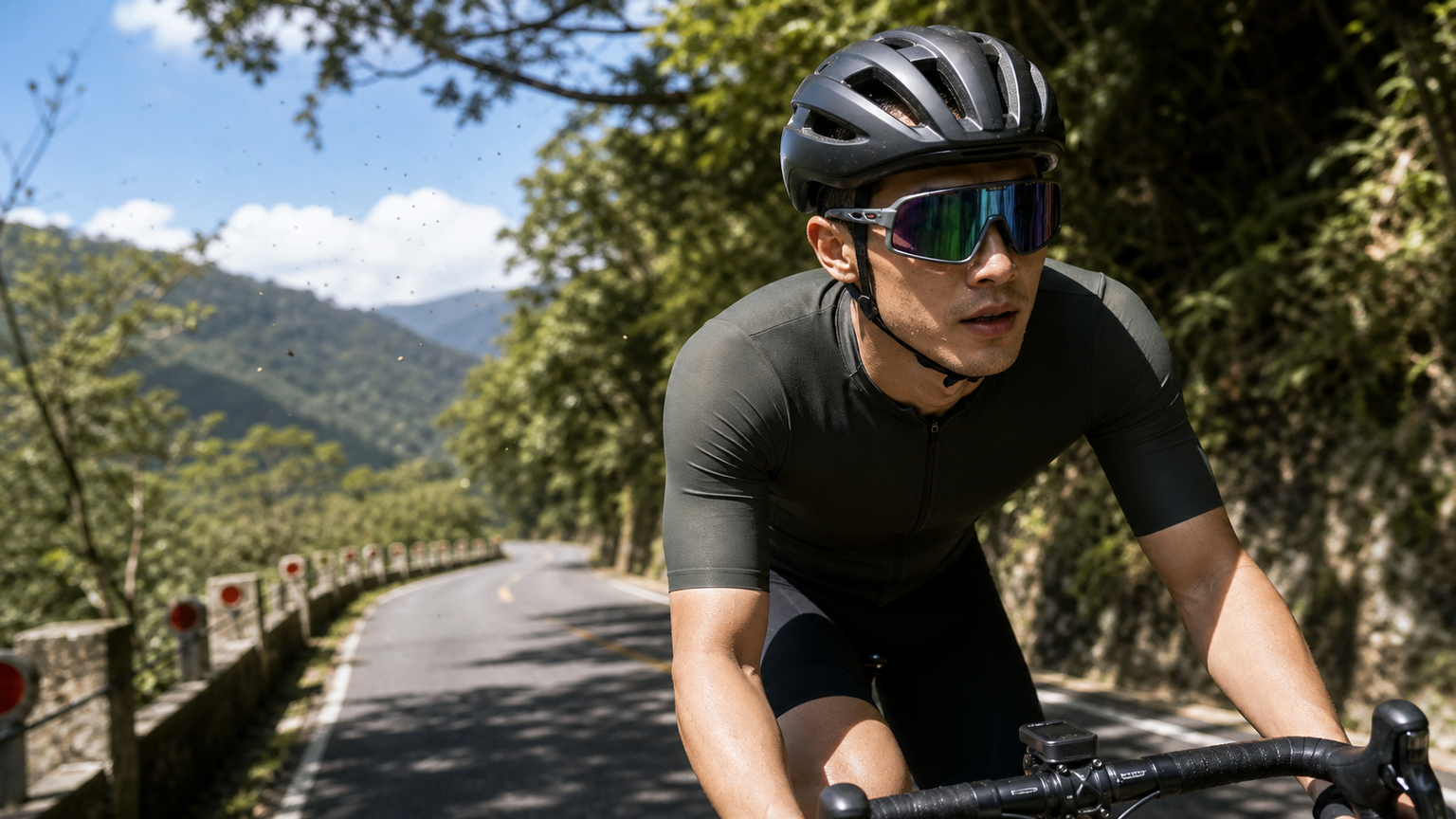
Introduction
When riding at high speed, the eyes are not just tools for seeing the road—they are the first line of sensory defense for personal safety. However, Taiwanese cyclists often place far less importance on eye protection than on helmets and knee pads. Strong UV rays, insects flying head-on, road dust, and sudden changes in light conditions on mountain curves—these threats test a rider’s eye health on every ride.
This article will systematically analyze the various threats to the eyes during cycling and provide a scientific guide for Taiwanese riders choosing goggles.
Eye Threats in Taiwan’s Riding Environment
Long-Term Damage of UV Rays to the Eyes
UV damage to the eyes is often harder to notice than damage to the skin, yet it is more difficult to reverse. Long-term cumulative UV exposure is clearly linked to the following eye conditions:
| Condition Type | UV Correlation | Taiwan Risk Assessment |
|---|---|---|
| Pterygium | Highly correlated | High risk for riders in southern and eastern Taiwan |
| Cataract | Moderate to high correlation | Accelerated onset in long-term outdoor riders |
| Macular Degeneration (AMD) | Under research | High-intensity UV may be a risk factor |
| Keratitis (Photokeratitis) | Directly correlated | Snow riding or highly reflective road surfaces |
When cycling, the eyes sit beneath the helmet, losing part of the shading effect that a regular cap brim provides; combined with long riding durations (Taiwan’s mountain routes often take 3–6 hours), the cumulative UV exposure is considerable.
Insect and Foreign Object Injuries
In Taiwan’s summer, riding on mountain roads, country lanes, and near river valleys means extremely high insect density. Hitting a bee or beetle head-on at the common road bike speed of 30–40 km/h delivers an impact no less than a small projectile, and cases of corneal lacerations are not uncommon.
Other common foreign object threats:
- Gravel and asphalt fragments kicked up from the road surface
- Branches and leaves (especially on shaded mountain roads)
- Dust blown by strong winds (during the autumn/winter northeast monsoon season)
- Chemical particles near industrial areas
The Challenge of Changing Light Conditions
The alternation between tunnels and daylight on Taiwan’s mountain roads, along with the stark light-and-shadow contrast under tree cover, poses a major challenge for visual adaptation. When the eyes transition from bright light into a tunnel, it takes 3–5 seconds to adapt to the dark environment—a period of near “temporary blindness” that is extremely dangerous on high-speed descents.
Goggle Function Analysis
Lens Types and Suitable Scenarios
| Lens Type | Light Transmission | Suitable Scenarios | Recommended Taiwan Use Cases |
|---|---|---|---|
| Dark lenses (Cat.3–4) | 8–18% | Bright sunny conditions | Summer flatlands, sunny high-altitude rides |
| Light lenses (Cat.1–2) | 18–43% | Overcast, early morning, dusk | Spring/autumn seasons, cloudy mountain areas |
| Clear lenses (Cat.0) | > 80% | Night or extremely low light | Night riding |
| Photochromic lenses | Auto-adjusting | Variable light conditions | Taiwan mountain routes with frequent tunnels |
| Polarized lenses | Reduces glare | Strong road surface reflection | Coastal routes, wet roads after rain |
For Taiwanese riders, photochromic lenses are the most versatile choice—Taiwan’s mountain roads are dense with tunnels, making fixed dark lenses dangerous in tunnels and fixed light lenses insufficient under the blazing sun; photochromic lenses automatically adapt to both situations.
UV Protection Standards
When purchasing goggles, confirm the lens is marked UV400 (blocking all UV rays below 400 nm)—this is the necessary minimum protection standard. Some low-cost products may have dark lenses but do not effectively block UV; worse, the darker tint causes the pupils to dilate, allowing even more UV to enter the eyes.
Practical Considerations for Buying Goggles
Frame Fit
Goggles need to sit snugly against the face to prevent wind-blown debris from entering from the sides. Key evaluation points:
- The upper edge of the frame should sit close to the helmet brim to reduce wind gaps
- Adjustable nose pad to ensure it does not press on the nasal bridge
- Temple arms should not slip off due to sweat
Lens Curvature and Field of View
When riding in a low, aerodynamic position, cyclists primarily view the road through the lower portion of the lens. Choose lenses with sufficient curvature and coverage so that looking downward does not take your line of sight beyond the lens edge.
Anti-Fog Treatment
Taiwan’s mountain weather is highly changeable; when suddenly entering clouds or mist, or when riding intensity increases, lens fogging severely compromises visual safety. Confirm the goggles have an anti-fog coating, or choose a dual-lens design.
Eye Emergency Response
Foreign Object in the Eye
- Do not rub the eye—the object may scratch the cornea
- Rinse the eye with plenty of clean water (mineral water or sterile saline)
- If it cannot be flushed out, close the eye gently and let tears wash it naturally
- Persistent stinging or blurred vision → seek an ophthalmologist immediately
Acute Light Injury
Photokeratitis from high-altitude snow riding or intense reflected light typically presents symptoms 6–12 hours later (tearing, light sensitivity, eye pain). Moving away from the light source and applying a cold compress to the eyes can provide temporary relief, but a medical examination is needed to confirm the condition of the cornea.
Practical Recommendations
- Inspect goggle lenses annually; replace them once the anti-fog coating wears off
- Keep a spare pair of clear or light lenses for overcast days or night riding
- Long-distance riders should carry a mini sterile saline solution (eye rinse) for emergencies
- Riders using orthokeratology (OK lenses) should switch to prescription goggles to avoid contact lenses shifting due to drying and wind during rides
- Schedule regular eye exams every year, especially for riders over 40, to assess cumulative UV damage
Conclusion
The eyes are not just visual organs—they are a rider’s lifeline for safety. Taiwan’s diverse riding environments—from sun-drenched coastlines to misty mountain ridges—make goggle selection all the more dependent on actual conditions. Invest in a quality pair of goggles so that every ride lets you see the road ahead clearly, protecting yourself and your fellow riders.
Related Reading
- Eye Protection for Cycling: Protection Against UV Rays, Windblown Sand, and Insect Impacts
- Cycling Vision Protection: UV Rays, Windblown Sand, and Goggle Selection During Rides
- Eye Protection for Riders: UV and Dust Protection for Outdoor Cycling in Taiwan
- Eye Protection for Cyclists: Protection Against UV Rays, Insects, and Airflow Damage to the Eyes
開箱) 近視車友 也可以很帥的 Envis Transform 太陽眼鏡開箱 翔鷹 配近視框超便宜秘訣
7 年前
再快都跟的上!? 單車跟隨攝影機之王 HOVERAir X1 PROMAX 全面實測 / 唯一!8K畫質&自行車專用模式和跟蹤信標&前後避障 / DJI Neo 可參考/ 公路車 / CT Yeh
1 年前
一日北高/長距離團騎 常見問題補充篇 / 組團或跟團的眉角 / 壯車友容易被瘦車友慢性拉爆 / 原來屁股痛可能是這個原因...? / 風場配速法 / 公路車 / CT Yeh
2 年前
公路車 | 塔塔加驚險員工旅遊 | 還好手腳快沒被抓交替!
5 年前
碟煞公路車 銑面器 !? 原來銑完差這麼多! 降低蹭碟機率! | TIME 公路車 保養小記錄 | CT Yeh
3 年前
騎單車去大屯山賞雪! 助航台滑冰 全記錄 | 台北R友大集合 | 下雪打雪仗囉 | 4K超高畫質
5 年前
一日北高常見問題大集合 | 攻略 | 路線 | 訓練 | 補給 | 自行車 單車 | 一日雙城 | 雙塔 | TWB北高360 | 屁股痛
6 年前
#Canyon Aeroad 公路車 三年騎乘 #心得 | 出保方式 | 購買價格計算 | 同場加映累積三年大保養慘況
6 年前