Introduction
“Training is just the trigger; recovery is what makes you stronger” — this principle, widely recognized in sports science, is especially important in cycling training. Many Taiwanese riders who complete Wuling, the Double Crossing, or a full island tour on the weekend still feel exhausted when they return to work, and their performance takes a long time to bounce back. Often, this isn’t due to insufficient training volume, but rather inadequate recovery.
This article will examine the scientific basis of various recovery methods from a sports physiology perspective, helping you build the most effective post-ride recovery strategy.
What Happens to Muscles After Exercise?
Exercise-Induced Muscle Damage (EIMD)
Long-distance riding, especially climbing and descending sections, causes Exercise-Induced Muscle Damage (EIMD):
- Microtears in muscle fibers (Microtrauma)
- Local inflammatory response activation (cytokine release)
- Significant depletion of muscle glycogen
- Central nervous system fatigue (Central Fatigue)
These responses peak 24–48 hours later, known as “Delayed Onset Muscle Soreness (DOMS).” A good recovery strategy can shorten this process, helping you return to peak condition faster.
Scientific Evaluation of Various Recovery Methods
Massage Therapy
Research shows that gentle massage within 1–3 hours after a ride can:
- Accelerate lactate removal from muscles (although lactate itself is not the main cause of soreness, clearing metabolic waste aids recovery)
- Reduce DOMS severity by approximately 20–30%
- Increase local blood flow, accelerating nutrient delivery to damaged areas
| Massage Type | Optimal Timing | Effectiveness Assessment |
|---|---|---|
| Gentle post-exercise massage | Immediately–6 hours after ride | Reduces DOMS, improves subjective fatigue |
| Deep tissue massage | 24–48 hours after ride | Relieves myofascial tightness, increases flexibility |
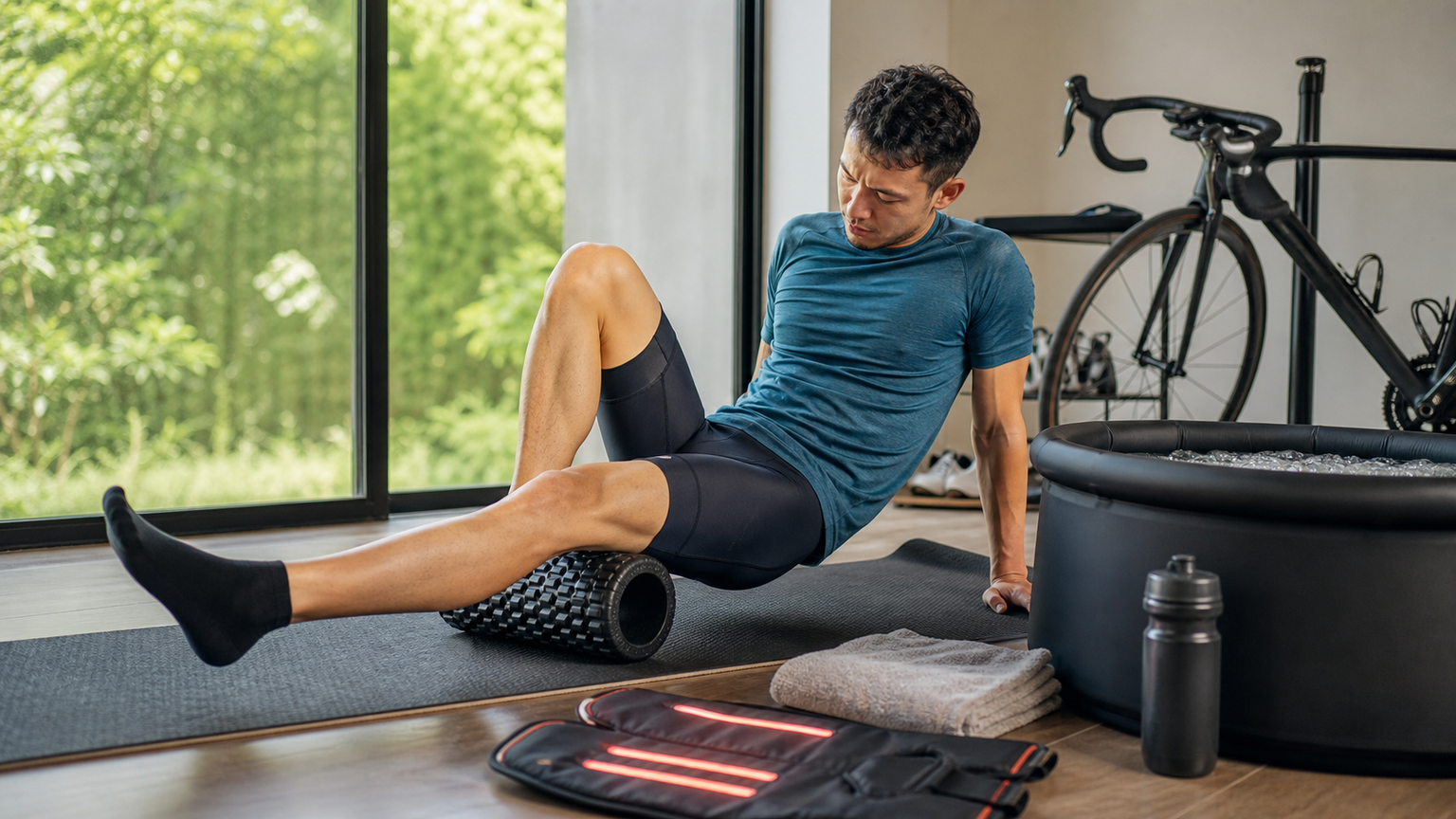
| Foam roller self-massage | Any time | Convenient, moderate effectiveness, suitable for daily maintenance |
| Pneumatic recovery boots | Immediately after ride | Accelerates venous return, reduces lower limb swelling |
Foam Roller Usage Recommendations: Roll each muscle group slowly (5–10 cm per second), holding on tight spots for 30–60 seconds to allow the fascia to gradually relax. Key areas: quadriceps, hamstrings, glutes, and triceps surae.
Cold Therapy (Ice Baths)
Ice baths (10–15°C, lasting 10–15 minutes) aid recovery through the following mechanisms:
- Vasoconstriction reduces inflammatory exudation
- Lowers local metabolic rate, reducing secondary damage
- Desensitizes pain receptors, reducing subjective DOMS perception
Note: Recent research shows that if the training goal is muscle growth (strength gains), ice baths may suppress the inflammatory signals needed for training adaptation, potentially hindering long-term progress. For cyclists focused primarily on cardiorespiratory endurance, ice baths remain an effective recovery tool after heavy training or races, but they don’t need to be used after every routine training session.
Heat Therapy and Contrast Baths
Hot baths or saunas (40–43°C):
- Promote vasodilation, accelerating muscle blood flow
- Reduce muscle tightness
- Induce heat shock protein production, aiding cellular repair
Contrast Water Therapy:
- Repeated vasoconstriction/vasodilation (“vascular pumping effect”), accelerating metabolic waste removal
- Multiple studies show superior DOMS improvement compared to cold therapy or heat therapy alone
- Recommended ratio: 3 minutes hot water → 1 minute cold water, repeated 3–4 cycles
Sleep: The Most Powerful Recovery Medium
The Physiology of Sleep and Muscle Repair
During sleep, the body secretes large amounts of Growth Hormone (GH), with approximately 70% of daily secretion concentrated during slow-wave sleep (Deep Sleep, Stage 3–4). Growth hormone directly drives:
- Repair of muscle fiber microdamage
- Protein synthesis (muscle rebuilding)
- Accelerated glycogen replenishment
- Immune function recovery
Research shows that for every 1 hour of sleep lost, muscle recovery efficiency drops by approximately 20–25%.
Strategies for Optimizing Sleep Quality
- Sleep duration: Aim for 8–9 hours during high-volume training periods, 30–60 minutes more than usual
- Cool down before bed: After a post-ride hot bath (37–38°C, not too hot), enter a cool sleeping environment to help fall into deep sleep faster
- Avoid bright light before bed: Avoid phone blue light for 1 hour after riding, as blue light suppresses melatonin secretion
- Consistent routine: A fixed sleep-wake schedule helps establish a stable circadian rhythm, increasing the proportion of deep sleep
- Short power naps: A 20–30 minute nap can supplement insufficient nighttime recovery; avoid exceeding 30 minutes (which affects nighttime sleep quality)
Timing of Post-Ride Nutritional Intake
The golden window for recovery is within 30 minutes after a ride:
- Carbohydrates: 1.0–1.2 g/kg body weight, replenishing depleted muscle glycogen
- Protein: 0.3 g/kg body weight, providing raw materials for muscle fiber repair
- Common Taiwanese options: Rice + tofu + soy milk, banana + milk, chicken breast rice balls
Practical Recommendations
- Don’t sit still immediately after a long ride — 10 minutes of easy spinning (Cool Down) allows heart rate and blood flow to gradually return to baseline
- Wear compression tights for 2–3 hours after riding to aid venous return and reduce lower limb swelling
- Taiwan’s summer heat causes heavy sweating; post-ride hydration is the top recovery priority (replenish 1.5 liters of fluid for every 1 kg of body weight lost)
- Schedule regular deep tissue massages (once every 2–4 weeks) to maintain long-term muscle health and prevent chronic tightness
Conclusion
High-quality recovery is not a luxury; it is an essential component of training. Massage loosens muscles, hot/cold therapy regulates inflammation, and sleep is the stage where all repair work is truly completed. If Taiwanese riders can strike a balance between training and recovery, they can not only ride faster and stronger, but also enjoy the sport sustainably, taking on new challenges year after year.
Related Reading
- Active Recovery After Riding: The Scientific Benefits of Baths, Massage, and Compression Garments
- Post-Ride Recovery Strategies: Scientific Massage, Stretching, and Hot/Cold Therapy
- The Science of Post-Ride Recovery: The Golden Triangle of Active Recovery, Sleep, and Nutrition
- Cycling Contrast Recovery: A Scientific Comparison of Contrast Baths, Ice Packs, and Heat Packs
#公路車 #Fitting 靠人工智慧APP 幫你調整單車
6 年前
一日北高常見問題大集合 | 攻略 | 路線 | 訓練 | 補給 | 自行車 單車 | 一日雙城 | 雙塔 | TWB北高360 | 屁股痛
6 年前
CT暗黑廚房) 車友必備 宇宙無敵鮮蚵湯 幫助訓練恢復 天然食補 好市多 超肥鮮蚵 破PR
7 年前
2019 夏季KOM 5小 完賽心得 準備攻略 東進武嶺 夏季登山王之路 Taiwan KOM Challenge
7 年前
大武山後門26%歡樂陡坡!JJSC南台灣單車行Day2 / 被颱風追著跑 / 公路車 / CT Yeh
2 年前
Insta360/DJI做不到的!如何製作「騎士頭頂瓦數特效」單車影片?CycleDash 完整教學 / 超強批次影片數據疊加軟體
13 天前
摔車後補裝備: 好市多新款單車安全帽& Specialized Romin 北高整路屁股都不痛的坐墊 | 一千元居然有MIPS | CT Yeh | 公路車
4 年前
西進武嶺 免費訓練分析服務 Intervals | 練不夠還是練過頭?你哪一種類型選手?AI模型告訴你! | 備戰神器 | 公路車 訓練 | CT Yeh
4 年前