Dietary Strategies for Competitive Swimmers: Weight Management and Carbohydrate Loading Plans During the Season
Introduction
Competitive swimming is a high-energy-expenditure sport. Depending on training intensity, swimmers’ daily energy expenditure can reach 3,500–6,000 kcal. If dietary intake is insufficient, training results will be significantly compromised; if intake is excessive, it may lead to unnecessary weight gain, affecting streamlining and relative strength in the water. Precisely managing nutrition during the season is a key step in evolving from an amateur to a competitive athlete.
This article is designed specifically for Taiwanese swimmers, combining Taiwan’s dietary environment (bento box culture, night markets, convenience stores) to provide practical and feasible nutrition strategies.
Energy Requirements of Swimmers
The Three Energy Systems and Their Relationship with Diet
| Training Type | Primary Energy System | Key Nutrients |
|---|---|---|
| Long-distance aerobic swimming | Oxidative phosphorylation (fat + carbohydrates) | Carbohydrates, fat |
| Anaerobic threshold training | Anaerobic glycolysis (glycogen-based) | Carbohydrates |
| Short-distance sprinting | ATP-PCr + anaerobic glycolysis | Phosphocreatine, carbohydrates |
| Land-based strength training | Mixed system | Protein, carbohydrates |
Daily Energy Estimation
Formula for calculating a swimmer’s daily energy requirements:
- Basal Metabolic Rate (BMR) × Activity Factor
- For athletes training twice a day, the activity factor is approximately 1.8–2.0.
Using a 70 kg, 18-year-old male athlete as an example: BMR is approximately 1,700 kcal, multiplied by 1.9 = approximately 3,230 kcal/day. A common mistake among Taiwanese student swimmers is training on a typical person’s dietary intake (2,000 kcal), leading to chronic energy deficiency that affects body composition and recovery.
In-Season Weight Management
Weight Is Not the Only Indicator
In competitive swimming, body fat percentage is more important than body weight. Overly pursuing low body weight may sacrifice muscle mass and reduce propulsive force. Research recommends:
- Male swimmers: body fat percentage 8–14%
- Female swimmers: body fat percentage 14–22%
Falling below this range does not necessarily improve performance and may instead affect hormonal function and bone health (especially the “Female Athlete Triad” in female athletes).
Weight Management in Taiwan’s Dietary Environment
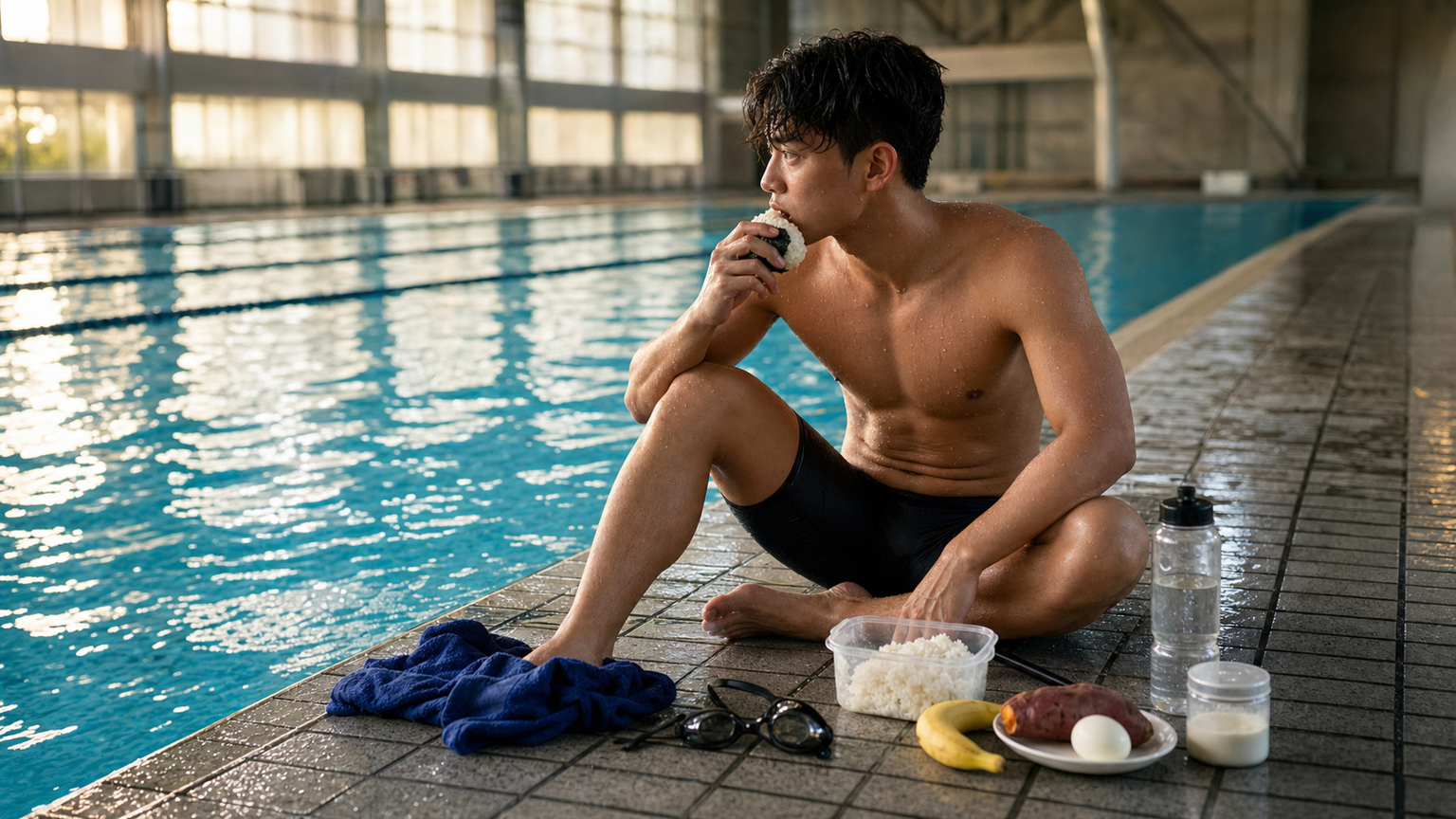
- Convenience store picks: Tea eggs (protein), sweet potatoes (complex carbohydrates), unsweetened soy milk, and cottage cheese from convenience stores are great quick options.
- Bento box adjustments: The white rice in traditional Taiwanese bento boxes can be moderately increased, but excessive braising sauce and overly fried side dishes should be avoided. Choose blanched vegetables, steamed fish, or chicken cutlet (skin removed) as protein sources.
- Night market selections: Grilled corn (complex carbohydrates), braised dishes (protein, but watch sodium intake), dried tofu, and boiled edamame are relatively better choices; fried chicken cutlet and salt-and-pepper chicken should be enjoyed in moderation on non-training days.
Pre-Competition Carbohydrate Loading Strategy
What Is Carbohydrate Loading
Pre-competition carbohydrate loading involves increasing the proportion of carbohydrate intake 1–3 days before competition to maximize muscle and liver glycogen stores. Research shows that adequate glycogen stores can delay the onset of fatigue, with the most significant benefits for events 400 meters and above; benefits are relatively limited for 50–200 meter events, but adequate carbohydrate intake remains the foundation for maintaining high-intensity performance.
| Time Before Competition | Dietary Strategy |
|---|---|
| 3 days before | Increase carbohydrate proportion to 60–65% of total calories, maintain protein intake |
| 2 days before | Continue high carbohydrate intake while reducing training volume (taper period) |
| 1 day before | Stick to familiar foods, avoid trying new foods, dinner should be carbohydrate-focused |
| Race day breakfast | 2–3 hours before competition, 300–400g carbohydrates (white rice, bread, cereal, bananas) |
| 60 minutes before race | Only a small amount of easily digestible carbohydrates (half a banana, 200ml sports drink) |
Hydration Management
Swimmers tend to underestimate fluid loss (because they don’t feel sweat in the water). In reality, swimmers in long training sessions lose approximately 500–1000ml of fluid per hour. Replenishing 150–200ml of water or a low-concentration electrolyte drink every 20–30 minutes during training is fundamental to maintaining cognitive function and muscle coordination.
Post-Training Recovery Nutrition
The 30–60 minutes immediately after training is the golden window for replenishment (Glycogen Window):
- Carbohydrates: 0.8–1.0g / kg body weight (for a 70kg athlete, approximately 55–70g, equivalent to one and a half bowls of white rice)
- Protein: 0.3g / kg body weight (approximately 20–25g, equivalent to 3–4 eggs or 100g chicken breast)
Practical options for Taiwanese athletes: one chicken leg bento box (with a slightly larger portion of rice) plus 500ml unsweetened soy milk can basically meet post-training recovery needs.
Practical Recommendations
- Keep a 3-day food diary: Use MyFitnessPal or handwritten records to understand your actual calorie intake and macronutrient ratios—this is the starting point for a personalized nutrition strategy.
- Consult a local sports nutritionist in Taiwan: Near Taipei City University of Science and Technology and National Taiwan Sport University, sports nutrition consultations with student discounts are available; it is recommended to consult at least once per season.
- Avoid extreme weight loss: If weight management is needed, plan together with your coach and nutritionist, and avoid extreme dietary restrictions during peak season.
- Supplement selection: Whey protein is a commonly used post-training supplement among Taiwanese swimmers. Choose products with BSCG or NSF certification to avoid banned substances.
Conclusion
A swimmer’s dietary strategy is a personalized, dynamically adjusted energy management system. Taiwanese athletes facing the local dietary environment do not need to pursue a “Westernized” eating pattern—instead, they should learn to make choices that meet training demands within familiar foods. Scientific nutrition strategies, combined with a systematic training plan, form the most solid foundation for continuous improvement.
Related Reading
- Swimming Athlete’s Dietary Strategy: Carbohydrate Timing for Water Sports
- Swimming Athlete’s Dietary Strategy: Carbohydrate Timing
- Dietary Needs of Young Swimmers: Calorie and Nutrition Supplementation Strategies During Growth
- Special Nutritional Needs of Adolescent Swimmers: Dietary Strategies During Growth
CT暗黑廚房) 車友必備 宇宙無敵鮮蚵湯 幫助訓練恢復 天然食補 好市多 超肥鮮蚵 破PR
7 年前
靠單車減肥35公斤 心得分享與整理
7 年前
西進武嶺 免費訓練分析服務 Intervals | 練不夠還是練過頭?你哪一種類型選手?AI模型告訴你! | 備戰神器 | 公路車 訓練 | CT Yeh
4 年前
#KOM 夏季登山王之路 比賽實況 #東進武嶺
7 年前
16/02/16 - 夜訪中社路 緩慢進步中
10 年前
live) 超越北高 之一日北高12小時 策略
7 年前
一日北高前的高裝檢 | 北高 360 | 挑戰11小時的裝備 | 一日雙塔 | 補給
6 年前
FTL 與 SYB 車隊專訪 西進武嶺 實用攻略分享! 2小時 如何練?!你不知道的眉角!新手準備武嶺必看 EP1 | 實力派女車友 | 精華版 | 公路車 | CTYeh
4 年前