Introduction
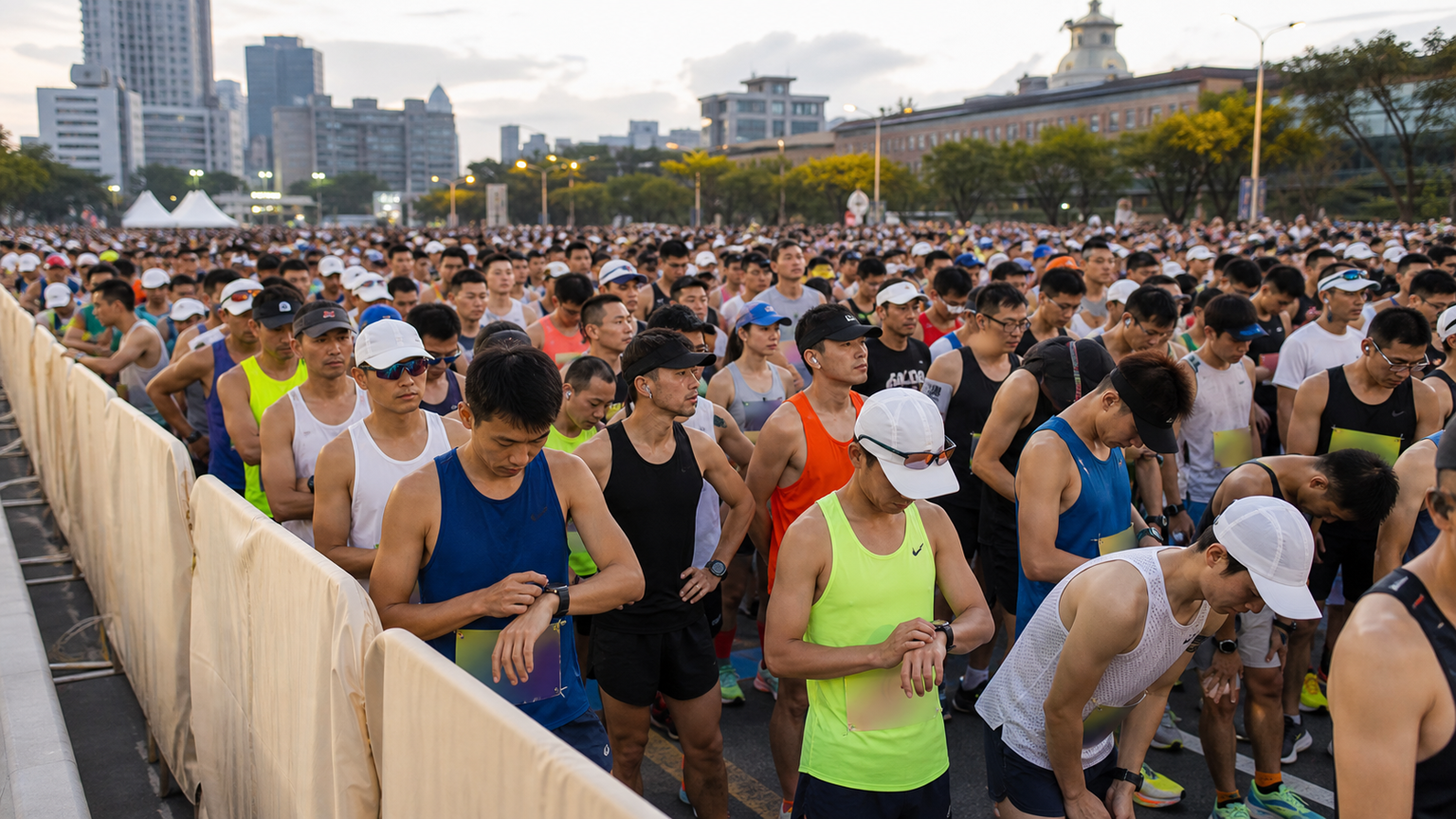
At major road races in Taiwan (such as the Taipei Marathon, Kaohsiung Marathon, and Taroko Marathon), the number of participants often ranges from several thousand to over ten thousand. Finding the right starting position, avoiding being slowed down by the crowd, and preventing excessive energy expenditure are the first steps in a successful race strategy. Many runners have only a vague understanding of the wave system, or make starting-strategy mistakes that throw off their rhythm in the first 5 kilometers, planting the seeds of trouble for the second half of the race.
The Wave System in Taiwanese Road Races
Taiwan’s major marathons generally adopt a “wave start” system, dividing runners into several waves or zones based on their estimated finish time:
| Wave | Target Finish Time | Notes |
|---|---|---|
| Elite / Zone A | Men under 3:00 / Women under 3:30 | Proof of performance required |
| Zone B | 3:00–3:30 | Based on qualification review or self-declaration |
| Zone C | 3:30–4:00 | Self-declared |
| Zone D | 4:00–4:30 | Self-declared |
| Zone E and beyond | 4:30 and above | General finishers |
Important: The wave criteria and names vary by event, so be sure to read the race regulations carefully when registering. Some events (such as the Taipei Marathon) require proof of performance to enter the front zones, while others operate on an honor-system declaration.
Choosing the Correct Starting Zone
Why You Shouldn’t “Jump Zones”
Many runners like to start in a zone ahead of their actual ability, believing they can “be pulled along to run faster.” This is a common misconception, for three reasons:
- Wasted energy in the early stages: Running among runners stronger than you can tempt you to go out too fast, exhausting your energy by 15–20K
- Obstructing other runners: If you’re slower than the runners ahead, others will have to repeatedly pass you, affecting the overall flow of the race
- Mental pressure: The psychological frustration of being constantly overtaken can hurt your performance in the second half
The correct strategy is to choose a starting position “slightly behind your target,” then naturally pick up the pace once the crowd thins out—this is far more conducive to maintaining a steady pace.
Tips for Declaring Your Pace Correctly
- Use your most recent half-marathon time ×2 + 10 minutes as a conservative full-marathon estimate
- If you have no half-marathon time, base it on your 10K pace plus a conservative estimate
- First-timers are advised to declare conservatively; passing others during the race is far better for your mental state than being passed
Practical Positioning Techniques
Pre-Race Gathering Strategy
- Arrive early to secure your spot: At Taiwan’s major marathons, the gathering time is usually 45–60 minutes before the start. Enter your zone 30 minutes before the gun goes off—the further forward you are, the easier it is to find space
- Enter after warming up: If the race has a warm-up area, complete your warm-up outside before entering the starting corral, avoiding wasted time in the crowded enclosure
- Choosing your spot: Within the same zone, positions near the center (rather than the edges) usually disperse the fastest after the start, allowing you to find your rhythm sooner
Crowd Management After the Start
In the first 1–3 kilometers after the gun, almost no runner can hit their target pace—this is normal. What matters is:
- Don’t force your way through: If the pace ahead is clearly slower than your target, tuck in temporarily until a gap opens up; don’t force your way through tight spaces
- Pass on the outside: Look for gaps along the roadside; taking a wide detour to pass is usually not worth it
- Stay calm: The 2–3 minutes you “lose” early can usually be made up in the second half, but the energy burned by impatiently surging cannot
Starting Strategy Differences: Half Marathon vs. 10K
Starting strategy varies slightly by distance:
- 10K: You can settle into your target pace more quickly after the start. In short races, early speed matters, so once you’ve secured a good position, you can push actively
- Half Marathon: Be conservative for the first 3K, find your rhythm after 5K, then assess whether to accelerate in the second half
- Full Marathon: The first 10K should always be slightly slower than planned; don’t let the excitement of the start control you
Special Scenario: Elite Runner Strategy
If you’re capable of contending for a top finish in your division or age group:
- Get into the corresponding zone and find your pace group within 500 meters of the start
- Use the drafting effect of the leading pack; don’t run alone into the wind in the early stages
- Know the times of your main competitors, and don’t blindly follow their pace
Practical Advice
- Wear your race number clearly so the timing chip is read correctly at the start line (some events use gun time rather than chip time—be aware of the difference)
- Study the layout of the starting section of the course in advance (whether there are narrow sections or turns) and anticipate when the crowd will thin out
- Carry a phone or GPS watch, check your pace during the first kilometer after the start, and adjust immediately if something is off
- If running with teammates, agree on a meeting point and starting strategy in advance to avoid having your rhythm disrupted by waiting for others
Conclusion
The start of a road race is not a side detail—it’s the first link in your overall strategy. Choosing the right starting zone, staying calm through the chaotic early kilometers, and letting the course naturally reveal your speed once the crowd disperses—that is the true strategy of an experienced runner.
Related Reading
- Marathon Wave Placement and Race Time Prediction: From Pace Calculation to Wave Strategy
- Standard Chartered Taipei Marathon Wave Start Strategy: How to Choose the Right Starting Zone
- Starting Strategy for Uphill Races: Finding the Best Position in the Starting Crowd
- Road Race Course Strategy: Speed Management on Straights, Corners, and at Aid Stations
Live) 備戰2019彰化經典百K 賽前攻略 (已完賽請看新影片
7 年前
2023桃園團體繞圈賽/環台賽等級拍攝/賽事精華/ 10人一隊缺一不可!50隊廝殺大場面 / 第三屆 海鷗繞圈賽 /公路車/CT Yeh
2 年前
2025 海鷗團體繞圈賽 網路直播 超激烈裁判長視角 / EIPC 李廷威、Waypoint 等眾多高手競爭 / feat. 卡密兒主持 / 海鷗繞圈賽
9 個月前
新屋團體繞圈賽 | 眾多菁英好手賽道奔馳 | 千瓦女子軍團 | 無敵交管狂獲好評 明年你一定不能錯過 | #公路車
5 年前
如何 搶 #中央山脈 報名 #公路車 #報名 #搶票
7 年前
一日北高/長距離團騎 常見問題補充篇 / 組團或跟團的眉角 / 壯車友容易被瘦車友慢性拉爆 / 原來屁股痛可能是這個原因...? / 風場配速法 / 公路車 / CT Yeh
2 年前
2023桃園團體繞圈賽 / 海鷗繞圈賽 | 全程空拍數據版 | 公路車 | CT Yeh
2 年前
爬坡ITT實境)台中 魔王 松鼠坡 首航 6:12 大肚山 大三元 科福路
8 年前