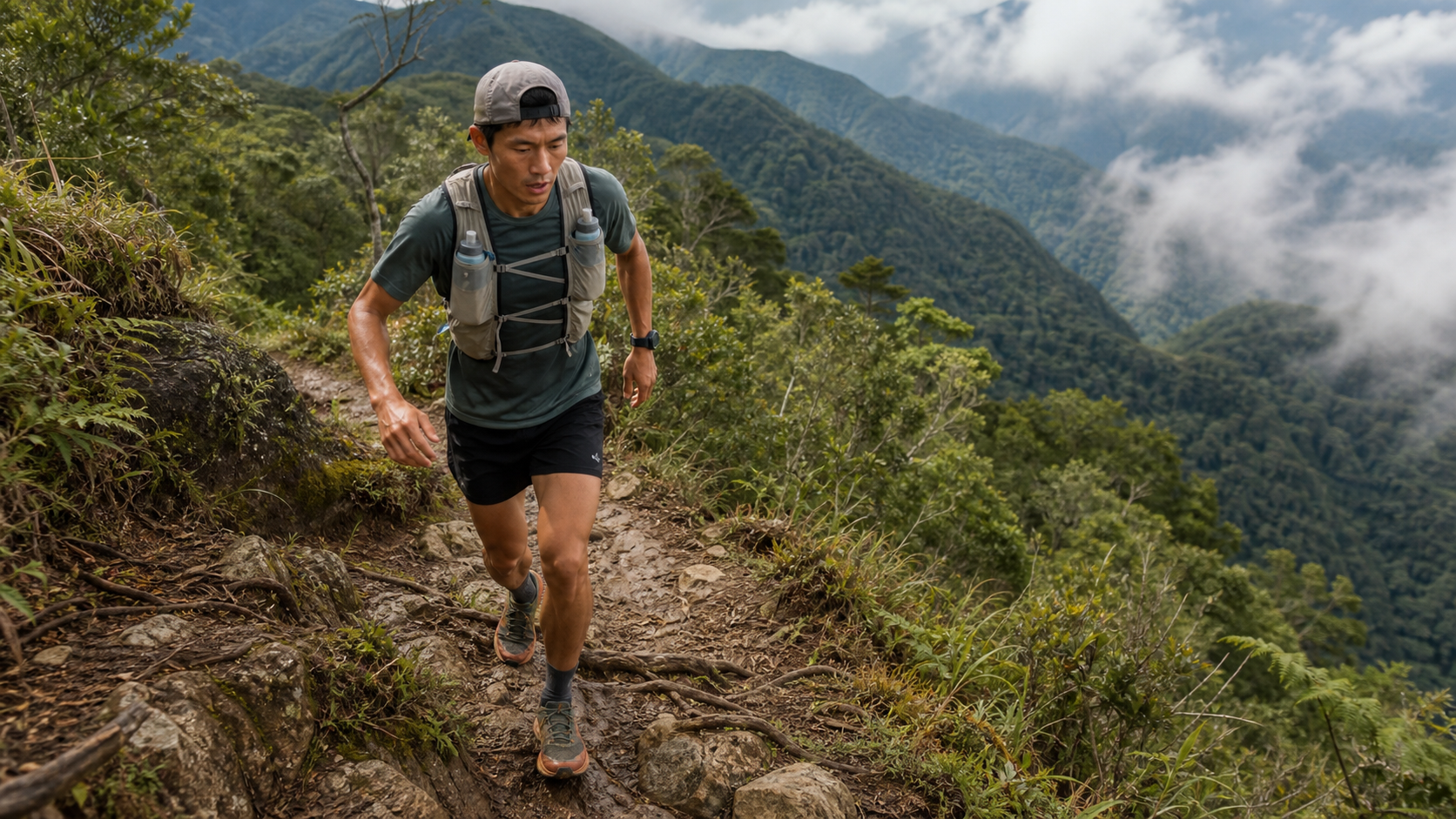
Introduction
Trail running is one of the fastest-growing running sports in Taiwan in recent years. From the Yilan 100 Peaks Trail Run and Taiwan Mountain Trail Challenge to trail races in various counties and cities, more and more runners are leaving the asphalt and stepping onto dirt trails. However, trail running is not simply running in the mountains—reading terrain, trail running technique, hydration pack setup, and learning how to assess a race’s elevation gain difficulty are all skills trail runners need to systematically master.
Trail Running Technique
Trail running technique differs fundamentally from road running and requires real-time adjustments based on the terrain:
Uphill Technique
- Short strides, high cadence: Shorten your stride and increase cadence on climbs to maintain forward momentum without burning excessive energy
- Forward lean: Lean your body slightly forward, feeling like “your feet are chasing your face”
- Arm drive: Swing your arms vigorously front and back to generate additional propulsion
- When to switch to hiking: When the grade exceeds 15–20% (more than 25 meters of climb per 100 meters), power hiking is more efficient than running
Downhill Technique
- Lower center of gravity: Slightly bend your knees and lower your center of gravity for better stability
- Short, quick strides: Don’t take long strides—short steps at high cadence are safer than long, fast strides
- Look ahead: Keep your eyes 3–5 meters ahead to spot foot placements in advance; don’t just stare at your feet
- Forefoot striking: Land on your forefoot on descents, using your ankle joints to absorb shock and reduce impact on your knees
Technical Terrain (Rocks/Roots/Wet Surfaces)
- Slow down before maintaining pace; test the stability of unfamiliar rocks before committing your full weight
- Keep a low center of gravity on rocky sections and spread your arms for balance
- On wet, rooty surfaces, stepping sideways (similar to a traverse) increases traction
Trail Running Gear: Hydration Pack Setup
Different race distances require different pack capacities:
| Race Type | Recommended Pack Capacity | Basic Configuration |
|---|---|---|
| Short distance (within 25K) | 6–10L | 1.5L bladder, energy gels, first aid kit |
| Medium distance (25–50K) | 10–15L | 2L bladder, soft flasks, real food, headlamp |
| Long distance (50K+) | 15–20L | 2L bladder + spare soft bottles, multiple meals, insulation layer |
Mandatory items (required by most Taiwan trail races):
- Headlamp (with spare batteries)
- Emergency whistle
- Insulation layer (light down jacket or windbreaker)
- First aid kit (bandages, antiseptic wipes, elastic bandage)
- Emergency contact information
- Mobile phone (fully charged)
Nutrition recommendations:
- Energy gels (one every 40 minutes)
- Solid food (dried sweet potato, dates, nuts)
- Salt tablets (one every 1.5 hours)
- At least one serving of “real food” (such as a packaged rice ball) for satiety in the latter half of the race
Elevation Gain Assessment: How to Judge Trail Running Difficulty
Trail running difficulty cannot be judged by distance alone—Total Elevation Gain (TEG) is a key indicator of race difficulty:
| Average Climb per Kilometer | Difficulty Rating | Pace Adjustment |
|---|---|---|
| < 20m/km | Low difficulty | Close to road running pace |
| 20–40m/km | Medium difficulty | 20–30% slower than road running |
| 40–60m/km | High difficulty | 40–50% slower than road running |
| > 60m/km | Extremely high difficulty | Estimate finish time using “hiking time” |
Finish time estimation method (Modified Naismith’s Rule):
Estimated time = Flat distance time + Every 100 meters of climb × 1 minute
Example: 50K trail race with 3000m of cumulative elevation gain:
- Flat distance time (assuming 7:00/km flat running pace) = 50 × 7 = 350 minutes
- Climb time = 3000 ÷ 100 × 1 = 30 minutes
- Estimated finish time ≈ 380 minutes (about 6 hours 20 minutes)
This is only a baseline estimate; technical sections and aid station stops must also be factored in.
Taiwan Trail Race Characteristics and Considerations
Taiwan’s mountain trails present unique environmental challenges:
- High humidity: Taiwan is rainy, and slippery trails are the norm—you need trail shoes with strong grip (such as Hoka Speedgoat, Salomon S-Lab)
- Snakes and wasps: Be alert when in the mountains; if encountered, keep your distance and leave quickly
- Sudden weather changes: Mountain weather is far more volatile than in the lowlands; even if it’s sunny at the start, always carry rain gear
- Mobile signal: Some sections of Taiwan’s mountain trails have no signal; it’s recommended to carry a GPS device with downloaded offline maps
Practical Advice
- For your first trail race, choose a short 10–15K beginner event to get a feel for trail running before tackling longer distances
- Trail shoes are completely different from road shoes—try them on at a physical store and test them on trails
- Taiwan trail running communities (such as iRunners, Taiwan Trail Runners Association) offer abundant race and training information
- Keep your pack weight under 10% of your body weight; an overly heavy pack significantly reduces trail running efficiency
Conclusion
Trail running is a sport that lets runners rediscover the beauty of Taiwan’s mountains—every trail tells a different story. Master the right technique, prepare your gear properly, and learn to assess race difficulty, and you’ll be able to safely explore your limits in Taiwan’s magnificent mountains.
Related Reading
- Trail Running Technique and Strategy: Complete Guide to Uphill/Downhill Running, Terrain Reading, Gear Navigation, and Safety Preparation
- Taiwan Trail Running Beginner’s Guide
- Mountain Marathon Training: How to Prepare for Climbing Power and Technique in Taiwan
- Trail Running Beginner’s Guide: Transitioning from Road to Trail
單車 梅山36灣 坡度介紹 路段介紹 空拍 (相關遊記影片,請參考說明或我的頻道喔,歡迎訂閱)
6 年前
太平山單車員工旅遊 | 這樣玩CP值最高!| 公路車
5 年前
公路車 爬坡 破PR 紀錄 小技巧 分享
6 年前
台灣登山王之路 KOM 全程參賽4K臨空錄影 PART1 穿越峽谷地形! #東進武嶺 太魯閣 / 燕子口 / 天祥 / 西寶 PART1 (公路車 / CT Yeh)
3 年前
單車 一日北高 ( 雙城 ) 肥宅雙人瘋狂行 紀錄片 REACTO
10 年前
富士山KOM 賽事篇 VLOG!/ 小野田出沒!/ 完整路段分析 / 武嶺要騎多快才能拿環?/ 台灣選手 第20回Mt.富士ヒルクライム 参加!/ 公路車 / CT Yeh
2 年前
一日北高前的高裝檢 | 北高 360 | 挑戰11小時的裝備 | 一日雙塔 | 補給
6 年前
崇越盃武嶺冠軍高手 賽前JJSC 群峰會精華!對應大數據分析,會有落差嗎?/ feat. JJSC中部公路車約騎 /公路車 / CT Yeh
2 年前