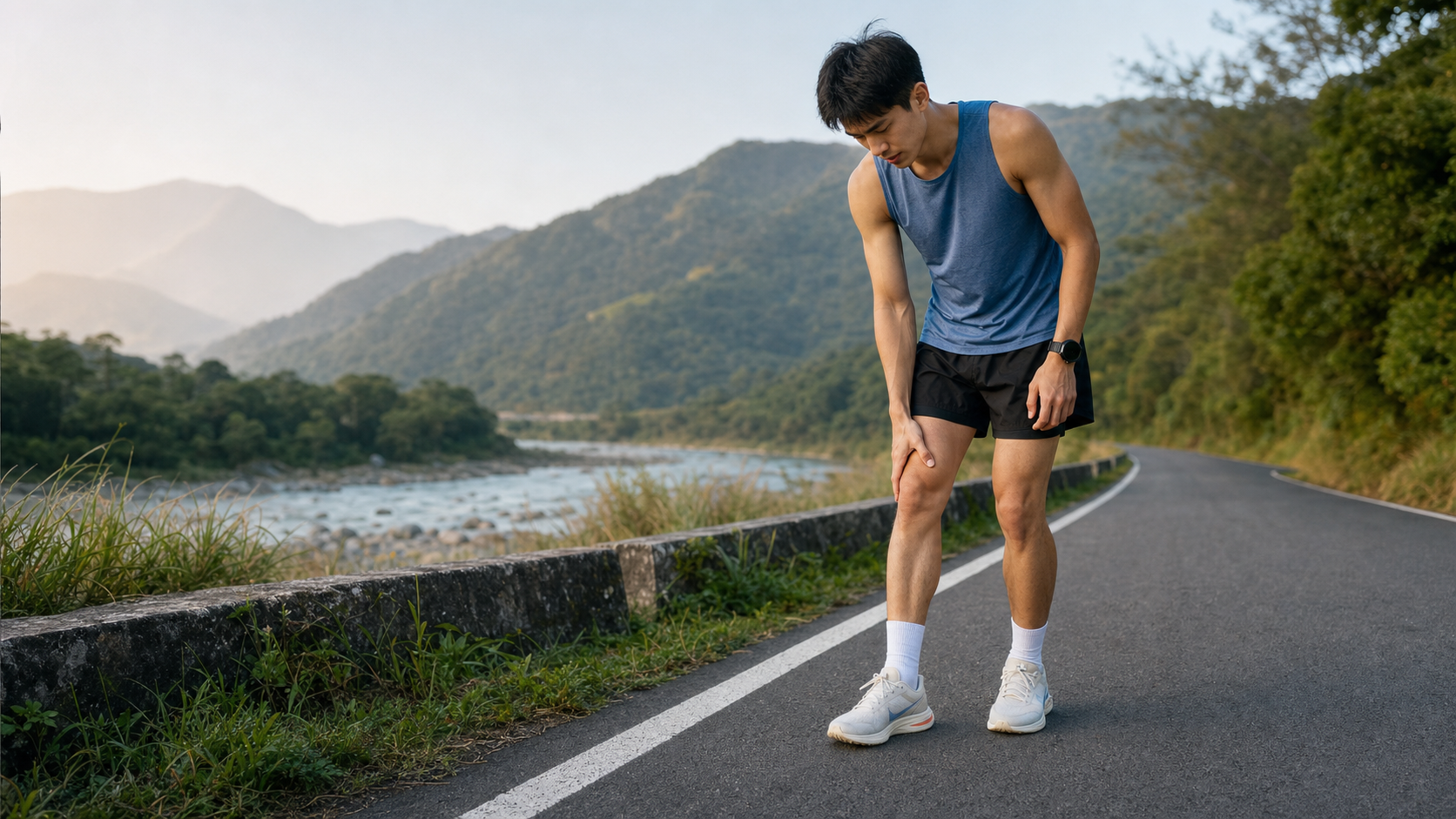
Introduction
In Taiwan’s trail running circles or marathon training groups, “IT Band” is a term that strikes fear into almost everyone. Iliotibial Band Syndrome (ITBS) is the leading cause of lateral knee pain in distance runners, accounting for approximately 12–22% of all running-related injuries, and is especially common during the final push of marathon training.
Many runners spend hours on foam rolling with limited results, because their understanding of the injury mechanism isn’t deep enough. This article will take you from an anatomical perspective to understand truly effective treatment approaches.
Anatomy and Function of the Iliotibial Band
The Iliotibial Band (ITB) is the longest fascial structure in the human body, extending from the iliac crest (lateral pelvis) all the way to the lateral tibia (Gerdy’s tubercle), connecting along the way with the gluteus maximus and the tensor fasciae latae (TFL).
Its primary functions:
- Stabilizing hip abduction
- Assisting knee extension during the swing phase of running
- Transmitting ground reaction forces upon foot strike
Updated Understanding of the Pain Mechanism
Previously, ITBS was thought to be caused by the iliotibial band “sliding and rubbing” against the lateral femoral epicondyle at the knee. However, recent research has proposed the “compression theory”: at approximately 30° of knee flexion, the fat pad and neurovascular tissue beneath the iliotibial band become compressed, producing pain—rather than simple friction.
The clinical significance of this understanding is: simply foam rolling the iliotibial band itself won’t solve the problem. Intervention must target the underlying biomechanical imbalances.
Analysis of Causes and Risk Factors
| Factor | Description |
|---|---|
| Hip abductor weakness | Insufficient strength in the gluteus medius and gluteus minimus, causing pelvic drop on foot strike (Trendelenburg gait) |
| Overstriding | Foot landing ahead of the body’s center of mass, increasing lateral knee angular momentum |
| Sudden training volume increase | Especially a sharp increase in long-distance mileage |
| Course environment | Prolonged running in one direction on cambered surfaces (e.g., riverside trail edges) |
| Shoe wear | Excessive lateral wear, exacerbating knee valgus |
| Leg length discrepancy | One leg longer than the other; the longer side is more prone to ITBS |
Typical Symptoms
- Sharp or burning pain on the lateral side of the knee during running
- Pain that “punctually” appears after a fixed mileage (e.g., pain starts every time at 8 km)
- Pain is most pronounced during downhill running
- Pain subsides after stopping, but quickly recurs upon resuming running
- Marked tenderness upon palpation approximately 3 cm above the lateral femoral epicondyle (Noble Compression Test)
Treatment Strategy: Four Levels
Level 1: Acute Phase Management (Weeks 1–2)
- Stop running; substitute swimming or cycling during the painful period
- Ice the lateral knee, 15–20 minutes per session
- If pain is severe (>6/10), short-term NSAIDs may be used for pain relief
Level 2: Flexibility and Tissue Quality
The following stretches target the TFL and hip flexors, not the iliotibial band itself (the ITB can barely be stretched):
- Standing side bend: Cross the affected leg behind the healthy leg, bend your torso toward the healthy side, and feel the stretch along the lateral thigh
- Pigeon pose yoga: Deep hip external rotation stretch to release TFL tension
- Foam rolling: Roll the glutes (gluteus medius, piriformis) and the lateral quadriceps, not the middle portion of the iliotibial band
Level 3: Hip Abductor Strengthening (Core Intervention)
Research shows that hip abductor weakness is the most consistent risk factor for ITBS. The following exercises are the core of treatment:
- Side-lying clamshell: 3 sets × 20 reps, focusing on gluteus medius contraction
- Lateral monster walk: Resistance band above the knees, walk sideways 20 steps × 3 sets
- Single-leg squat (Pistol Squat preparatory movement): Keep the knee aligned with the second toe, don’t let it cave inward
- Step-down landing drills: Simulate running dynamics, emphasizing no pelvic tilt at landing
Level 4: Running Form Correction
Biomechanical intervention is key to long-term prevention:
- Shorten stride length: Reduce lateral knee angular momentum at foot strike; increase cadence to 170–180 steps/min
- Slight lateral knee tracking: Ensure the knee doesn’t cave inward at landing
- Avoid pelvic drop: Strengthen core exercises, particularly lateral stability
Progressive Return-to-Running Plan
After acute symptoms subside + 3–4 weeks of hip abductor strengthening:
- Week 1: Run no more than 3 km per session; observe the 24-hour response
- Week 2: Increase to 5 km; avoid hills for now
- From Week 3: Increase mileage by 10–15% weekly, continuing strengthening work
Practical Advice
Riverside trail runners, take note: Taipei’s riverside trails have a slight camber, and consistently running on the same side increases ITBS risk. Run half of your session in each direction, or find flat, even sections.
Ultrasound-guided corticosteroid injection: If conservative treatment fails after 6 weeks, this can be considered. The injection should target the fat pad adjacent to the lateral femoral epicondyle, rather than the iliotibial band itself, for a higher success rate.
Conclusion
Iliotibial band syndrome reminds us that running injuries are often not just a local problem, but an imbalance in the entire kinetic chain. Building gluteus medius strength is the fundamental solution to eliminating lateral knee pain. Consistent hip strengthening, combined with subtle running form adjustments, can return the vast majority of ITBS sufferers to the trails and marathon courses.
Related Reading
- Iliotibial Band Syndrome (IT Band Syndrome): The Most Common Lateral Knee Pain in Distance Running
- Iliotibial Band Syndrome (IT Band): Complete Prevention and Rehabilitation Guide
- Iliotibial Band Syndrome (ITBS): Complete Management Manual for Runners’ Lateral Knee Pain
- Iliotibial Band Syndrome Complete Guide: A Full Home Rehabilitation Record for Runners’ Lateral Knee Pain
一日北高常見問題大集合 | 攻略 | 路線 | 訓練 | 補給 | 自行車 單車 | 一日雙城 | 雙塔 | TWB北高360 | 屁股痛
6 年前
一日北高/長距離團騎 常見問題補充篇 / 組團或跟團的眉角 / 壯車友容易被瘦車友慢性拉爆 / 原來屁股痛可能是這個原因...? / 風場配速法 / 公路車 / CT Yeh
2 年前
西進武嶺 免費訓練分析服務 Intervals | 練不夠還是練過頭?你哪一種類型選手?AI模型告訴你! | 備戰神器 | 公路車 訓練 | CT Yeh
4 年前
單車AI教練!全新 ChatGPT4o 幫你分析訓練成果!排武嶺課表,分析騎車姿勢! 太神了! / 公路車 / CT Yeh / feat. 緯緯
2 年前
iPhone內建一秒變長腿🤣 車友必備#cycling
2 年前
約騎爆笑地獄梗 大腸怎麼了🤣 #公路車 #cycling
3 年前
CT 喇低賽) 武嶺牽車 才是王道 西進牽車四小時內秘訣 攝手位置 如何判斷 防抽筋小秘訣
7 年前
Never Stop 西進武嶺 前後雙機 完整全程錄影 訓練台 實境
8 年前