Introduction
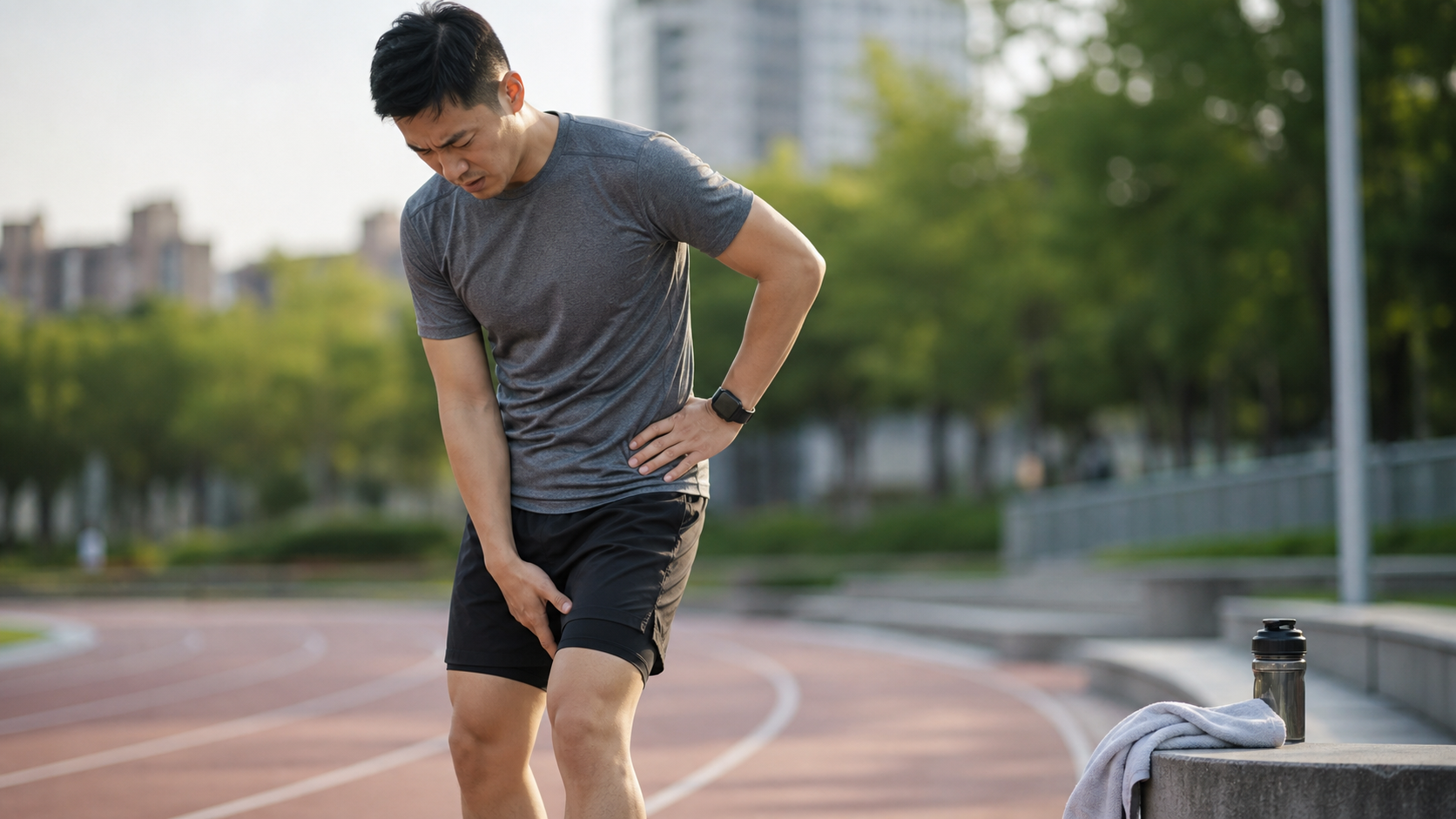
During speed work, hill sprints, or in the fatigued gait of the late stages of a marathon, you suddenly feel a “pulled” pain in the groin or front of the thigh—this is the classic presentation of a hip flexor strain. While less common than knee or calf issues among road runners, when it does occur, it often catches runners off guard and forces them to stop training before important races.
The hip flexor group comprises several muscles, with the iliopsoas (the primary hip flexor) and the rectus femoris (part of the quadriceps, responsible for both hip flexion and knee extension) being the most frequently injured. Understanding the characteristics of these two muscles is a prerequisite for proper rehabilitation.
Anatomical Characteristics and Injury Mechanisms
Iliopsoas Strain
The iliopsoas extends from the lumbar spine and ilium to the lesser trochanter of the femur, making it the strongest hip flexor in the body. During running, it is responsible for pulling the thigh forward during the swing phase, repeating this action thousands of times with every run.
Injury mechanisms:
- Sudden forceful exertion during rapid acceleration (e.g., the start of interval runs)
- Muscle fatigue after long-distance running, reducing its protective capacity
- Sudden high-intensity running in sedentary workers (whose iliopsoas is chronically shortened)
Rectus Femoris Strain
The rectus femoris is the only quadriceps head that crosses both the hip and knee joints. During the running kick motion, it must simultaneously extend the knee and flex the hip, making its biomechanical demands more complex.
Injury mechanisms:
- Most commonly occurs during kicking-style sprinting (e.g., the final acceleration in a short sprint)
- Downhill running places the greatest eccentric load on the rectus femoris
- Violent stretching when muscle flexibility is insufficient
Strain Severity Classification
| Grade | Degree of Damage | Symptoms | Estimated Time to Return to Running |
|---|---|---|---|
| Grade 1 (Mild) | Minor micro-tears of a few muscle fibers (< 10%) | Mild pain and tightness; can continue activity; no loss of strength | 1–2 weeks |
| Grade 2 (Moderate) | Partial muscle fiber tear (10–50%) | Significant pain, bruising; pain worsens with leg raises or resisted hip flexion; difficulty running | 3–6 weeks |
| Grade 3 (Severe) | Complete rupture (> 50%) | Severe pain; inability to actively flex the hip; visible indentation | 3–6 months (surgery may be required) |
Key Points for Differential Diagnosis
Related conditions that need to be ruled out:
- Groin strain (adductors): Pain is located on the inner thigh, not the front
- Femoral hernia: Localized lump in the groin that worsens with coughing
- Hip joint pathology: Deep pain that also occurs at night; requires MRI to rule out
- Osteitis Pubis: Bilateral groin pain with tenderness at the pubic symphysis
Acute Phase Management (Days 1–3)
- Stop running immediately to avoid further damage to muscle fibers
- Ice application: Apply to the affected area for 15–20 minutes every 2–3 hours for 48–72 hours
- Compression bandaging: Light compression with an elastic bandage on the front of the thigh to reduce swelling
- Resting position: Avoid excessive hip flexion (e.g., deep sitting positions); you can place a pillow under the buttocks
- If it is a Grade 3 strain: Seek medical attention immediately; arrange for an ultrasound or MRI to confirm the extent of the injury
What NOT to do: Massage within 48 hours of injury (may increase bleeding), forced stretching (increases the risk of tearing), and heat application (during the acute phase).
Progressive Rehabilitation Plan
Days 1–5: Protection and Passive Movement
- Ankle circles in bed and isometric thigh contraction exercises (without producing movement, to reduce atrophy)
- Short-distance walking to maintain circulation; stop if pain exceeds 4 out of 10
Weeks 1–2: Active Range of Motion Recovery
- Supine hip flexion: Lying on your back, slowly pull the knee toward the chest until a slight tension is felt; it should not be painful
- Standing hip flexor gentle stretch: Low lunge position, feeling a slight stretch in the front of the hip; hold for 20 seconds
- Swimming or water walking: Perform active hip flexion movements with the assistance of buoyancy
Weeks 2–4: Strength Rebuilding
- Supine straight leg raises: Compare both sides to confirm the degree of weakness on the affected side
- Seated hip flexion leg raises: Sitting on the edge of a chair or table, raise the knee, gradually adding resistance with a resistance band
- Dynamic lunge training: Forward and backward steps, gradually increasing speed and stride length
- Hip extension strengthening: Glute bridges and hip extensions to ensure strength balance between the hip extensor and flexor muscle groups
Weeks 4–8: Functional Training and Return to Running
- Slow straight-line running: Gradually increase pace and observe the reaction in the groin area
- High knee drill: Running-specific movement training
- Resistance band running motion simulation: Standing with a band around the ankle, simulating the running leg swing motion
- Increase weekly mileage by no more than 10–15%; only progress when pain-free throughout
Long-Term Plan for Preventing Recurrence
Weekly preventive exercises to perform:
- Deep lunge stretches (to maintain hip flexor flexibility)
- Glute strengthening (gluteus maximus and medius to balance the hip flexors)
- Core stability training (pelvic stability to reduce compensation)
Practical Advice
Special note for sedentary workers: Many runners in Taiwan are office workers during the day, sitting for 8–10 hours, which chronically shortens the iliopsoas. It is recommended to get up and move for 5 minutes every hour, and to perform 5–10 minutes of dynamic warm-up before running (hip circles, walking lunges) rather than static stretching.
When to return to speed work: Only add speed training after running movements are pain-free and you can complete full sessions. Interval running intensity is the most likely stimulus to trigger a recurrence and should be the last training element to add back.
Conclusion
A hip flexor strain is an injury from which you can fully recover, but it requires respecting the timeline of muscle repair. Appropriate protection during the acute phase, combined with a systematic rehabilitation plan, can get you back to training within 4–8 weeks. Through long-term strengthening and flexibility maintenance, you can make this muscle—the one that powers your acceleration—even stronger.
Related Reading
- Runner’s Hip Flexor Strain: Complete Guide to Causes, Rehab Exercises, and Return to Training
- Runner’s Hip Flexor Strain and Iliopsoas Syndrome: Complete Plan for Anatomical Principles, Diagnosis, Stretching, and Strengthening
- Tight Hip Flexors When Running: Causes, Effects, and Complete Stretching Methods
- Runners with Tight Hip Flexors: Causes, Assessment, and Stretching Prescriptions
一日北高/長距離團騎 常見問題補充篇 / 組團或跟團的眉角 / 壯車友容易被瘦車友慢性拉爆 / 原來屁股痛可能是這個原因...? / 風場配速法 / 公路車 / CT Yeh
2 年前
爬陡坡被爆胎的車友跑步超車 #cycling #里佳部落
9 個月前
iPhone內建一秒變長腿🤣 車友必備#cycling
2 年前
西進武嶺 免費訓練分析服務 Intervals | 練不夠還是練過頭?你哪一種類型選手?AI模型告訴你! | 備戰神器 | 公路車 訓練 | CT Yeh
4 年前
摔車後補裝備: 好市多新款單車安全帽& Specialized Romin 北高整路屁股都不痛的坐墊 | 一千元居然有MIPS | CT Yeh | 公路車
4 年前
Never Stop 西進武嶺 前後雙機 完整全程錄影 訓練台 實境
8 年前
Live) 備戰2019彰化經典百K 賽前攻略 (已完賽請看新影片
7 年前
CT 喇低賽) 武嶺牽車 才是王道 西進牽車四小時內秘訣 攝手位置 如何判斷 防抽筋小秘訣
7 年前