Introduction
In Taiwan’s winter, the north can experience weeks of continuous rain, the northeast monsoon brings strong winds along the coastline, and with darkness falling by 5 PM, many commuting cyclists find themselves unable to ride outdoors for 4–5 months. Every spring, a group of riders laments, “I didn’t train in winter, and my fitness has dropped so much in spring.”
But skipping winter training entirely isn’t an option either—if you completely stop aerobic training for more than 2–3 weeks, your aerobic capacity begins to decline; after 4–6 weeks off, FTP may drop by 5–10%; and after more than 8 weeks off, the fitness accumulated over the previous season is nearly wiped out. This is the purpose of “winter maintenance training”: not to reach your peak in winter, but to preserve the gains built during summer and autumn, and to lay a new foundation for next spring.
Redefining Winter Training Goals
Winter training is fundamentally different from in-season training:
| Aspect | In-Season (Spring/Summer) | Winter Maintenance |
|---|---|---|
| Training Goal | Achieve peak performance | Maintain aerobic base, prevent regression |
| Intensity Focus | High-intensity intervals, threshold | Low-intensity aerobic (Zone 1–2 primarily) |
| Weekly Training Volume | 8–12 hours | 5–7 hours |
| Mindset | Competitive, breakthrough | Recharge, enjoy, recover |
Embracing the mindset that “winter is not the season for breakthroughs” can actually help you avoid overtraining and gives both body and mind a necessary rest period.
Indoor Trainers: The Core Winter Equipment
Advantages of Smart Trainers
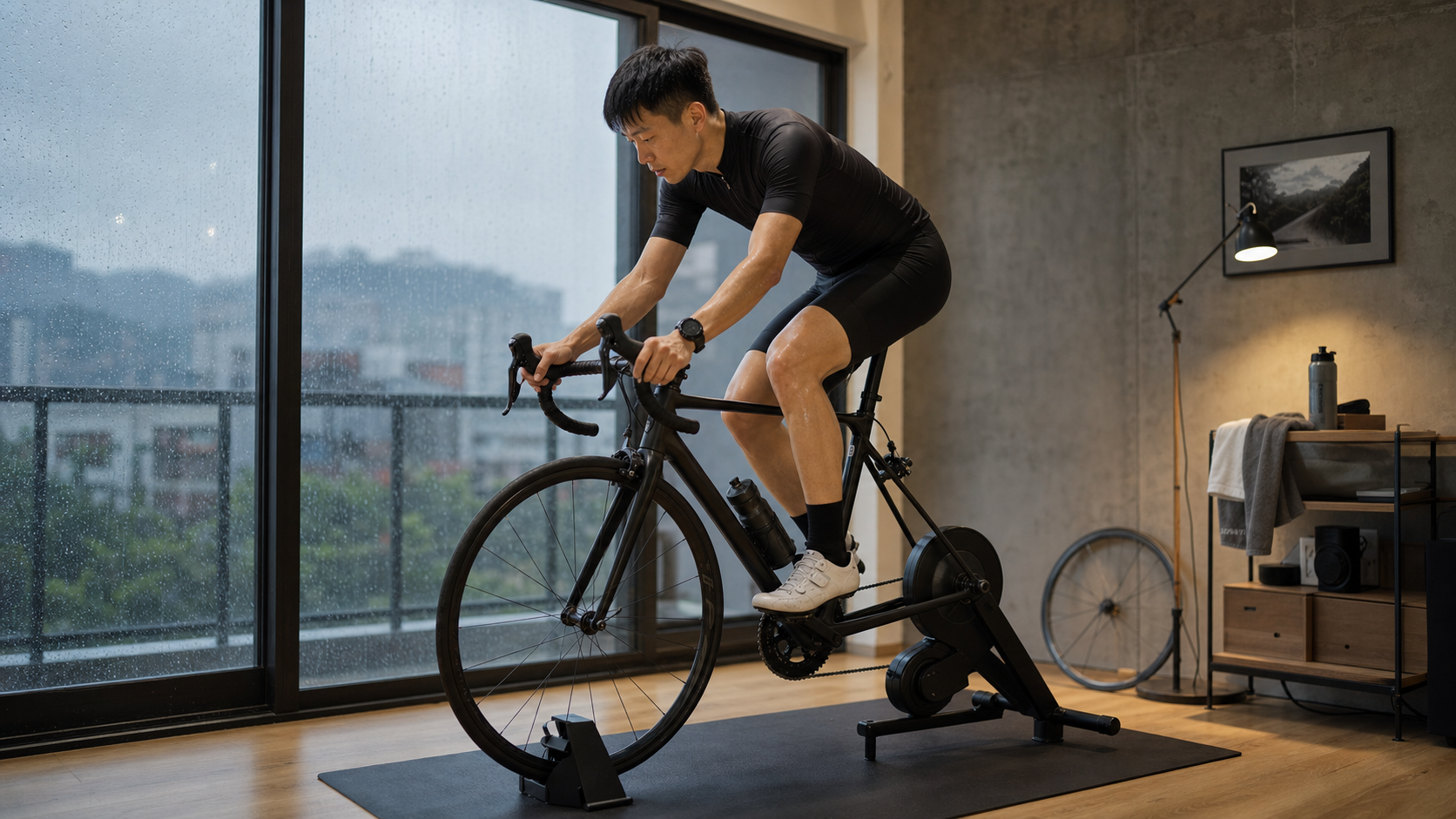
Smart trainers commonly available in the Taiwanese market (Wahoo KICKR, Tacx NEO, Elite Direto, etc.) have become indispensable equipment for modern amateur cyclists. The advantages of using a trainer in winter:
- Rain and wind protection: Unaffected by Taiwan’s rainy winter weather
- Efficient training: 45–60 minutes of indoor training equals the pedaling effect of 90 minutes outdoors (no red lights, no downhill coasting)
- Precise intensity control: Paired with TrainerRoad or Zwift, perfectly executing power-based workouts
- Safety: No need to ride on dark, wet roads
Recommended Winter Indoor Training Workouts
Tuesday (45-minute Sweet Spot):
- 10-minute warm-up
- 2×12 minutes SST (90% of FTP), 5-minute recovery between intervals
- 8-minute cool-down
Thursday (60-minute Aerobic):
- Zone 2 throughout (60–75% of FTP)
- Watch a show or listen to a podcast to keep the low-intensity ride from getting boring
Saturday or Sunday (depending on weather):
- Good weather: 2–3 hour outdoor aerobic endurance ride (Zone 2)
- Bad weather: 60–75 minutes indoors, with a small amount of tempo riding (Zone 3)
Outdoor Training Adjustments for Winter
Outdoor riding in Taiwan’s winter isn’t impossible—it just requires more preparation:
Timing: Choose windows with relatively good weather (forecast with no rain, wind speed under 5 m/s). Winter in central and southern Taiwan is relatively drier, so riders in Kaohsiung, Tainan, and Pingtung can maintain a better frequency of outdoor training.
Equipment Upgrades:
- Full-finger gloves, long-sleeve bibs (or leg warmers)
- Windproof vest or light jacket (especially for descents after climbs)
- Front and rear lights (short winter daylight means it’s dark by 5 PM)
- Waterproof shoe covers (essential for riding in the rain)
Route Selection: Avoid high-altitude routes in winter (extremely low temperatures in mountainous areas, dangerous descents), and opt for flat roads or low-altitude hills instead. In Taipei, consider the Dahan River riverside path; in Hsinchu, the Touqian River bike path; in Taichung, the Dajia River route.
Winter Opportunities for Physical Improvement
With reduced training volume in winter, it’s actually a great time to address issues outside of cycling:
Core Strength Training: Cycling primarily uses the legs and cardiovascular system, with the core receiving less direct work. In winter, add 2–3 core sessions per week (planks, bridges, Russian twists) to improve stability and reduce lower back pain come spring.
Flexibility Improvement: Cycling causes tightness in the hip flexors, hamstrings, and chest muscles. Winter is an ideal time for systematic stretching. Two to three sessions of yoga or static stretching per week will make your riding position more comfortable and efficient next spring.
Old Injury Rehabilitation: Old injuries in the knees, hips, and ankles may have been nagging during the cycling season, but you put them off because you “didn’t want to skip training.” Reducing training volume in winter, combined with physical therapy or strength training, is the best time to rehabilitate old injuries.
Maintaining Motivation in Winter
Declining training motivation is the biggest challenge of winter. Here are a few ways to stay motivated:
- Set next year’s goals: Establish your race or challenge targets for next year during winter (e.g., “complete Wuling by the end of May”), turning abstract motivation into concrete plans
- Join Zwift or RGT communities: Online virtual riding platforms provide a sense of competition and social interaction, keeping indoor training from becoming monotonous
- Log every session: Use Garmin Connect or Strava to record every winter ride; visually tracking your training history helps maintain the habit
- Training partners: Recruit friends to train indoors together (trainers set up in the same space, or ride together online on Zwift)
Practical Advice
Three principles for creating a winter training plan: First, reduce training volume but don’t drop to zero; second, maintain a habit of at least 3 rides per week; third, focus training on the aerobic base rather than high intensity. Follow these three principles, and your spring will start from a higher point.
Conclusion
The results of winter training are only visible in spring. Every time you choose to get on the trainer on a rainy day, every time you put on your bibs while the wind blows outside, you’re making an early investment in next spring’s self. Taiwan’s winter isn’t long, but use it well, and your cycling career can progress steadily on a year-by-year basis.
Related Reading
- Winter Training: Off-Season Conditioning Plans for Taiwanese Cyclists
- Building Base Aerobic Mileage for Cyclists: The Importance of Winter Long-Distance Training
- Cross-Season Training for Cyclists: Maintaining Base Fitness in Winter
- The Importance of Winter Base Training: Why Your Aerobic Foundation Determines Your Ceiling
一個測試有沒有認真練車的方法😂 #公路車
10 個月前
一日北高/長距離團騎 常見問題補充篇 / 組團或跟團的眉角 / 壯車友容易被瘦車友慢性拉爆 / 原來屁股痛可能是這個原因...? / 風場配速法 / 公路車 / CT Yeh
2 年前
一日北高 11小時 賽後心得分享篇 | TWB北高360 | 一日雙城 | 單車 | 公路車
6 年前
一日北高常見問題大集合 | 攻略 | 路線 | 訓練 | 補給 | 自行車 單車 | 一日雙城 | 雙塔 | TWB北高360 | 屁股痛
6 年前
CT暗黑廚房) 車友必備 宇宙無敵鮮蚵湯 幫助訓練恢復 天然食補 好市多 超肥鮮蚵 破PR
7 年前
備戰 戀戀197 賽前關門點分析 西濱團練 #公路車 4K高畫質
6 年前
碟煞公路車 優缺點?換車一年半實際經驗分享 / 公路車 / CT Yeh
2 年前
JJSC南台灣單車走春三日行 DAY 1 / 強度 x 美食 x 節慶體驗 / 公路車 CT Yeh
5 個月前