Introduction
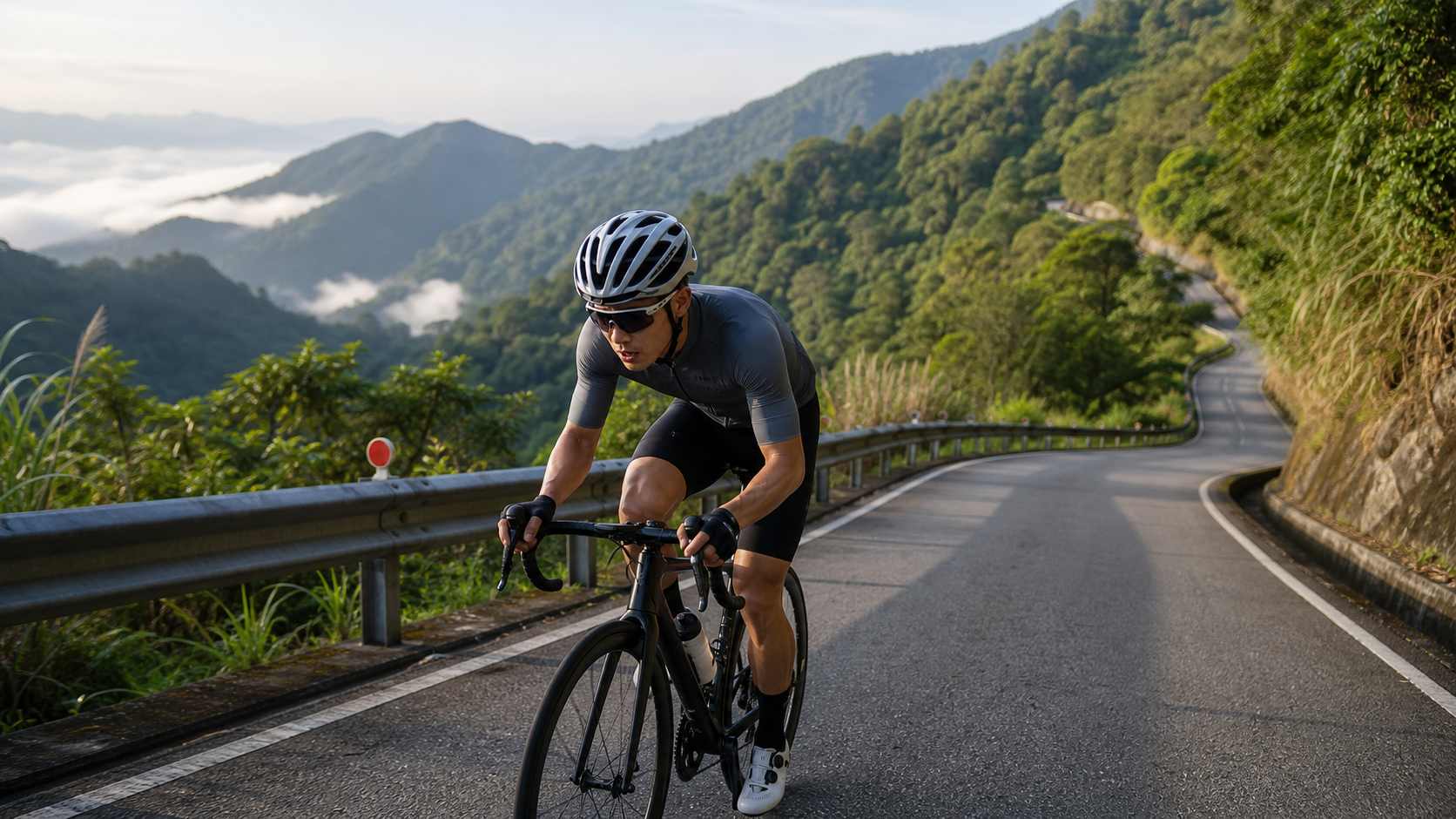
Taiwan is a paradise for climbing training. From Yangmingshan and Pinglin in the north to Alishan and Wutai in the south, countless mountain roads await riders to conquer. However, many cyclists approach climbing training in a monotonous way: every time they go uphill, they just “ride as fast as possible,” and once they descend, they consider the workout done. This approach does work, but it is far less efficient than a well-designed segmented intensity training plan.
The art of long-climb training lies in this: different climbing segments at different intensities train different physiological systems, and proper combination allows every climb to deliver maximum training benefit.
Understanding the Characteristics of Taiwan’s Long Climbs
Taiwan’s mountain roads have several notable characteristics that influence training design:
| Characteristic | Description | Training Impact |
|---|---|---|
| Highly variable gradients | The same road can have 3% gentle sections and 15% steep sections | Makes it difficult to maintain constant power |
| Large elevation gains | Wuling climbs 3,200 meters from Puli to the summit | High-altitude hypoxia effects |
| Complex road conditions | Some mountain roads have rockslides and potholes | Affects focus allocation |
| Long distances between aid stations | Supply points are inconvenient in high mountain areas | Requires planning food to carry in advance |
| High technical demands on descents | Steep drops with continuous hairpin turns | Descents consume cognitive resources |
Three Main Training Types for Segmented Intensity Climbing
Type 1: Steady State Climbing
Best suited for: 2–5% gentle slopes (e.g., Pingjing Street in the north, the early section toward Cingjing in central Taiwan)
Intensity: Sweet Spot (88–94% of FTP) or Threshold (95–105% of FTP)
Execution: Choose a gentle slope that can be climbed continuously for 10–30 minutes. Maintain a steady power output or an intensity that leaves you slightly breathless but not falling apart, keeping the same rhythm from start to finish.
Training effect: Improves lactate threshold; this is the most “efficient” type of climbing training.
Notes: The core challenge of steady state climbing is “pacing discipline”—when it feels too easy in the first 15 minutes, resist the urge to accelerate, because fatigue in the latter half will naturally push the intensity up.
Type 2: Gradient Simulation Intervals
Best suited for: Mountain roads with pronounced gradient changes (e.g., Wuling’s alternating steep and gentle sections)
Execution:
- Sections below 5% gradient: maintain Sweet Spot or Threshold power
- Sections at 8–12% gradient: allow power to rise into the VO2max zone (106–120% of FTP), but do not exceed 2–3 minutes
- Sections above 12% gradient: switch to out-of-saddle climbing, go all-out but briefly
- Flat recovery sections: Zone 2 recovery, refuel
Training effect: Simulates the power fluctuations of a real race, training the body’s ability to switch quickly between different intensities.
Type 3: Short Steep Efforts
Best suited for: Short steep climbs above 10% gradient (e.g., certain sections of Jiufen in the north, Yuemei Mountain in the south)
Execution: Sprint up a short steep climb at near-maximal effort (90–100%) for 30 seconds to 2 minutes, then recover by riding back down or on flat roads. Repeat 4–8 times.
Training effect: Improves anaerobic capacity, explosive power, and out-of-saddle climbing technique. Particularly useful for the short, steep sections in the final kilometers of Wuling.
Recommended Long-Climb Training Routes Across Taiwan and Their Corresponding Types
Northern Region
| Route | Distance/Elevation Gain | Suitable Training Type | Notes |
|---|---|---|---|
| Pingjing Street Lane 45 | 9km/750m | Steady State Climbing | Consistent gradient, ideal for threshold training |
| Beiyi Highway (Pinglin section) | 15km/600m | Gradient Simulation Intervals | Rolling gradients, ideal for race simulation |
| Fengguizui (Beitou section) | 6km/450m | Steady State + Short Steep | Steady at the start, steep at the end |
Central Region
| Route | Distance/Elevation Gain | Suitable Training Type |
|---|---|---|
| Cingjing Farm (starting from Wushe) | 25km/1200m | Steady State Climbing (long version) |
| Wuling early section (Cuifeng) | 30km/1600m | Gradient Simulation Intervals |
Southern Region
| Route | Distance/Elevation Gain | Suitable Training Type |
|---|---|---|
| Alishan Highway (Chiayi section) | 45km/2400m | Long-distance Steady State Climbing |
| Tengzhi Forest Road | 20km/1000m | Short Steep Intervals |
Technical Elements of Climbing Training
Cadence selection: Many riders habitually push a big gear at a slow cadence (60–70rpm) when climbing, which places greater stress on the knees and depletes muscular strength faster. It is recommended to maintain a cadence of 75–85rpm, using a lighter gear to sustain rhythm.
Seated vs. out-of-saddle climbing: Seated climbing is more efficient and can be sustained for longer periods; out-of-saddle climbing has an advantage on gradients above 10% or during sprint climbs, but you need to return to a seated position to recover after each out-of-saddle effort. Learning to switch between both techniques and alternating them on long climbs helps distribute muscular fatigue.
Breathing rhythm: Consciously controlling your breathing rhythm while climbing (e.g., inhaling over two pedal strokes, exhaling over two pedal strokes) helps stabilize power output and prevents erratic breathing from causing intensity to spiral out of control.
Practical Advice
Make good use of Strava’s Segment feature: Most of Taiwan’s popular climbing routes have already been marked on Strava, allowing you to track your improvement curve and compare yourself with other riders. Checking your segment times after each workout is an effective way to maintain training motivation.
Plan your refueling in advance: Confirm you have enough food and water before heading up the mountain. Supply points are scarce in Taiwan’s mountain areas, so carrying 2 bottles of water and 3–4 food items (energy gels, bananas, salty rice cakes) is the basic setup for long-climb training.
Conclusion
Taiwan’s mountainous terrain is your best training ground, but only by using the right methods will every ride uphill bring the greatest training returns. Whether your goal is breaking 6 hours at Wuling, improving your KOM segment ranking, or simply enjoying the joy of conquering climbs—segmented intensity design can make every climb you do more meaningful.
Related Reading
- Climbing Endurance Training: Sustained Output on Long Climbs and Cardiorespiratory Adaptation
- Road Bike Climbing Strategy: Precise Pacing and Mental Segmentation for the Full 3,275-Meter Wuling Climb
- Analysis of Taiwan’s Cycling Training Environment: Routes and Time Slots Best Suited for Various Training Purposes
- Climbing Interval Training: Designing a 5×5-Minute Climbing Workout Using Taiwan’s Mountain Roads
一個測試有沒有認真練車的方法😂 #公路車
10 個月前
單車 梅山36灣 坡度介紹 路段介紹 空拍 (相關遊記影片,請參考說明或我的頻道喔,歡迎訂閱)
6 年前
大禹嶺 到 武嶺牌樓 全程前後實況錄影 | 北進武嶺 | 東進武嶺 | KOM | 訓練台 | 坡度分析 | Taiwan KOM Last 10 km HARD | 公路車
6 年前
#公路車 #西進武嶺 配速配瓦實驗 坡度分析 四小時內攻略 建大盃 NeverStop #西進武嶺攻略
6 年前
大武山後門26%歡樂陡坡!JJSC南台灣單車行Day2 / 被颱風追著跑 / 公路車 / CT Yeh
2 年前
藤枝二集團 單車行 Day1 | 南部小武嶺 | 爬坡爬到罵罵叫 | JJSC | 公路車 | CT Yeh
3 年前
#北橫 + #北進武嶺 最硬的員工旅遊 EP1 | #公路車 #拉拉山 | 明池 | 武嶺 | 武陵農場 | 雲海 | Taiwan Cycling Route Wulin
6 年前
爬坡ITT實境)台中 魔王 松鼠坡 首航 6:12 大肚山 大三元 科福路
8 年前