Introduction
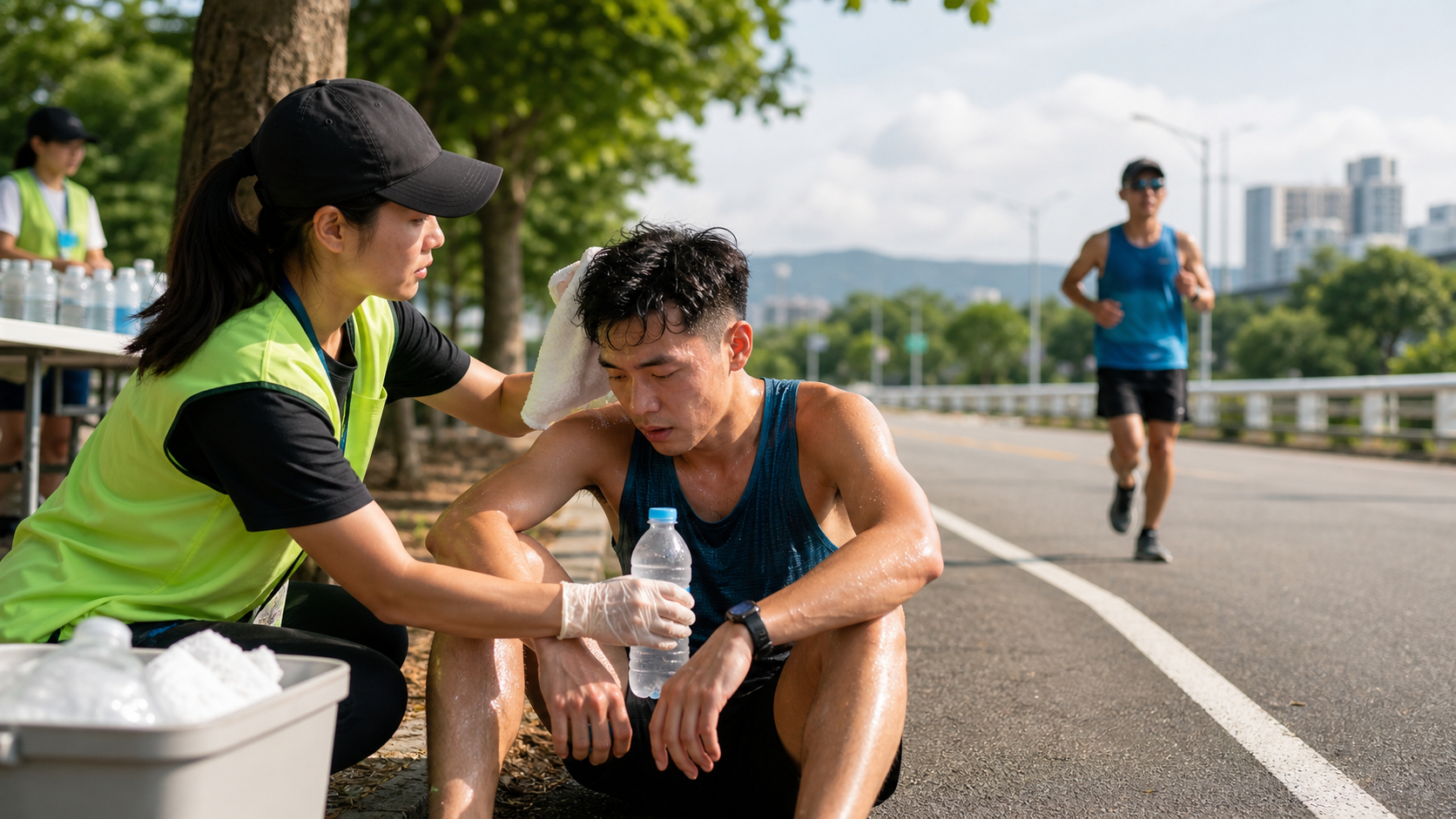
At the 2023 Taipei Marathon, with temperatures exceeding 26°C combined with high humidity, medical personnel were busy all day; at the annual Wan Jin Shi Marathon and Tanaka Marathon, heat-related injuries are the most common emergency cases at medical stations. Taiwan’s hot and humid summer environment poses a real health threat to road runners.
Heat-related illness is a continuous spectrum: from mild heat cramps, to heat exhaustion, and in the most severe cases progressing to “Exertional Heat Stroke” (EHS)—a life-threatening medical emergency with a mortality rate exceeding 60% if cooling is not initiated promptly.
Classification and Symptoms of Heat-Related Illnesses
| Type | Core Body Temperature | Main Symptoms | Mental Status |
|---|---|---|---|
| Heat Cramps | Normal | Muscle cramping (especially calves, abdomen) | Normal |
| Heat Exhaustion | 37–40°C | Profuse sweating, dizziness, nausea, headache, pale and clammy skin | Normal or mildly confused |
| Heat Stroke | > 40°C | Skin may be dry and hot or still sweaty, confusion, disorientation, coma | Markedly confused or loss of consciousness |
The most important distinguishing point: Heat stroke is characterized by central nervous system dysfunction (confusion, slurred speech, abnormal behavior). Any runner who exhibits altered consciousness after exercising in a hot environment should be treated as a heat stroke emergency.
Why Is Taiwan’s Summer Particularly Dangerous?
The human body relies on sweating to dissipate heat, but the efficiency of sweating depends on the environment’s “wet-bulb temperature”—the higher the humidity, the harder it is for sweat to evaporate. During Taiwan’s summer (May–September), relative humidity often reaches 70–85%. Even when the air temperature is “only” 30°C, the perceived temperature can exceed 38°C, making heat dissipation extremely inefficient.
High-risk situations (Taiwan scenarios):
- Running on west-facing sections of road after 8 AM
- Competing after several consecutive days of insufficient sleep or after alcohol consumption
- Participating in a summer road race for the first time without completing heat acclimatization training
- Individuals with cardiovascular disease or diabetes
- Those taking diuretics, antihistamines, or certain cardiac medications (which affect heat dissipation)
Heat Acclimatization
The body can adapt to hot environments through a process called “heat acclimatization,” which requires approximately 10–14 days. Physiological changes after acclimatization include: increased plasma volume, a lower sweating threshold, and decreased electrolyte concentration in sweat.
Progressive heat acclimatization plan:
- Days 1–5: Run at low intensity at 60–70% of maximum heart rate for 60–90 minutes in the heat
- Days 6–10: Maintain the same duration, gradually incorporating moderate-intensity training
- Days 11–14: Resume normal training intensity, but still pay attention to fluid replenishment
Entering a summer race without completing heat acclimatization is one of the most common causes of heat stroke.
Emergency Treatment
On-Site Management of Heat Exhaustion
- Immediately move to a shaded, well-ventilated area or an air-conditioned room
- Lie flat and elevate the legs (unless nauseated or vomiting)
- Remove excess clothing and wipe the skin with a wet cloth or spray with water
- If conscious, replenish with an electrolyte-containing drink (sports drinks are better than plain water)
- Monitor symptoms; seek medical attention if there is no improvement within 30 minutes
Emergency Management of Heat Stroke (Can Be Performed On-Site)
The golden rule for heat stroke: “Cool First, Transport Second”
- Call 119 immediately
- The most effective cooling method: Cold Water Immersion—immerse the patient’s entire body (except the head) in cold water (10–15°C) or a tub with plenty of ice. The goal is to lower core body temperature to below 38.5°C within 30 minutes
- If cold water immersion is unavailable: apply large ice packs to the neck, armpits, and groin (areas with major blood vessels), and continuously fan the patient
- Do not wait for the ambulance to arrive before starting cooling—every minute of delay increases the risk of brain damage
Safety Guidelines for Summer Road Running in Taiwan
Hydration strategy:
- Drink 500 mL of water 2 hours before running
- Drink 150–250 mL every 15–20 minutes; do not wait until thirsty
- For runs exceeding 60 minutes, replenish electrolytes (to avoid hyponatremia)
- For every 1 kg of body weight lost after a run, replenish with approximately 1.5 liters of fluid
Training schedule:
- In summer, train as much as possible before 6 AM or after 6 PM
- Avoid the high-temperature window from 10 AM to 3 PM
- If midday training is unavoidable, choose routes with tree shade (such as Taipei Daan Forest Park or the Botanical Garden)
Clothing recommendations:
- Light-colored, breathable, moisture-wicking fabrics
- Loose-fitting cuts; avoid tight clothing that impedes heat dissipation
- Wear a sun visor, but make sure it does not obstruct heat loss from the head
Practical Advice
Pre-race self-assessment: Monitor hydration status using urine color. Dark yellow (beer-colored) urine indicates severe dehydration and training should be postponed; pale yellow to nearly clear indicates adequate hydration.
Aid station strategy: At summer road races in Taiwan, drink water at every aid station, even if you are not thirsty. Additionally, placing ice cubes in your cap or on the back of your neck to cool down is more effective than drinking more water.
Conclusion
Summer road running in Taiwan is beautiful yet hot, and safety is always the top priority. Recognizing the symptoms of heat-related illnesses, building a solid heat acclimatization foundation, and mastering the “cool first” principle of on-site emergency care are essential knowledge for every Taiwanese road runner before enjoying summer races.
Related Reading
- Heat Injury in Summer Running in Taiwan: Prevention and Emergency Management of Heat Stroke and Heat Exhaustion
- Summer Heat Injury in Taiwan: Emergency Response for Runner Heat Stroke and Heat Exhaustion
- High-Temperature Heat Stroke Warning Signs and Rescue: The Red Line Guide for Runners’ Summer Training
- Exertional Heat Exhaustion and Heat Stroke: Advanced Warning Signs from Core Temperature 38.5°C to 41°C
單車 一日北高 ( 雙城 ) 肥宅雙人瘋狂行 紀錄片 REACTO
10 年前
CT暗黑廚房) 車友必備 宇宙無敵鮮蚵湯 幫助訓練恢復 天然食補 好市多 超肥鮮蚵 破PR
7 年前
2023 夏季KOM 參賽實況 / 穿越空拍視角 / 整車都凸台 / 太魯閣峽谷x合歡山絕美大景 / 東進武嶺 / Taiwan KOM Challenge / 公路車 / CT Yeh
3 年前
水金九不厭五分 10度寒流冷到不願停!feat. 卡卡 / 公路車 / CT Yeh
6 個月前
TBA 北高360 逆風爆熱再送空汙 苦行挑戰賽全記錄 4K沈浸式臨空畫質| 公路車 | CT Yeh
3 年前
2018 田中馬拉松 全程健跑 VR 360 環景錄影 體驗現場狂野加油氣氛! Insta 360
7 年前
台灣旅行團參加 第7回まえばし赤城山ヒルクライム大会 雙視點
8 年前
台灣登山王之路 KOM 全程參賽4K臨空錄影 PART1 穿越峽谷地形! #東進武嶺 太魯閣 / 燕子口 / 天祥 / 西寶 PART1 (公路車 / CT Yeh)
3 年前