Introduction
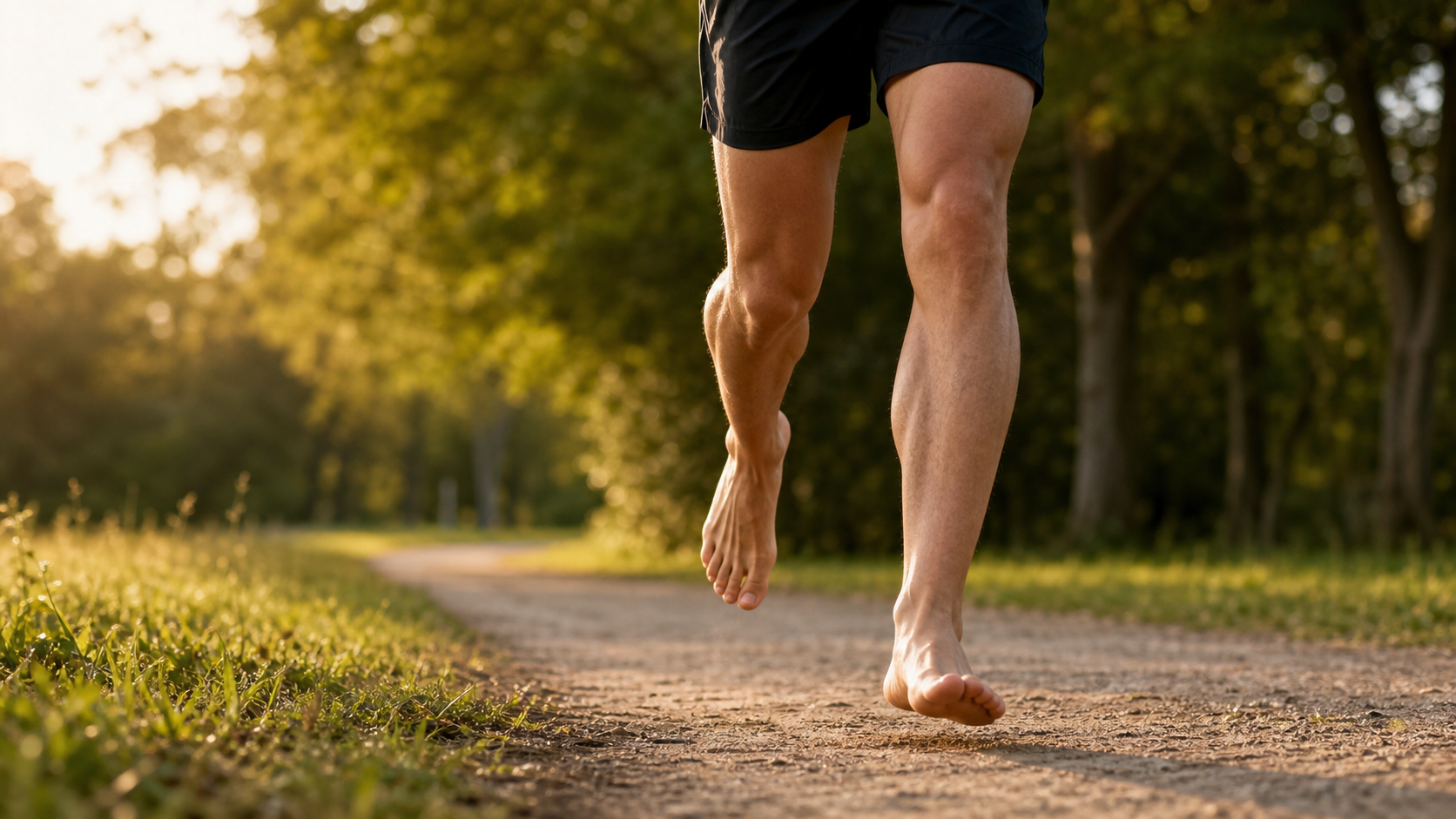
In 2009, the book Born to Run sparked a revolution in the running world, turning “barefoot running” and “natural running” into hot topics. Subsequently, major brands launched the Vibram FiveFingers and various minimalist running shoes, spreading this trend among runners worldwide.
More than a decade later, scientific research on barefoot training has accumulated considerably. The answer is not simply “good” or “bad,” but rather “for whom, and under what conditions” it is beneficial.
Biomechanical Differences in Barefoot Running
Runners wearing conventional running shoes typically land with a “heel strike,” while barefoot or minimalist shoe runners usually naturally transition to a “forefoot strike” or “midfoot strike.”
Biomechanical impact of landing patterns:
| Landing Pattern | Heel Strike | Midfoot/Forefoot Strike |
|---|---|---|
| Impact Force | High peak impact (peak force of approximately 1.5–2.5 times body weight) | Lower impact peak, but longer force application time |
| Knee Loading | Higher | Lower |
| Calf/Ankle Loading | Lower | Higher (Achilles tendon and plantar fascia require more preparation) |
| Energy Efficiency | Efficient with high heel-to-toe drop shoes | Comparable efficiency after full adaptation |
Key conclusion: Forefoot striking “reduces knee injuries” while “increasing the load on the calves and feet.” In other words, injury risk does not disappear—it shifts.
Potential Benefits of Barefoot Training
Benefits supported by science include:
- Strengthening intrinsic foot muscles: The supportive features of shoes allow the arch muscles to “slack off.” Barefoot running stimulates plantar proprioception, forcing the intrinsic muscles to work actively, which aids arch development and long-term prevention of plantar fasciitis
- Improving running form: Barefoot training helps runners naturally shorten stride length and increase cadence, reducing the tendency to overstride
- Proprioceptive training: The rich sensory nerve endings in the soles are limited in function when protected by shoes; running barefoot on grass or sand activates these neural pathways
- Enhanced ankle stability: Research shows that 6–8 weeks of barefoot training can improve dynamic ankle stability, helping prevent sprains
Risks and Precautions of Barefoot Training
High-risk scenarios:
- Abruptly transitioning from conventional running shoes to minimalist shoes or barefoot (high incidence of Achilles tendinitis and anterior shin pain)
- Running barefoot on hard surfaces (concrete, asphalt) (skin damage, excessive plantar loading)
- Attempting barefoot running during the acute phase of plantar fasciitis (worsens symptoms)
- Individuals with osteoporosis or a history of stress fractures (increased loading on the metatarsals or tibia)
Populations unsuitable for barefoot training:
- Diabetics (impaired foot sensation, unable to perceive injuries)
- Those with metatarsalgia or Morton’s neuroma
- Those with a history of calcaneal stress fractures
Strategies for Safely Transitioning to Minimalist Running
If you decide to try barefoot or minimalist training, “gradual transition” is the only safe approach:
Recommended 12-week transition plan:
- Weeks 1–2: Walk barefoot at home (hard floors) for 15–30 minutes daily to allow the plantar skin and muscles to begin adapting
- Weeks 3–4: Jog barefoot on grass or sand for 5–10 minutes (ideally on the lawn of Daan Forest Park in Taipei), keeping your regular shoe-based training schedule unchanged
- Weeks 5–8: Increase the proportion of barefoot/minimalist shoe training to 20–30% of total weekly mileage
- Weeks 9–12: Assess calf and plantar condition; if no discomfort, continue increasing the proportion
Important rule: While increasing barefoot training volume, total weekly mileage should remain unchanged or be reduced by 10–20% to give the body time to adapt.
Practical Considerations for the Taiwan Environment
Taiwan’s road running environment is predominantly concrete surfaces, limiting the practicality of running completely barefoot. Alternatives:
- Minimalist shoes: Provide basic protection while allowing a natural landing pattern, such as the New Balance Minimus or Merrell Trail Glove series
- Indoor barefoot training: Short barefoot sessions on a treadmill (mind the belt hygiene)
- Barefoot on the track: Rubber track surfaces are suitable for barefoot training, offering cushioning while being safer than concrete
Practical Recommendations
Prioritize intrinsic foot muscle strengthening: Before attempting barefoot running, perform 4–6 weeks of “short foot exercises” and towel curl exercises to ensure the plantar muscles are adequately prepared.
Listen to your body’s signals: During the first month of transitioning to minimalist running, if you experience forefoot or calf pain, immediately reduce volume. This is your body telling you the adaptation period is not yet complete—pushing through will only lead to injury.
Conclusion
Barefoot training is a tool, not a belief. For healthy adult runners, incorporating natural foot training in moderation can enhance foot function; but it is not a panacea, nor is it a training method suitable for everyone. Understanding your own physical condition and following the principle of gradual progression are the keys to truly reaping the benefits of barefoot training.
Related Reading
- Barefoot Running and Natural Running: Ground-Feel Training for Taiwan’s Climate
- The Relationship Between Running Shoes and Injuries: A Complete Analysis of Over-Supportive Shoes, Minimalist Shoes, and the Latest Shoe Selection Science
- Minimalist Shoes and Barefoot Running: Who Should Use Them and How to Transition Safely
- Forefoot vs. Heel Striking: Which Running Style Suits You?
#公路車 #Fitting 靠人工智慧APP 幫你調整單車
6 年前
大家都在開箱的...單車用藍芽對講耳機真的有幫助嗎? SENA BiKom 20 長距離旅遊 & 海鷗繞圈賽 實際體驗心得 / 公路車 / CT Yeh
9 個月前
用了AirTag 單車就不怕被偷?盲點大測試 結果… |公路車|CT Yeh
5 年前
單車元宇宙新霸主?TrainingPeaks Virtual 實測 / Zwift 完美平替? 還是超越?/ 有台灣國旗!前身 indieVelo / 公路車 / CT Yeh
1 年前
單車AI教練!全新 ChatGPT4o 幫你分析訓練成果!排武嶺課表,分析騎車姿勢! 太神了! / 公路車 / CT Yeh / feat. 緯緯
2 年前
西進武嶺 免費訓練分析服務 Intervals | 練不夠還是練過頭?你哪一種類型選手?AI模型告訴你! | 備戰神器 | 公路車 訓練 | CT Yeh
4 年前
3D 列印車褲墊 / 舒適改善? / 無痕 x 分區壓縮 / ATK & Decider系列 / JE22黑科技 / #公路車 #CTYEH
11 個月前
Fitting訓練兩用功率車 ! Thinkrider ST900 完整實測!/ 坡度升降 / 鄰居測試/ smart bike/公路車/ CT Yeh
2 年前