Introduction
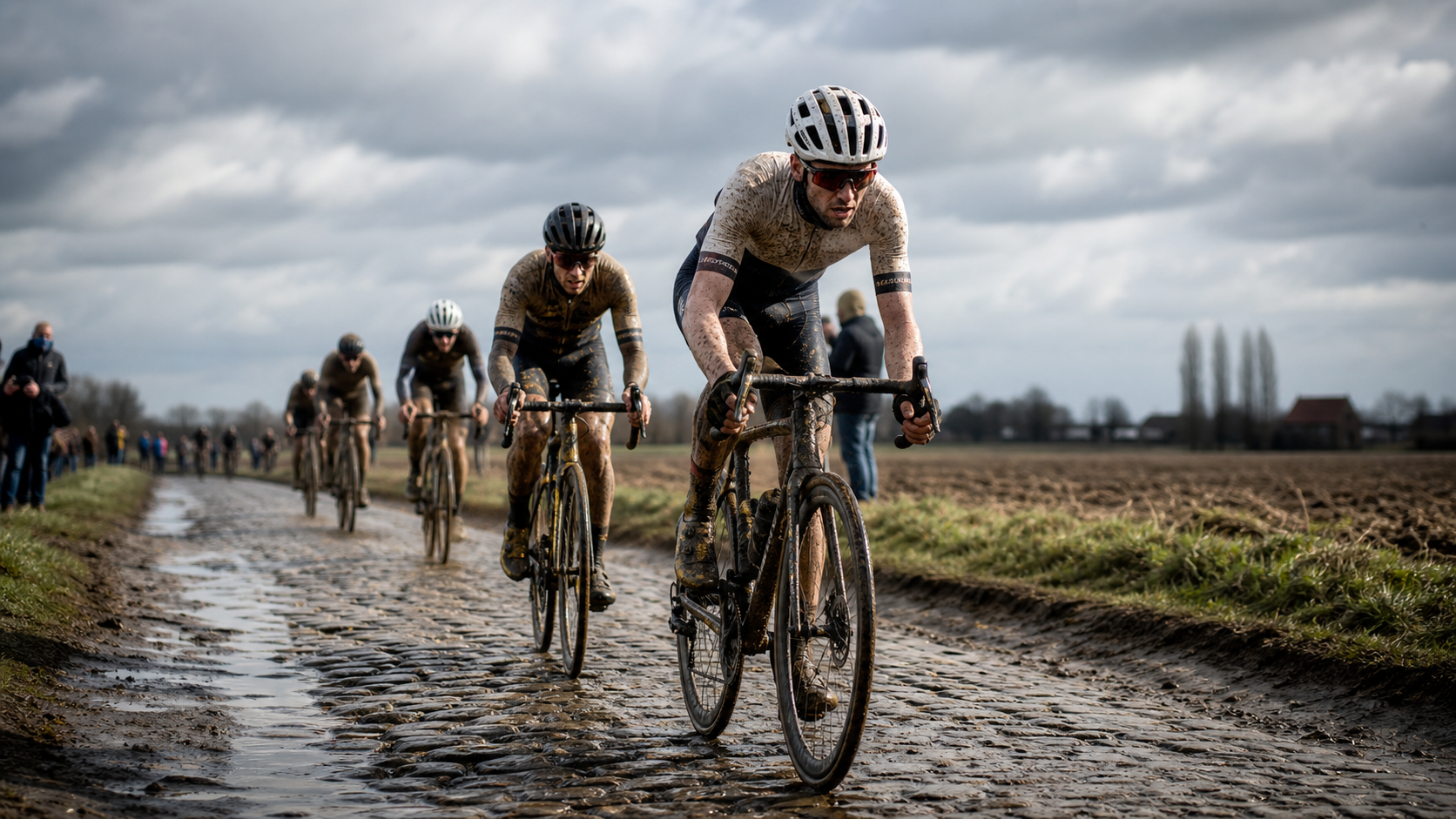
Every spring, the cobblestones (known as “Pavé” in French) of Belgium and northern France bear witness to the most brutal battles in professional cycling. Paris-Roubaix and the Tour of Flanders (commonly known as “De Ronde”) are the two races among the Spring Monuments that riders both love and hate the most. These races are not decided by power-to-weight ratio, but by technique, explosive power, mechanical judgment, and mental toughness.
The Test of the Cobblestones
Paris-Roubaix
Founded in 1896, Paris-Roubaix covers approximately 257 kilometers, including about 55 kilometers of cobblestone sections spread across multiple “Sectors,” marked with a star-based difficulty rating:
| Sector | Length | Difficulty |
|---|---|---|
| Carrefour de l’Arbre | 2.1km | ⭐⭐⭐⭐⭐ (Highest difficulty) |
| Mons-en-Pévèle | 3.0km | ⭐⭐⭐⭐⭐ |
| Wallers-Arenberg | 2.4km | ⭐⭐⭐⭐⭐ |
| Haveluy | 2.5km | ⭐⭐⭐⭐ |
| Remaining sectors | Varies | ⭐⭐⭐ to ⭐⭐ |
The jarring vibration of the cobblestones causes significant fatigue to accumulate in riders’ hands, arms, and lower back, while mud and rain in the gaps between stones drastically reduce tire grip.
Tour of Flanders
The Tour of Flanders covers approximately 273 kilometers, with its defining feature being multiple short, steep cobblestone climbs:
- Koppenberg: A cobblestone climb with gradients up to 22%, requiring sheer pedaling force to conquer
- Paterberg: The key climb before the final sprint, with a 20.3% gradient
- Oude Kwaremont: A 3.7-kilometer cobblestone climb, a common launching point for tactical breakaways
- Kapelmuur (Muur van Geraardsbergen): The most historic symbolic climb, though no longer part of the recent official route
Core Tactical Analysis
Equipment Strategy
The equipment demands of cobblestone races are completely different from those of regular road races:
Tire Selection:
- Tire width increases from the standard 25mm to 28–32mm
- Tire pressure drops significantly to 40–60 psi (compared to roughly 80–90 psi for regular road races)
- Some riders use tubular tires to improve puncture resistance
Frame Selection:
- Use of specially designed frames with greater vibration absorption (such as Quick-Step’s design)
- Some teams use specially built cobblestone-specific bikes with wider tire clearance
Rider Preparation:
- Thicker gloves paired with vibration-damping handlebar tape
- Some riders receive local anti-inflammatory injections before riding (within legal limits)
Positioning
The fight for position before the entrances to cobblestone sections is the most intense moment:
- Get to the front before entering the cobblestones: Before each cobblestone sector entrance, the whole team must secure a position in the top 10–20
- Avoid being trapped at the back of the bunch: Overtaking on cobblestones is extremely difficult; falling behind means giving up
- Choose the dry edge: The sides of the cobblestone roads are often smoother than the middle, but also narrower, requiring skill
Attack Timing
- Flanders’ “Golden Triangle” attack point: The consecutive hard climbs of Oude Kwaremont and Paterberg are the best attack zones
- Roubaix’s Arenberg Forest: This hardest cobblestone section often causes mass gaps, creating decisive time differences
- Decisive breakaway: Top professionals tend to launch a solo attack 40–80 kilometers from the finish, rather than waiting for a final sprint
Historical Cobblestone Heroes
These two races have produced a generation of “Cobble Specialists”:
- Fabian Cancellara: 3-time Flanders and 3-time Roubaix champion, known as the “King of the Cobblestones”
- Tom Boonen: 4-time Roubaix and 2-time Flanders champion
- Peter Sagan: Slovakian all-rounder, first Roubaix title in 2018
- Mathieu van der Poel: Dutch superstar, sweeping the Spring Classics in recent years
Analogies to Taiwan’s Road Conditions
Although Taiwan has no cobblestones, certain road conditions can serve as comparable practice:
- Beitou Shipai Section Old Road: Some sections feature uneven brick and stone surfaces
- Old mountain cobblestone paths: Such as historic trail sections around Taipei’s Maokong and Nantou’s Cingjing
- Sand or gravel road practice: Helps train bike handling skills on unstable surfaces
Practical Advice
Riding techniques Taiwanese cyclists can learn from the Spring Classics:
- Lower tire pressure for road conditions: Try reducing pressure by 2–5 psi when encountering uneven surfaces
- Relax your upper body: The most important thing on cobblestones is letting your arms act as a “natural shock absorber”
- Maintain pedaling rhythm: Keep a steady cadence on uneven surfaces; don’t interrupt it due to impacts
- Take position early: In any race or group ride, securing position before key sections is an essential skill
Conclusion
Paris-Roubaix and the Tour of Flanders are the races in professional cycling that come closest to “pure instinct”: no complex tactical calculations, only life-and-death speed on the cobblestones. That image of fighting forward through the mud, that technical beauty of mastering chaotic surfaces—that is exactly why the Spring Classics drive millions of cycling fans around the world crazy.
Related Reading
司馬庫斯 | 單車員工旅遊 | 比武嶺還接近上帝的路 | 2021 全面實況 路況解析 | 空拍 櫻花炸開超濃密 | 財伯觀光果園 | CT Yeh
5 年前
微雨戰! 2022桃園市長盃錦標賽 無敵交管 沒來玩太可惜了! 羅馬公路太可怕 差點成佛! 公路車 | CT Yeh
4 年前
一個測試有沒有認真練車的方法😂 #公路車
10 個月前
2024 如來神掌 百人約騎挑戰!feat. 秘境單車社團 / 神人們太可怕 / 全程錄影 x 完整坡度解析 / 公路車 / CT Yeh
2 年前
5 ℃ 櫻花之旅 / 75萬單車直接雨中洗車.../ 平菁街 / 北迴歸小隊 / 公路車 / CT Yeh
5 個月前
2024 春季KOM 賽事精華版 / 太魯閣 / 貓捉老鼠精彩追擊 / 錄影剪輯版 / 東進武嶺 / 公路車 (請開啟字幕)
2 年前
萬年峽谷! 30% 超激陡坡 里佳部落DAY2 還是很硬! | 公路車 | CT Yeh
3 年前
單車實況) 車測中心高速賽道 96 彰化讚 挑戰組一圈實錄 | ARTC
6 年前