Introduction
Many swimming enthusiasts who have practiced in pools for years yearn for the freedom of open water, yet feel uneasy about “water where you can’t see the bottom.” The biggest difference between open water swimming and pool swimming lies in the unpredictability of the environment—water temperature, currents, visibility, wave conditions, and the complete absence of walls to push off or rest on. This article will systematically explain how to safely and effectively transition from the pool to open water, suitable for Taiwanese readers trying sea or lake swimming for the first time.
Key Differences Between Pool and Open Water
| Item | Pool | Open Water |
|---|---|---|
| Visibility | Clear, bottom visible | Depends on weather and location, often below 1 meter |
| Water Temperature | Constant, approx. 27–30°C | Seasonal variation; northern Taiwan can drop to 17°C in winter |
| Current | None | Tidal currents, wind-driven waves, rip currents |
| Navigation | Black lane lines | Buoys, landmarks, sighting with head-up breathing |
| Rest | Touch wall every 25/50 meters | No fixed rest points |
| Safety | Lifeguards watching closely | Must bring your own safety gear |
Once you understand these differences, your transition training strategy becomes clearer.
Pool Foundation Before Entering Open Water
Before entering open water, it is recommended to have the following pool abilities:
- Swim 1500 meters continuously without stopping: This is the minimum safety threshold for entering open water
- Be comfortable with freestyle breathing rhythm: Ideally able to breathe bilaterally (breathe every 2–3 strokes)
- Know sidestroke or backstroke: Alternative strokes for emergency situations
- Able to float and rest in deep water: Without touching the bottom or grabbing the wall, maintain a stationary float for 30 seconds or more
If you have not yet reached the above standards, continue practicing in the pool—do not rush the transition.
Preparation Steps for Your First Sea Swim
Choosing the Right Location and Timing
Location Selection:
- Choose a legal swimming area with lifeguards on duty (such as Baishawan on the North Coast or Nanwan in Kenting)
- Avoid swimming near unmarked, unmonitored rocky areas or fishing harbors
- For the first time, choose a sheltered bay-type beach with calm waves, no higher than 0.5 meters
Timing Selection:
- Between low tide and 2 hours before high tide, when tidal currents are relatively stable
- Avoid the 48 hours before and after typhoons; even if the weather looks clear, swells may still be strong
- Early morning or before 3 PM, when light is sufficient
Essential Gear Checklist
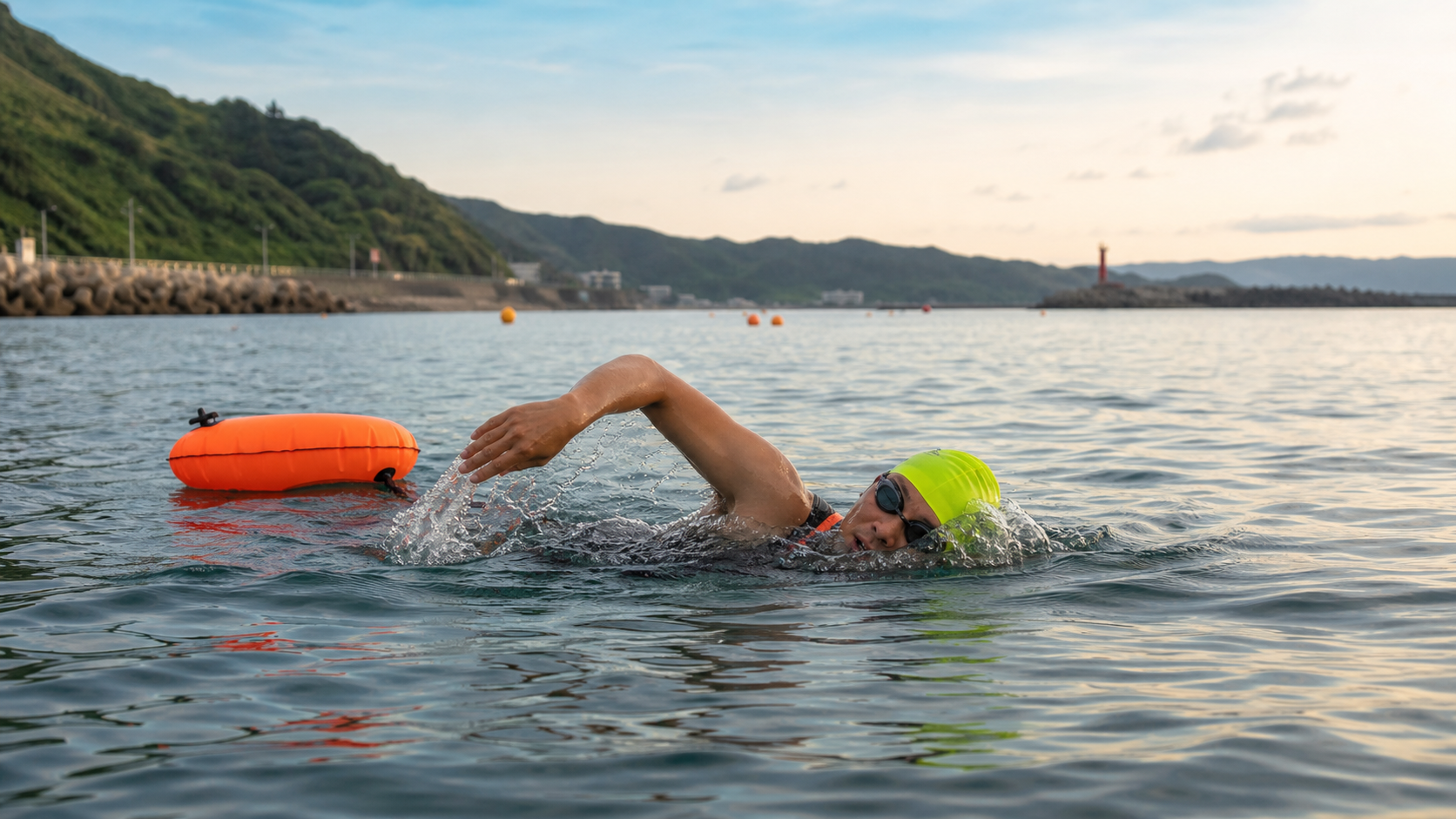
- Swim cap (fluorescent or orange): Increases visibility so people on shore can easily spot you
- Goggles (anti-fog, UV-protective): Open water requires a wide field of vision
- Tow Float: Attached to your waist; grab it for support in case of cramps
- Wetsuit (Optional): Recommended when water temperature is below 24°C
- Sunscreen (water-resistant SPF50+): Apply 20 minutes before swimming
Acclimatization Drills Before Entering the Water
- Stand in waist-deep water to acclimate to the temperature: Let your body gradually adjust to the temperature change
- Practice underwater swimming in shallow water: Feel the visibility difference in open water
- Practice floating with the waves: Relax your body and feel the wave rhythm
- Swim with a buddy: Never swim in open water alone
Common Physical Reactions in Open Water
Many pool swimmers encounter the following reactions when entering open water for the first time:
Rapid Breathing (Cold Shock):
When your body contacts cold water, it triggers a reflexive rapid breathing response. The remedy is to enter the water slowly, letting your face be the last part to touch the surface, and deliberately slow your breathing at the first breathing point.
Disorientation:
Without black lane lines, it’s easy to drift off course. The solution is to develop the habit of lifting your head to sight every 6–8 strokes (see the navigation techniques article for details).
Muscle Cramps:
Cold water and differences in salinity can both cause cramps in the calves or soles of the feet. If this happens, immediately roll onto your back and float, straighten the cramped area, and hold onto your tow float to stabilize your body.
Practical Advice
- Progress gradually: Swim only 100–200 meters the first time, then increase distance week by week
- Don’t swim alone: Swim with at least one other person, or have a kayak or SUP accompany you
- Learn the distress signal: Raising one arm vertically and waving it is the international distress signal
- Respect nature’s warnings: In the flag system, a red flag or double red flags mean swimming is prohibited
- Record your experiences afterward: After each session, note the water conditions, how you felt, and areas for improvement to accelerate your learning curve
Conclusion
Transitioning from the pool to open water is an exciting major step in your swimming journey. Safety is not timidity—it’s the prerequisite for being able to keep enjoying this sport. By building the right gear awareness, technical foundation, and buddy culture, you can enjoy the freedom and challenge of open water along Taiwan’s beautiful coastline.
Related Reading
- Open Water Swimming for Beginners: A Complete Adaptation Guide from Pool to Ocean and Lakes
- The Complete Open Water Swimming Guide: Transition Training from Pool to Ocean
- Open Water 1km Swim Training Plan: A Transition Program from Pool to Sea
- Physical Differences Between Pool and Open Water: How to Simulate Open Water Intensity in Pool Training
滑雪新手們慘摔學習全紀錄(請開字幕),滑雪好好玩 | Snowboard + Ski | 岩原 スキー場 | 滑雪APP使用 | GoPro Max
6 年前
一起升級!海鷗盃LSD團練...JJSC Zone2招待 騎到手抖 / 公路車 / CT Yeh
1 天前
西進武嶺 自製新版AI配速表產生器 x 賽前攻略 抱佛腳! 沒有功率計也可以產生配速表嗎?有什麼其他眉角賽前要注意的呢? | 西進武嶺 / 東進武嶺 KOM 攻略 | 公路車 | CT Yeh
4 年前
FTL 與 SYB 車隊專訪 西進武嶺 實用攻略分享! 2小時 如何練?!你不知道的眉角!新手準備武嶺必看 EP1 | 實力派女車友 | 精華版 | 公路車 | CTYeh
4 年前
備戰 戀戀197 賽前關門點分析 西濱團練 #公路車 4K高畫質
6 年前
西進武嶺 免費訓練分析服務 Intervals | 練不夠還是練過頭?你哪一種類型選手?AI模型告訴你! | 備戰神器 | 公路車 訓練 | CT Yeh
4 年前
大禹嶺 到 武嶺牌樓 全程前後實況錄影 | 北進武嶺 | 東進武嶺 | KOM | 訓練台 | 坡度分析 | Taiwan KOM Last 10 km HARD | 公路車
6 年前
[教學] Premiere 影片 手震 修正 教學 防抖 單眼 影像 GoPro 穩定 Video Stabilization
8 年前