Introduction
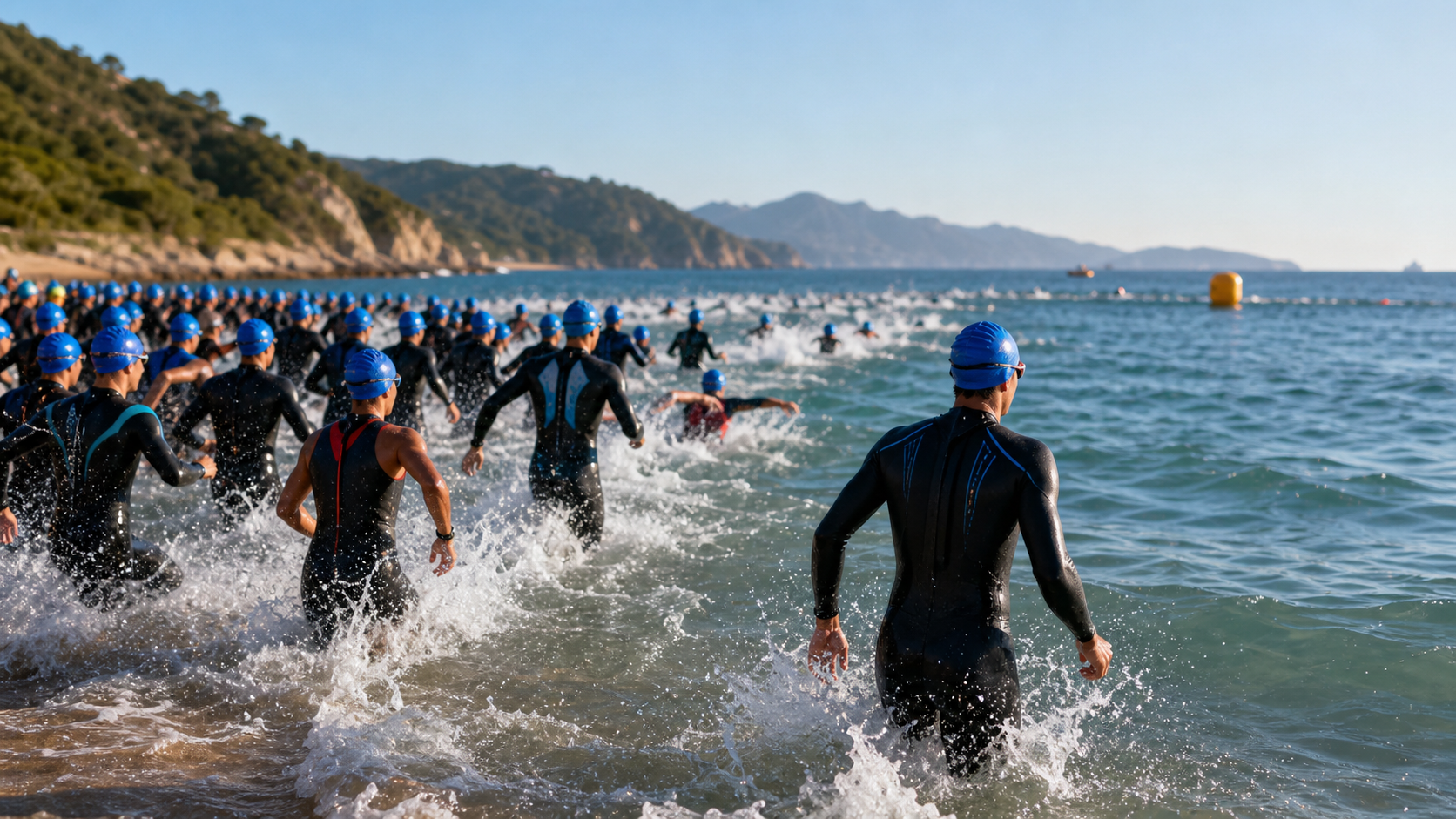
For many newcomers to triathlon or open-water swim races, the “Mass Start” is the most nerve-wracking moment before the gun goes off. Hundreds of athletes charge into the water at once, arms and legs tangling, spray flying everywhere—one wrong move and you could get kicked in the face, have your goggles knocked off, or even swallow a mouthful of seawater in a panic. However, experienced athletes know that starting position and early-race strategy often determine how the race feels—success or struggle—more than swimming technique itself. This article breaks down the strategic logic behind open-water mass starts.
Understanding the Start Area Terrain and Dynamics
Typical Start Scenarios
Open-water races in Taiwan typically use one of two starting methods:
| Start Method | Characteristics | Typical Events |
|---|---|---|
| Beach run-in | Athletes run from the beach into the sea before starting to swim | Kenting, Fulong Beach triathlons |
| In-water start | Athletes are already waiting in the water and set off after the gun | Sun Moon Lake Mass Swim |
| Pontoon start | Athletes dive in from a pontoon or pier | Some harbor events |
Each method requires slightly different start tactics, but the core principle remains the same: protect yourself in the opening chaos and establish a steady rhythm with minimal energy expenditure.
The Logic Behind Choosing Your Starting Position
Lateral Position: Left, Center, or Right Trade-offs
On the starting line, your position determines how crowded it will be before the first turn buoy.
Front and Center (where the fastest athletes go):
- Pros: Shortest route, straight shot to the first buoy
- Cons: Most intense competition, most contact, requires very high swimming ability
Outer Edge (near the sidelines):
- Pros: Plenty of room, can breathe freely without interference
- Cons: Longer route (sweeping the outside arc), you’ll already be behind by the first buoy
Front Flank (recommended for mid-pack athletes):
- Choose a position toward the front-left or front-right
- After the start, “cut” diagonally toward the inside to reach the first buoy, balancing route efficiency with open space
Longitudinal Position: Which Row?
- Elite athletes: First row, able to hold top speed and dictate the line
- Mid-pack athletes: Rows three to five, letting the fastest swimmers surge ahead so the crowding has already thinned out
- First-timers / conservative strategy: Row ten or further back, waiting for the pack to spread out before accelerating
Mental Preparation Before the Start
Accept That You Will Be Touched
In a mass start, getting kicked or scratched is almost inevitable. Mentally accepting this fact beforehand can dramatically reduce your panic response once you’re in the water. You can practice this before race day:
- Contact swimming drills: Deliberately practice swimming alongside others in training to get used to the crowded feeling
- Positive visualization: Close your eyes and imagine the start scenario, rehearsing the reaction of “staying calm and continuing to swim after being kicked”
Breathing Control Is Key
Many athletes hyperventilate from nerves before the start, only to feel dizzy once they hit the water. Recommendations:
- 5 minutes before the start, do 5 deep breaths on a 4-second inhale–4-second exhale rhythm
- For the first 30 seconds after entering the water, deliberately slow down your breathing rhythm—don’t rush to accelerate
Early-Race Strategy After the Start
First 200 Meters: Survival Mode
The first 200 meters after the start are the most chaotic part of the entire race. The goal is not to overtake opponents, but to:
- Find space: If it’s too crowded around you, drift slightly to the outside—better to swim a few extra meters than to lose your breathing room
- Keep sighting with your head up: You must sight every 4–6 strokes to avoid drifting off course in the chaos
- Control your pace: Your heart rate in the first 200 meters should not exceed 85% of your personal maximum
200–500 Meters: Establishing Rhythm
Once the pack begins to spread out, it’s time to settle into a steady rhythm:
- Find an athlete of similar ability and swim slightly to the side and behind them (drafting position) to use their wake and save energy
- Reduce sighting frequency to once every 8–10 strokes
- Begin consciously assessing whether your overall pace can be sustained to the finish
The Correct Drafting Position
Swimming behind the athlete in front of you can save 5–15% of your energy. The best drafting positions:
| Drafting Position | Energy Savings | Risk |
|---|---|---|
| Directly behind, 0.5 m | Highest (10–15%) | May kick the athlete ahead, or get kicked yourself |
| Diagonal behind (45°, 0.5 m) | High (8–12%) | Lower collision risk, recommended |
| Side-behind (90°, 0.3 m) | Low (3–5%) | Almost no collision risk |
Turn Buoy Technique
Turn buoys are another congestion point in a group. Strategy:
- Move inside early: Get to the inside at least 30 meters before the buoy, so you don’t get pushed wide by outside swimmers at the turn
- Hug the buoy: The tighter your turning radius, the shorter your route
- Accelerate out of the turn: Push hard for 5–6 strokes after completing the turn to gap the athletes whose speed has dropped
Practical Tips
- Pre-race swim test: Your warm-up swim on race day isn’t just about loosening muscles—also confirm the current direction in the start area
- Swim along the outside buoy line: The route is slightly longer, but you’ll avoid most of the pack’s collisions
- Remember your finish time goal: The excitement at the start can easily make you go out too fast, causing a late-race collapse
- Have a goggle backup plan: If your goggles get knocked askew during the race, you need to be able to adjust them quickly in the water without panicking
Conclusion
The mass start is one of the most challenging—and most memorable—experiences in open-water swimming. From the survival mindset of “finding safe space” to the tactical use of “smart drafting to save energy,” refining your start strategy takes accumulated race experience. After every race, carefully review your starting choices and early-race pacing, and you’ll find that even without improving your swimming ability, optimizing your strategy can significantly improve both your race experience and your results.
Related Reading
- Triathlon Swim Leg Mass Start Strategy: Position Selection and Physical Contact Management
- Open-Water Start Chaos Strategy: How to Find Your Rhythm in the Crowd
- Open-Water Triathlon Swim Start Strategy: Crowd Conflict Management and Sighting Technique
- Open-Water Start Strategy: Positioning, Contact, and Rhythm Building
2023桃園團體繞圈賽 / 海鷗繞圈賽 | 全程空拍數據版 | 公路車 | CT Yeh
2 年前
CT 喇低賽) 武嶺牽車 才是王道 西進牽車四小時內秘訣 攝手位置 如何判斷 防抽筋小秘訣
7 年前
戰略) Zwift Race 如何咬在第一集團 如何評估自己要開多少推力 (請開1.5倍速看)
7 年前
2025 海鷗團體繞圈賽 網路直播 超激烈裁判長視角 / EIPC 李廷威、Waypoint 等眾多高手競爭 / feat. 卡密兒主持 / 海鷗繞圈賽
9 個月前
新屋團體繞圈賽 | 眾多菁英好手賽道奔馳 | 千瓦女子軍團 | 無敵交管狂獲好評 明年你一定不能錯過 | #公路車
5 年前
Live) 備戰2019彰化經典百K 賽前攻略 (已完賽請看新影片
7 年前
2023桃園團體繞圈賽/環台賽等級拍攝/賽事精華/ 10人一隊缺一不可!50隊廝殺大場面 / 第三屆 海鷗繞圈賽 /公路車/CT Yeh
2 年前
#東進武嶺 全程實況錄影 5小時半 #夏季KOM #太魯閣 Taiwan KOM Challenge Reality Video Taroko scenery
7 年前