Introduction
The refueling issue in open-water swimming is often overlooked by beginners. In cycling or running races, it’s easy to stop at aid stations to refuel; but in sea swimming, you can’t just “pull over,” and the refueling windows are very limited and brief. Especially for sea swims longer than 2 kilometers (such as the 3.3 km Sun Moon Lake Mass Swim, or the 4 km long-distance leg in triathlon), poor energy management can lead to cramping, pacing collapse, or even hypoglycemic incapacitation. This article starts from the scientific basis of energy expenditure and provides practical refueling strategies for Taiwanese sea swimmers.
Estimating Energy Expenditure in Swimming
Calorie expenditure in swimming is greatly affected by water temperature, speed, and technical efficiency. The following is a rough estimate:
| Swimming Pace | 1500 meters | 3.8 km (Long-Distance Triathlon) | Approximate Hourly Expenditure |
|---|---|---|---|
| Slow (>2:30 per 100m) | Approx. 250–300 kcal | Approx. 600–700 kcal | 400–500 kcal/hour |
| Moderate (2:00–2:30 per 100m) | Approx. 300–400 kcal | Approx. 700–900 kcal | 500–700 kcal/hour |
| Fast (<2:00 per 100m) | Approx. 350–450 kcal | Approx. 800–1000 kcal | 700–900 kcal/hour |
Additional expenditure: In cold water (<22°C), the body expends extra energy to maintain core temperature, which can be 15–25% more than at the same pace.
Human Glycogen Stores and Depletion Risk
The human body’s glycogen stores are approximately 450–550 grams (about 1800–2200 kcal), of which muscle glycogen is about 400 grams and liver glycogen about 100 grams.
The swim leg of a long-distance triathlon (Ironman) consumes approximately 25–35% of total body glycogen stores. Even in a standalone long-distance sea swim, if swimming time exceeds 90 minutes, the risk of glycogen depletion cannot be ignored. The main risk is: if you have to bike and run after the sea swim (in a triathlon), or if you have other activities after exiting the water, failing to refuel during the swim may set the stage for a late-stage collapse.
Practical Refueling Methods for Sea Swimming
Method 1: Support Kayak/SUP
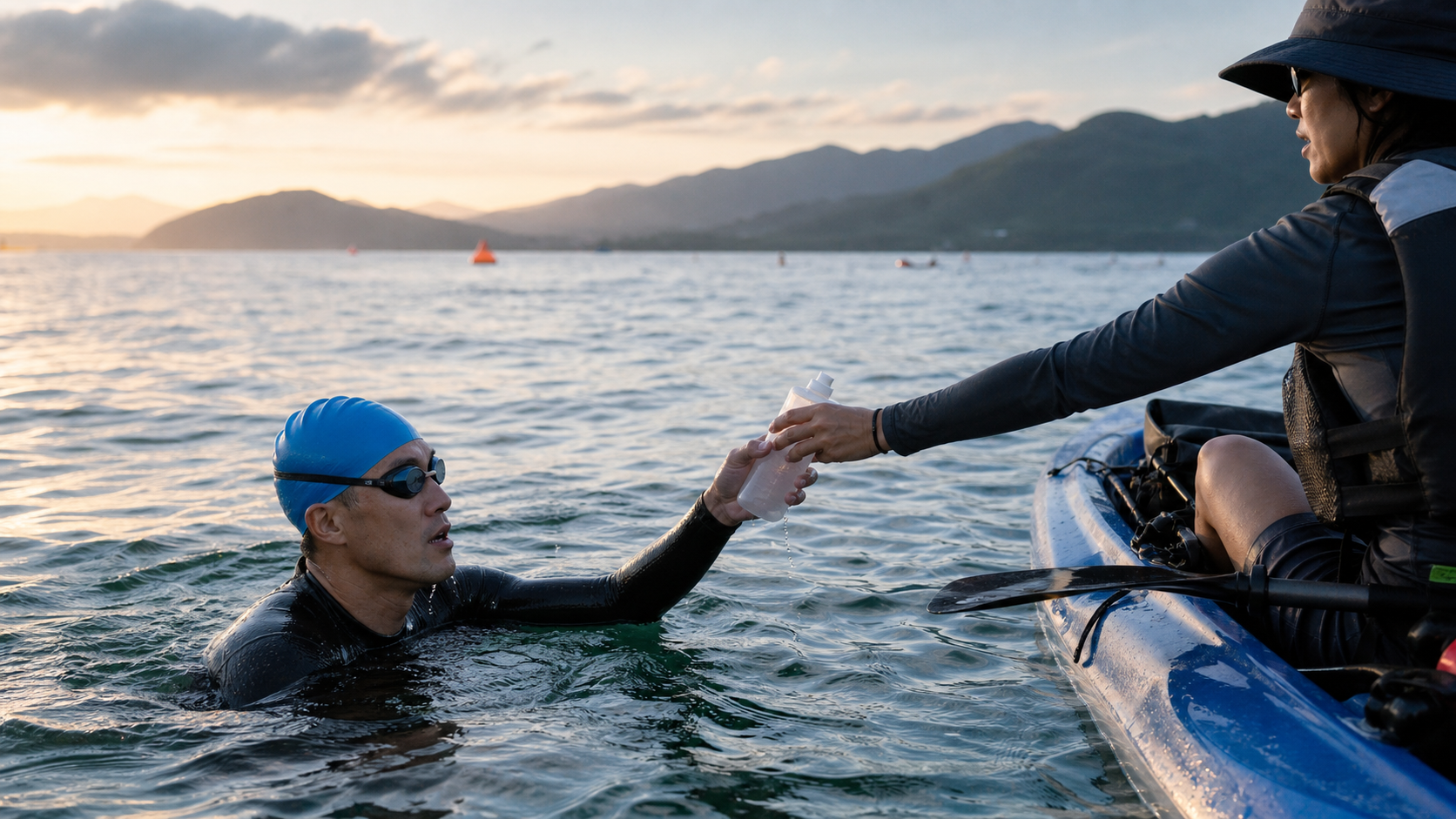
In long-distance training or races, arranging a partner to paddle a support kayak alongside you is the most common refueling method. The support kayak can provide:
- Liquid refueling: Sports drinks, diluted energy gel
- Solid refueling: Energy gels, banana chunks (packaged in waterproof bags)
- Emergency supplies: Electrolyte tablets
Refueling tips:
- Swim to the support kayak and switch to an upright treading-water position
- Complete refueling within 30–60 seconds; do not linger for long
- After refueling, take a few deep breaths to confirm normal breathing before continuing to swim
Method 2: Waist-Mounted Refueling (Pocket Wetsuit / Waist Belt)
Some athletes use specially designed waist belts to carry refueling supplies, suitable for shorter long-distance swims requiring 1–2 refuels:
- Energy gels: Can be consumed by briefly treading water upright mid-swim and squeezing into the mouth
- Salt electrolyte tablets: Dissolve quickly, small in size, easy to carry
Note: Solid food carries a choking risk when consumed while swimming; choose liquid or semi-liquid refueling products instead.
Pre-Race Energy Storage (Carbo-Loading)
For long-distance sea swims exceeding 90 minutes, carbohydrate loading 2–3 days before the race can maximize glycogen stores:
| Time Point | Recommended Intake | Food Choices |
|---|---|---|
| 3 days before race | High-carb (8–10g/kg body weight/day) | White rice, pasta, bread |
| 1 day before race | High-carb, reduce fiber | White rice, bananas, low-fat foods |
| Race day breakfast | Moderate carb (2–3g/kg), 2–3 hours before race | Congee, toast, bananas |
| 30 minutes before race | Small amount of easily digestible food | Energy gel, banana |
Electrolyte and Hydration Management
The Unique Hydration Issue in Sea Swimming
- Surrounded by water while swimming, you can’t perceive sweat evaporation, making it easy to overlook dehydration risk
- Salt in seawater causes a small amount of additional sodium loss through the skin and mouth
- After long-distance sea swims, it’s common to experience dehydration despite thinking “I didn’t sweat”
Electrolyte Supplementation Guidelines
| Race Duration | Sodium Supplementation Target | Supplementation Method |
|---|---|---|
| <60 minutes | Not necessary | Just ensure adequate hydration before the race |
| 60–90 minutes | 300–500mg sodium | Replenish with sodium-containing sports drinks immediately after the race |
| >90 minutes | Supplement every 30 minutes during the race | Electrolyte tablets + diluted sports drinks |
Practical Recommendations
- Simulate refueling in training: During long-distance training before the race, practice using a support kayak or waist belt to get your body accustomed to eating while swimming
- Choose refueling products your palate can accept: The taste and sweetness of energy gels during exercise may differ greatly from everyday; test them in training first
- Monitor your sweat rate: Weigh yourself after each training session and replenish an equivalent amount of water for each kilogram of body weight lost
- Avoid trying anything new on race day: Refueling strategies should be repeatedly tested in training; on race day, only execute the validated plan
Conclusion
The refueling strategy for open-water swimming is the bridge between “swimming long” and “swimming well.” Especially for triathletes, energy management during the swim leg directly affects subsequent cycling and running performance. Plan ahead, practice repeatedly, and make refueling an organic part of your race plan rather than an improvised problem—your long-distance sea swim performance will be more stable and more outstanding.
Related Reading
- Open-Water Energy Refueling: How to Eat During Long-Distance Swim Races
- Refueling Strategies for Long-Distance Swim Races: Energy Preparation for 1500m and Above
- Refueling Strategies for Long-Distance Swimming: Differences Between Pool Refueling and Open-Water Refueling
- Long-Distance Open-Water Refueling: Practical Strategies for Energy Gels and Salt Tablets
CT暗黑廚房) 車友必備 宇宙無敵鮮蚵湯 幫助訓練恢復 天然食補 好市多 超肥鮮蚵 破PR
7 年前
西進武嶺 免費訓練分析服務 Intervals | 練不夠還是練過頭?你哪一種類型選手?AI模型告訴你! | 備戰神器 | 公路車 訓練 | CT Yeh
4 年前
靠單車減肥35公斤 心得分享與整理
7 年前
大家都在開箱的...單車用藍芽對講耳機真的有幫助嗎? SENA BiKom 20 長距離旅遊 & 海鷗繞圈賽 實際體驗心得 / 公路車 / CT Yeh
9 個月前
2019 夏季KOM 5小 完賽心得 準備攻略 東進武嶺 夏季登山王之路 Taiwan KOM Challenge
7 年前
半日 小台灣 極限單車路線挑戰實錄
7 年前
一起升級!海鷗盃LSD團練...JJSC Zone2招待 騎到手抖 / 公路車 / CT Yeh
1 天前
#公路車 #Vo2Max #最大攝氧量 測驗 體驗 | 心肺測試
6 年前