Shoulder Protection for Young Swimmers: Prevention and Early Intervention for Swimmer's Shoulder
Introduction
The shoulder is a swimmer’s primary tool and also their most vulnerable area. “Swimmer’s shoulder” broadly refers to shoulder pain syndromes caused by swim training, with an incidence rate as high as 40–70% among adolescent athletes, making it the most common swimming-related sports injury. For adolescents who are still growing and developing, if not properly managed, it can evolve into a chronic problem that affects their long-term swimming career.
Anatomical Basis of Swimmer’s Shoulder
The shoulder joint has the greatest range of motion and the lowest stability of any joint in the body. During the swimming stroke, each arm cycle requires completing:
- Forward extension (entry phase)
- Catch phase — highest risk position for impingement
- Pull phase — greatest load on the rotator cuff
- Push phase
- Exit and forward arm recovery (recovery phase)
With 2,000–3,000 strokes per training session, this accumulates to hundreds of thousands of shoulder cycles per year. Any technical flaw or muscle imbalance will be amplified into injury risk under this massive volume of repetition.
Main Types of Swimmer’s Shoulder
| Injury Type | Affected Structures | Predominant Stroke | Typical Symptoms |
|---|---|---|---|
| Subacromial impingement syndrome | Rotator cuff, bursa | Freestyle, butterfly | Pain when raising the arm, worse at night |
| Rotator cuff tendinitis | Supraspinatus, subscapularis | All strokes | Deep aching pain in the shoulder |
| Acromioclavicular joint injury | Acromioclavicular ligament | Butterfly | Tenderness at the end of the clavicle |
| Anterior instability | Joint capsule ligaments | Freestyle | Sudden “giving way” sensation during swimming |
Special Risk Factors for Adolescent Swimmer’s Shoulder
In addition to the risks shared with adult athletes, adolescents have several unique high-risk conditions:
1. Open epiphyseal plates
The epiphyseal plate of the greater tubercle of the humerus does not fully close until after age 18. Before that, excessive rotator cuff tension can cause apophysitis, with symptoms similar to tendinitis but a longer recovery period.
2. Strength imbalance during rapid growth
During the adolescent growth spurt (PHV), bone growth outpaces muscle growth, leading to temporary muscle tightness and strength imbalances that significantly increase impingement risk.
3. Technique not yet stabilized
Technical errors in adolescents, such as thumb-first hand entry or crossing the body’s midline, directly increase the likelihood of impingement with each stroke.
Prevention Strategies: A Three-Tier Protection Framework
Tier 1: Technique Correction
Technical issues are the root cause of swimmer’s shoulder, and correcting technique is more fundamental and effective than any external treatment:
- Hand entry position: The entry point should be directly in front of the same-side shoulder, avoiding crossing the body’s midline
- High elbow catch: Avoid excessive compression of the subacromial space
- Head position on the breathing side: Excessive head rotation causes compensatory shoulder movement
Tier 2: Strength Balance Training
Swimming movements are dominated by “pushing” muscles (pectoralis major, anterior deltoid), which over time creates anterior-posterior muscle imbalance. The following dry-land training should be added weekly:
Rotator cuff strengthening (3 times per week):
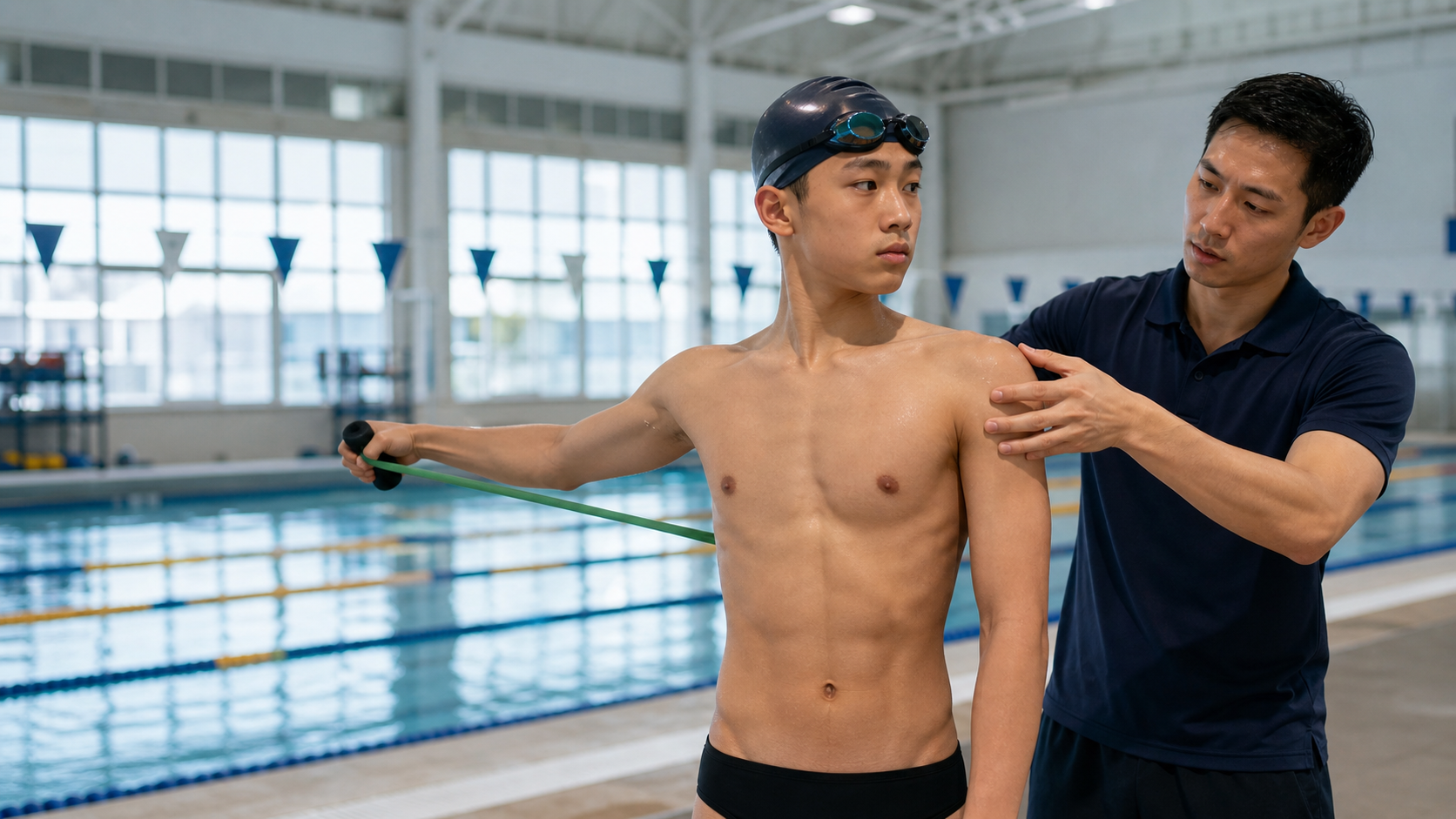
- Resistance band external rotation: 3 × 15 reps (strengthens infraspinatus)
- Resistance band scapular retraction: 3 × 12 reps (strengthens middle and lower trapezius)
- Prone T/Y/W raises: 2 × 12 reps (comprehensive scapular stabilization training)
- Side-lying dumbbell external rotation: 2 × 12 reps (eccentric training for infraspinatus)
Tier 3: Load Management
- Weekly butterfly volume should not exceed 20% of total swimming volume
- Insert 1 deload week after every 3 weeks of training
- Schedule 3–5 days of low-intensity recovery before and after competitions
- If shoulder pain occurs (above 3/10), immediately reduce intensity and report to the coach
Early Intervention: Steps to Take When Pain Occurs
Many adolescent athletes (or parents) choose to “tough it out” when facing pain, which is the main reason swimmer’s shoulder transitions from acute to chronic.
Correct pain response protocol:
- If shoulder pain persists for more than 2 days or the pain score exceeds 4/10: immediately inform the coach and stop high-intensity training
- Days 1–3: Apply ice (15 minutes per session, 3 times daily), reduce aggravating movements
- Days 3–7: If pain does not improve, seek evaluation from a sports medicine physician or physical therapist
- After diagnosis: Follow the physical therapy plan and continue low-intensity swimming within permitted limits (avoid complete cessation of training)
Practical Recommendations
- Conduct a shoulder functional assessment once per season (Hawkins-Kennedy test, Neer test) to detect abnormalities early.
- Incorporate rotator cuff training into the regular training schedule (10–15 minutes per session), rather than waiting until after injury to strengthen.
- Adolescent athletes should perform 5 minutes of dynamic shoulder mobility and static stretching before and after each training session.
- Coaches and parents should establish a communication culture where “pain is not weakness,” encouraging athletes to report discomfort early.
Conclusion
Preventing swimmer’s shoulder is far easier and less costly than treating it. For adolescent athletes, a serious shoulder injury can mean several months of mandatory rest, affecting not only performance but also psychological morale. Establishing correct technical habits, implementing strength balance training, and maintaining reasonable training loads—these three prevention strategies are fundamental skills that every youth swimming coach should master in depth.
Related Reading
- Overuse Shoulder Injuries in Child Swimmers: A Complete Guide to Identification, Prevention, and Rehabilitation
- Shoulder Injuries in Swimming: Causes and Prevention of Swimmer’s Shoulder
- A Complete Guide to the Diagnosis and Treatment of Swimmer’s Shoulder
- Swimmer’s Shoulder Fully Explained: Causes, Diagnosis, and Prevention
[教學] Premiere 影片 手震 修正 教學 防抖 單眼 影像 GoPro 穩定 Video Stabilization
8 年前
一日北高/長距離團騎 常見問題補充篇 / 組團或跟團的眉角 / 壯車友容易被瘦車友慢性拉爆 / 原來屁股痛可能是這個原因...? / 風場配速法 / 公路車 / CT Yeh
2 年前
抖肩舞 台灣x日本交流版 (台灣 vs 前橋) 赤城山登山賽 coincidance
8 年前
2026 輪霸西濱200K 挑戰VLOG / 第一集團 / 首次參加..經驗不足、膀胱不足 /死守6H內 / AI戰鬥力顯示系統 / 公路車 / CT Yeh
4 個月前
一日北高常見問題大集合 | 攻略 | 路線 | 訓練 | 補給 | 自行車 單車 | 一日雙城 | 雙塔 | TWB北高360 | 屁股痛
6 年前
CT 喇低賽) 武嶺牽車 才是王道 西進牽車四小時內秘訣 攝手位置 如何判斷 防抽筋小秘訣
7 年前
滑雪新手們慘摔學習全紀錄(請開字幕),滑雪好好玩 | Snowboard + Ski | 岩原 スキー場 | 滑雪APP使用 | GoPro Max
6 年前
松運深水池拍攝 作品 防寒衣品牌
8 年前