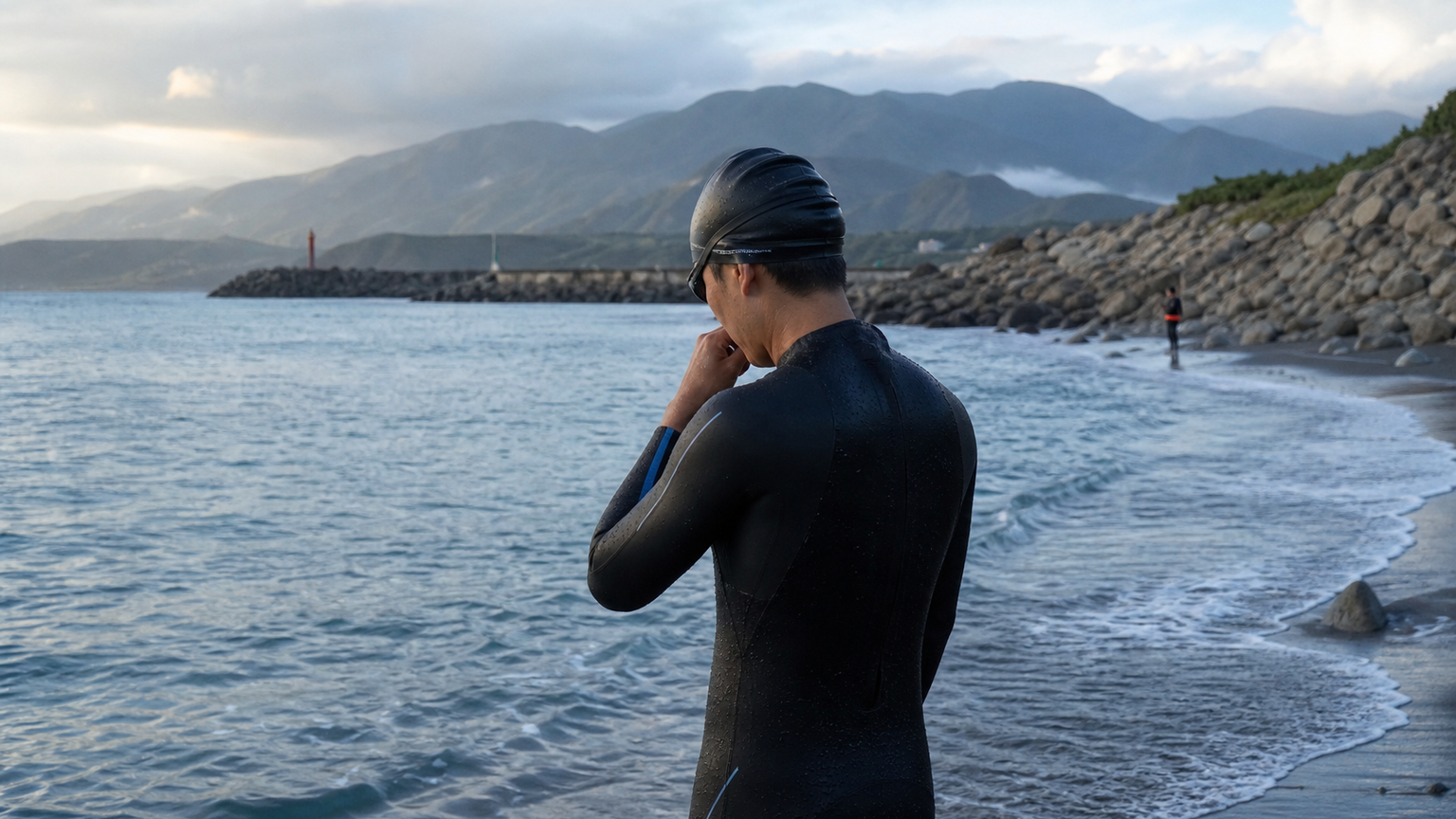
Introduction
From December to March each year, seawater temperatures in northern Taiwan drop to 17–19°C, a temperature most people consider “impossible to swim in.” However, in Japan, Nordic countries, and the UK, winter sea swimming is already an established sporting culture, with participants believing the physical and mental benefits of cold-water swimming far outweigh the discomfort. In recent years, a growing number of swimmers in Taiwan have begun exploring winter sea swimming. This article provides a complete preparation guide for winter sea swimming in northern Taiwan, helping those interested safely step into this unique cold-water world.
Overview of Northern Taiwan Winter Sea Conditions
| Month | Average Water Temp | Air Temp | Wave Conditions | Recommended Level |
|---|---|---|---|---|
| November | 22–24°C | 18–22°C | Moderate waves | Suitable |
| December | 19–21°C | 15–18°C | Increasing northeast monsoon swells | Caution advised |
| January | 17–19°C | 13–16°C | Monsoon season, large waves | Experienced swimmers only |
| February | 17–18°C | 13–15°C | Coldest of the year, strong waves | High risk, thorough preparation required |
| March | 18–20°C | 15–18°C | Gradually improving | Caution advised |
| April | 20–22°C | 18–22°C | Warming up, diminishing waves | Suitable |
Location-specific notes: Along the northern coast, Shimen, Wanli, and Jinshan experience significant swells during winter due to the northeast monsoon. Even on clear days, wave conditions may be unsuitable for swimming. It is recommended to choose sheltered bays or harbor-type beaches, such as Fulong (which has relatively better topographical protection).
The Science Behind Cold-Water Swimming
Physiological Adaptations to Cold-Water Exposure
Regular cold-water swimming training can induce the following physiological adaptations:
- Reduced cold shock response: Decreased intensity and duration of reflexive hyperventilation
- Enhanced brown adipose tissue (BAT) activation: Improved heat-generating capacity of the body
- Improved vasomotor response: Faster peripheral vasoconstriction to preserve core temperature
- Improved heart rate stability: Reduced risk of cold-induced arrhythmias (after training)
Health Benefits (Supported by Preliminary Research)
- Reduced inflammatory markers (lower CRP)
- Improved mood (cold water stimulates endorphin and norepinephrine release)
- Enhanced immune system (some small-scale studies)
- Increased cold tolerance (practical for outdoor sports enthusiasts)
Note: Most of the above research findings are preliminary. Cold-water swimming is not beneficial for everyone; in particular, those with cardiovascular conditions should evaluate under a physician’s guidance.
Physical Assessment Before Cold-Water Swimming
Before attempting winter sea swimming, please conduct the following self-assessment:
Conditions where cold-water swimming is not recommended:
- History of heart disease or arrhythmia
- Poorly controlled hypertension
- Raynaud’s phenomenon (peripheral circulatory disorder)
- Asthma (cold air may trigger attacks)
- Recent respiratory infection or physical discomfort
Conditions requiring physician evaluation before attempting:
- First-time cold-water swimmers over 60 years of age
- Family history of heart disease
- Currently taking medication that affects blood pressure or heart rate
Progressive Cold-Water Training Plan
Phase 1: Cold Shower Habit (Months 1–3)
- End each daily shower with 2–3 minutes of cold water
- Gradually lower the temperature each week (from cool to cold)
- Combine with deep breathing exercises to reduce the cold shock response
Phase 2: Autumn Sea Swimming (Water Temp 22–24°C)
- During October–November, practice in seawater wearing only swimwear (no wetsuit)
- Goal: swim comfortably for 20 minutes in water below 22°C
Phase 3: Transition Season (Water Temp 18–22°C)
- In December, attempt swimming 5–10 minutes in 19–20°C water without a wetsuit
- If experiencing severe discomfort, a thin wetsuit may be worn initially
- Increase by 2–3 minutes each week (within safe limits)
Phase 4: Winter Sea Swimming (Water Temp 17–18°C)
- Starting in January, target 15–20 minutes per session (initially)
- Must be accompanied by a partner, or have someone observing from shore
- Equipment: waterproof watch (to monitor time), safety buoy
Equipment Selection for Cold-Water Swimming
Skins Swimming (Without Wetsuit)
- Swimwear (cap, goggles, suit)
- Silicone swim cap (better insulation than latex)
- Specialized thermal swim cap (neoprene material, significantly better insulation)
- Neoprene gloves and neoprene booties (optional, helping beginners adapt to low temperatures more easily)
Winter Sea Swimming with Wetsuit
- 5mm full wetsuit
- Neoprene hood (the head is the area with the fastest heat loss)
- Neoprene gloves (3mm)
- Neoprene booties
Post-Swim Recovery Protocol
The body continues to cool after cold-water swimming, making the recovery process critical:
- Leave the cold water immediately: Do not stand by the water’s edge (wind accelerates heat loss)
- Change into dry clothing quickly: Put on a hat first (to reduce heat loss from the head)
- Consume warm drinks: Ginger tea, hot cocoa, cinnamon milk (alcohol is not recommended, as it dilates blood vessels and accelerates heat loss)
- Do not take a hot bath immediately: Rapid rewarming is actually dangerous; wrap yourself in a room-temperature blanket and allow the body to rewarm naturally
- Monitor body temperature: If shivering persists for more than 20 minutes, consider seeking medical attention
Practical Advice
- Join a cold-water swimming community: Taiwan has several winter sea swimming groups (search Facebook for “台灣冬泳” or “台灣海泳俱樂部”), and swimming with experienced partners is recommended
- Never swim alone in cold water: This is a stricter safety rule than for summer sea swimming
- Enter briefly, savor fully: The joy of winter sea swimming lies not in “how far you swim,” but in “feeling the clarity” and the warmth after getting out
- Respect your own limits: Some people naturally have lower cold tolerance; there is no need to force yourself to reach specific goals
Conclusion
The winter ocean of northern Taiwan is silent, clear, and full of power. Summoning the courage to step into that 17°C seawater in the depths of winter is an active exploration of your own boundaries. The “feeling of being alive” that winter sea swimming brings is difficult to put into words, but this experience must be built on thorough preparation and rigorous safety awareness. By adapting progressively starting in autumn, the winter sea will give you an unforgettable gift in its own unique way.
Related Reading
- Winter Swimming Challenge: Cold Adaptation Training in Northern Taiwan’s 18°C Waters
- Physiological Adaptation to Cold-Water Swimming: Coping with Winter Water Temperatures at Taiwan’s Northeast Coast
- Risk Management in Cold Water (<18°C): Safety Guidelines for Cold-Water Swimming
- Cold-Water Adaptation in Swimming: Effects of Water Temperature on Heart Rate, Metabolic Rate, and Oxygen Consumption
CT暗黑廚房) 車友必備 宇宙無敵鮮蚵湯 幫助訓練恢復 天然食補 好市多 超肥鮮蚵 破PR
7 年前
[防寒衣體驗] 鐵人魂 三鐵 防寒衣試穿會 於松運 深水游泳池 鯨魚池
8 年前
水金九不厭五分 10度寒流冷到不願停!feat. 卡卡 / 公路車 / CT Yeh
6 個月前
虎豹潭!日本老師來台一日約騎 台灣車友熱情招待私房路線 / CT Yeh
21 天前
滑雪新手們慘摔學習全紀錄(請開字幕),滑雪好好玩 | Snowboard + Ski | 岩原 スキー場 | 滑雪APP使用 | GoPro Max
6 年前
秘境雪場 日本 八甲田 冰樹探險與滑雪體驗 ft. Q老師 & 運動生活
7 年前
備戰 戀戀197 賽前關門點分析 西濱團練 #公路車 4K高畫質
6 年前
一起升級!海鷗盃LSD團練...JJSC Zone2招待 騎到手抖 / 公路車 / CT Yeh
2 天前