Introduction
The challenge of climbing comes not just from leg strength, but also from energy management. Many riders start at the base of a climb full of confidence, only to suddenly “run out of juice” in the latter half of the climb—this is the infamous “Bonk,” a power collapse caused by low blood sugar. The key to avoiding the bonk isn’t eating a huge amount before the climb, but rather refueling at the right time and in the right way. This article provides practical fueling strategies for common long-distance climbs in Taiwan.
Energy Expenditure Characteristics During Climbing
Climbing burns energy faster than riding on flat roads, mainly because power output is higher and sustained for longer periods. Using a 70kg rider as an example:
| Climbing Intensity (%FTP) | Carbohydrates per Hour | Total Calories per Hour |
|---|---|---|
| 70% (Z2) | 45–55g | 550–650 kcal |
| 80% (Z3) | 60–75g | 700–800 kcal |
| 88–93% (Sweet Spot) | 75–90g | 850–950 kcal |
| 95%+ (Threshold) | 90–110g | 1000–1100 kcal |
The body’s muscle glycogen stores can support roughly 90–120 minutes of moderate-to-high intensity exercise. Beyond that time limit, without external fueling, power output will drop significantly.
The Golden Window for Fueling
Before Departure (-60 to -30 Minutes)
The “pre-fueling” before a climb is the most overlooked aspect:
- 2 hours before departure: a proper meal (rice, noodles, and other complex carbohydrates), about 400–600 kcal
- 30 minutes before departure: a light snack (banana, energy bar, rice ball), about 150–200 kcal
- 5–10 minutes before departure: optionally take one energy gel (about 20–25g of carbohydrates) to quickly raise blood sugar
Mid-Climb (Refuel Every 20–25 Minutes)
The gut’s absorption rate is limited during exercise; consuming too much at once can cause stomach discomfort. Recommended principles:
- Refuel every 20–25 minutes, don’t wait until you feel hungry
- Consume 20–30g of carbohydrates per feeding (one energy gel or half an energy bar)
- Pair with 150–200ml of water to aid absorption
- For climbs exceeding 2 hours, aim for 60–80g of carbohydrates per hour
The Latter Half of the Climb (Especially Important)
The latter half of a climb is often where fueling is most easily neglected, yet it’s also when it’s needed most:
- 30–40 minutes from the summit, proactively take an energy gel or fruit gel
- If your legs feel “empty,” that’s an early bonk signal—refuel immediately and ease off the pace
- Don’t “wait until the top to eat”; by the time you reach the summit, it’s already too late
Comparison of Different Fueling Foods
| Fueling Product | Carbohydrate Content | Absorption Speed | Convenience | Best Use Case |
|---|---|---|---|---|
| Energy Gel | 20–25g | Fast (10–15 min) | Most convenient | Primary fuel during climbs |
| Energy Bar | 25–35g | Medium (20–30 min) | Requires chewing | Gentle slopes, when time allows |
| Banana | 25–30g | Medium | Requires one hand | When stopped at aid stations |
| Sports Drink | 6–8g per 100ml | Fast | Refuels while hydrating | Use throughout the ride |
| Japanese Rice Ball | 40–50g | Medium | Feels heavy | Aid points mid-way up long climbs |
| Taiwanese Red Bean Bun | 50–60g | Medium-slow | Requires chewing, crumbly | Not recommended while climbing |
Techniques for Fueling While Climbing
Taking a hand off the bars to fuel is harder on a climb than on flat roads. These tips can help:
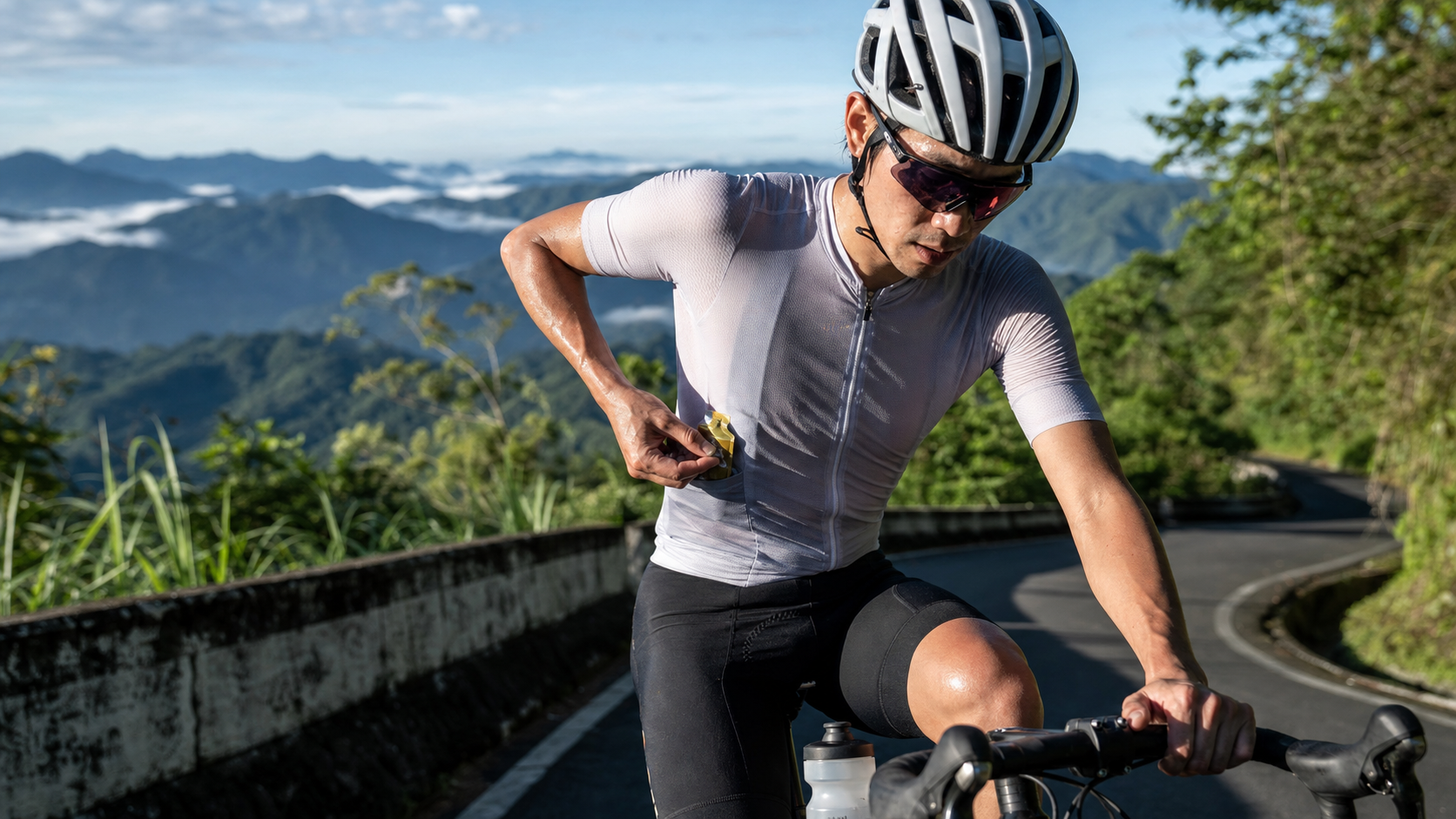
- Place fuel in an easily accessible spot beforehand: in the left rear jersey pocket (for right-handed riders); don’t stuff everything into the same pocket
- Refuel on gentler sections or straightaways after a turn, avoiding one-handed handling on steep pitches
- Tear the energy gel halfway open and fold it back into your pocket, making it quick to grab without wasting time opening the package
- Practice one-handed control: during training, practice reaching for your bottle, drinking, and returning it with your right hand
- If you can’t safely ride one-handed on Taiwan’s mountain roads, it’s better to briefly pull over and stop on a flatter section to refuel rather than take risks
Hydration Strategy
During climbs, sweat evaporation is slower (due to lower relative speed and less airflow), making it easy to underestimate actual sweat loss. Recommendations:
- Gentle slopes: 500–700ml per hour
- High-intensity climbs or summer: 700–1000ml per hour
- Above 2000m elevation: the air is dry; maintain hydration even if you don’t feel hot
- Electrolyte supplementation (containing sodium) helps retain fluids in the body; on long climbs, drink a sodium-containing sports drink once per hour
Practical Tips
- Taiwan’s convenience stores (7-Eleven, FamilyMart) have branches along most mountain routes and can serve as natural aid stations (Cingjing, Lushan, Taipingshan all have them)
- Refueling points along Wuling: Puli → Wushe → Lushan → Hehuanshan National Forest Recreation Area Service Station → Wuling
- If you suddenly feel extremely fatigued or dizzy mid-climb, first drink a sugary beverage, then assess whether to continue
- Individual fueling needs vary by body size, intensity, and temperature; during training, record your consumption and fueling amounts to establish your own baseline
- Protect fuel from heat in summer: energy gels won’t spoil in high temperatures, but chocolate bars and certain foods will melt
Conclusion
The core principle of climbing nutrition is: fuel early, take small amounts frequently, and don’t wait until you’re hungry to eat. With the right fueling strategy, your long climbs become less about “whose willpower is stronger” and more of a planned energy management game. Next time you tackle Wuling or Taipingshan, bring enough fuel and refuel on schedule—you’ll be surprised to find you still have energy to accelerate in the latter half.
Related Reading
- Climbing Nutrition Strategies: Timing Your Refueling on Ascents and Choosing Between Solid Food vs. Gels
- Fueling Timing for Mountain Riding: Carbohydrate Strategies Before, During, and After Climbs
- The Complete Guide to Cycling Nutrition: Energy and Hydration Management for Long Rides
- Climb Fueling Timing: Designing Carbohydrate Intake Points for Long Ascents
一日北高/長距離團騎 常見問題補充篇 / 組團或跟團的眉角 / 壯車友容易被瘦車友慢性拉爆 / 原來屁股痛可能是這個原因...? / 風場配速法 / 公路車 / CT Yeh
2 年前
單車 一日北高 ( 雙城 ) 肥宅雙人瘋狂行 紀錄片 REACTO
10 年前
CT暗黑廚房) 車友必備 宇宙無敵鮮蚵湯 幫助訓練恢復 天然食補 好市多 超肥鮮蚵 破PR
7 年前
一日北高前的高裝檢 | 北高 360 | 挑戰11小時的裝備 | 一日雙塔 | 補給
6 年前
一日北高常見問題大集合 | 攻略 | 路線 | 訓練 | 補給 | 自行車 單車 | 一日雙城 | 雙塔 | TWB北高360 | 屁股痛
6 年前
阿里山塔塔加 兩倍特濃版!全新隧道開通! 進喔!公路車 | CT Yeh
3 年前
大武山後門26%歡樂陡坡!JJSC南台灣單車行Day2 / 被颱風追著跑 / 公路車 / CT Yeh
2 年前
公路車 爬坡 破PR 紀錄 小技巧 分享
6 年前