Technical Differences Between 50m Short-Course and Long-Course Swimming: Turn Ratio and Pacing Strategies
Introduction
Swimming competitions are divided into two main categories based on venue specifications: 25-meter short-course meters (SCM) and 50-meter long-course meters (LCM). To the average spectator, the difference may seem minor; but for competitive swimmers, short-course and long-course represent completely different energy distribution patterns, turn technique requirements, and pacing rhythms. Understanding the differences between the two is the first step in developing a race strategy.
The Fundamental Difference in Turn Ratio
Take the 100m freestyle as an example:
| Event | Short Course (25m) | Long Course (50m) |
|---|---|---|
| Number of turns | 3 | 1 |
| Turn proportion of total distance | Approx. 15–20% | Approx. 5–8% |
| Underwater propulsion distance (per turn) | Up to 10–12m | Up to 10–12m |
| Reliance on momentum utilization | High | Low |
In short-course events, the proportion of the overall result accounted for by turns and start propulsion (including the dive entry and underwater dolphin kicks after turns) is far greater than in long-course. This is also why short-course world records are typically 1–3 seconds faster than long-course records (for 100m) — not just because the distance segments are shorter, but because of the accumulated advantage from turns.
The Technical Core of Short Course: Maximizing Turn Efficiency
In short-course races, swimmers must complete a flip turn every 25 meters. Take the 200m freestyle as an example: a swimmer must complete 7 turns. If each turn can save 0.2 seconds compared to an opponent, that accumulates to a 1.4-second advantage — enough to decide who takes home the medal.
Key points for optimizing short-course turns include:
- Approach rhythm when nearing the wall: Whether a swimmer can accurately judge the distance after the final full stroke cycle without needing a “half-stroke” or “glide” to reach the wall is a core difference between elite and amateur swimmers.
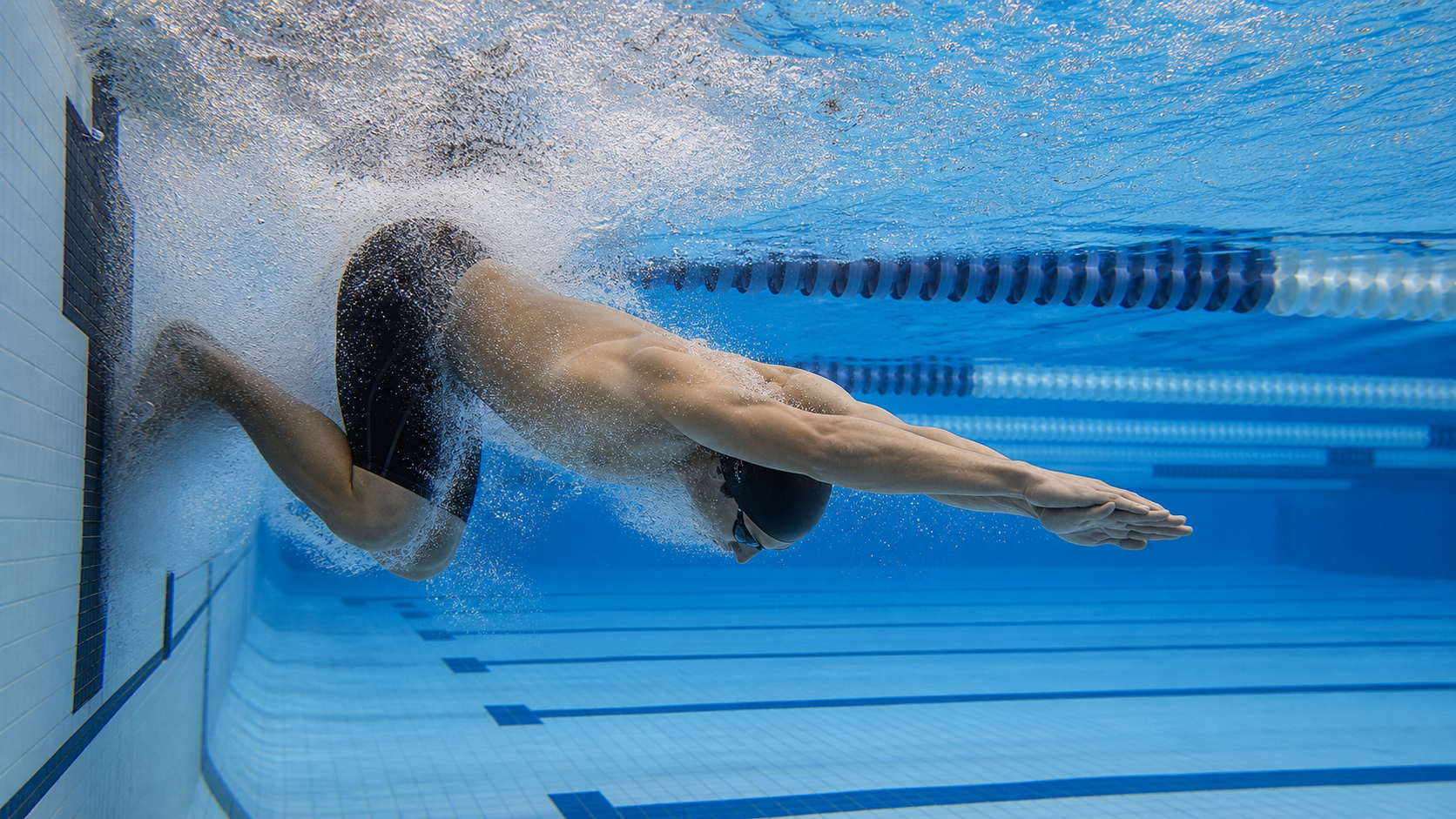
- Development of underwater dolphin kicks (UDK): Underwater dolphin kicks after turns are the fastest form of propulsion, and rules generally allow underwater gliding of no more than 15 meters. Making full use of this distance is crucial.
- Control of breakout timing: Surfacing too early sacrifices underwater speed; surfacing too late affects subsequent stroke rhythm due to oxygen debt.
The Technical Core of Long Course: Stroke Efficiency and Aerobic Reserve
In long-course (50m) events, the number of turns is greatly reduced, and swimmers must rely on highly efficient stroke technique and a more solid aerobic foundation to maintain speed.
- Stroke rate vs. distance per stroke (DPS): Long-course swimmers tend to pursue a higher DPS, moving as much water as possible with each stroke to reduce unnecessary stroke counts.
- Strategic adjustment of breathing rhythm: In long-course, a more regular breathing pattern (e.g., breathing every 3 strokes) can be adopted, whereas in short-course, the high frequency of turns makes breathing rhythm more complex and variable.
- Preserving energy for the latter half: In long-course races, the penalty for going out too fast in the early stages is more severe, because there are no turn advantages in the latter half to “mask” the decline in stamina.
Differences in Pacing Strategy
Short-course and long-course differ significantly in pacing strategy:
- Short course tends toward even or slightly positive splits (slightly faster early): Because turns can “reset” some fatigue, swimmers can sprint slightly in the early stages and rely on the underwater segment after turns to help restore rhythm.
- Long course tends toward negative splits or precise even pacing: With no buffer over long distances, the consequences of going out too hard early are difficult to reverse, especially in events of 200m and above.
Practical Recommendations
- Strengthen turn training for short-course races: It is recommended to allocate at least 30–40% of each practice session to practicing wall approaches and underwater dolphin kicks after turns.
- Focus on stroke efficiency in long-course training: Use a stroke counter or counting ring to monitor stroke count per lap, ensuring a stable DPS.
- Develop dual-track pacing awareness: If preparing for both short-course and long-course events simultaneously, it is recommended to record “per-lap swim time” and “underwater distance after turns” separately with a stopwatch to build rhythm memory for each venue.
- Research the specifications of target events: Confirm whether the registered event is SCM or LCM, and adjust training focus accordingly in advance.
Conclusion
Short-course and long-course are not merely a matter of “different pool sizes” — they represent two distinctly different philosophies of competitive swimming. Short course relies on the precise accumulation of turn technique, while long course tests aerobic endurance and the sustained output of stroke efficiency. Understanding the strategic differences between the two helps swimmers prepare optimally for different events and allows coaches to allocate training resources more precisely, aiming to perform at the highest level in key competitions.
Related Reading
- Technical Differences Between Short-Course and Long-Course: The Impact of Turn Frequency on Pacing
- Race Strategy Differences Between Short-Course (25m) and Long-Course (50m) Pools
- 25m Short Course vs 50m Long Course: What Exactly Is Different in Training Strategy?
- Swimming Interval Training Design: Workout Differences Between Short Course and Long Course
Live) 備戰2019彰化經典百K 賽前攻略 (已完賽請看新影片
7 年前
靠單車減肥35公斤 心得分享與整理
7 年前
西進武嶺 免費訓練分析服務 Intervals | 練不夠還是練過頭?你哪一種類型選手?AI模型告訴你! | 備戰神器 | 公路車 訓練 | CT Yeh
4 年前
教學) 如何做出專業 慢動作 影片 Slow Motion 120fps GoPro 7 ActionCam AX700 A99II
7 年前
2019 夏季KOM 5小 完賽心得 準備攻略 東進武嶺 夏季登山王之路 Taiwan KOM Challenge
7 年前
實景訓練台) 彰化經典百K 高強度喵團 90分鐘 跟著一起練功 2019 Indoor workout Changhua Classic 100 Taiwan
7 年前
RAMP FTP Test 直播 究竟能撐到幾瓦 訓練台 Gravat Zwift
6 年前
崇越盃武嶺冠軍高手 賽前JJSC 群峰會精華!對應大數據分析,會有落差嗎?/ feat. JJSC中部公路車約騎 /公路車 / CT Yeh
2 年前