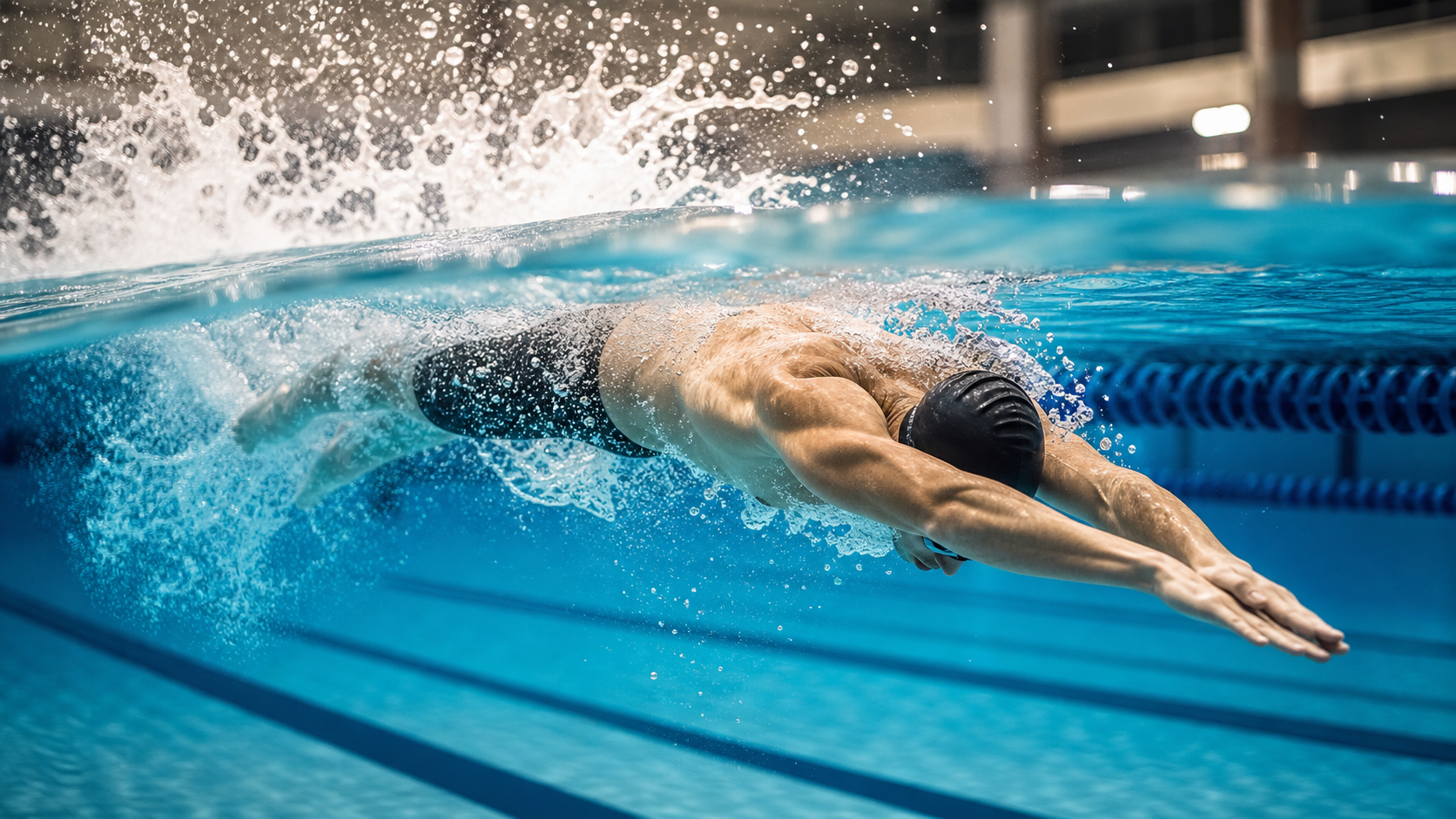
Introduction
The 50-meter swim (using the 50m freestyle as an example) is the shortest and most intense event in all of swimming. World-class male times are around 20–21 seconds, and female times around 23–24 seconds. In this brief window, swimmers barely need to consider pacing strategy—the entire race is one all-out sprint. But this does not mean the 50m is the easiest event to prepare for; quite the opposite, it places the most demanding requirements on the nervous system.
Energy Systems in 50m Swimming
| Energy System | Contribution | Duration | Characteristics |
|---|---|---|---|
| Phosphocreatine System (ATP-PCr) | Approximately 70–80% | 0–10 seconds | Highest explosive power, no lactate |
| Anaerobic Glycolysis | Approximately 20–25% | 5–30 seconds | Rapid energy supply, produces lactate |
| Aerobic System | Approximately 5% | Continuous | Minimal contribution |
The 50m swim relies almost entirely on the phosphocreatine and anaerobic glycolysis systems, with aerobic capacity being far less important than in sprint and middle-distance events. This means training focus must be placed on maximizing neuromuscular explosive power, rather than improving the aerobic base.
The Neuroscience of Maximum Speed
Swimming speed = Stroke Rate (SR) × Distance Per Stroke (DPS). In a 50m race, elite swimmers can reach stroke rates of 60–80 strokes per minute, requiring the nervous system to coordinate muscle contractions at extremely high frequencies.
The nervous system’s contribution to explosive power includes:
- Motor Unit Recruitment: Maximum speed requires recruiting nearly all fast-twitch muscle fibers (Type II), not just slow-twitch fibers (Type I).
- Neural Synchronization: Multiple motor neurons firing simultaneously to produce maximal muscular force output.
- Reflex Arc Speed: The reaction speed between sensing water resistance during the pull and adjusting stroke power.
Core Methods of Explosive Power Training
1. Short-Distance All-Out Sprints (Sprint Sets)
The training goal is to habituate the nervous system to maximal intensity output.
- 8–12×25m, all-out sprint, with complete rest between sets (1–2 minutes)
- 4–6×50m, swum at race intensity (95–100%), with 3–5 minutes rest between sets
- Key point: Every repetition must be a genuine “all-out” effort; if speed cannot be maintained due to fatigue, stop the set immediately and extend rest
2. Underwater Explosive Power Training
- Vertical Kick: In deep water, tread water vertically with arms crossed over the chest, performing high-frequency dolphin kicks in 30-second sets to train lower-body explosive power and resilience.
- Push-off Sprints: Push off the wall with maximum force, performing a 15m underwater dolphin kick to train the neural explosive power of the start and underwater propulsion.
3. Resisted & Assisted Swimming
- Resisted Training: Swim while towing a drag parachute or wearing resistance pants to train maximal strength against resistance, allowing the nervous system to establish stronger recruitment patterns.
- Assisted Training (Overspeed Training): Swim while being pulled by an elastic cord at speeds exceeding personal maximum by 105–110%, allowing the nervous system to experience a stroke rhythm “faster than usual” and establish a new upper limit of speed perception.
Explosive Power Elements of the Start
In a 50m race, the start and entry phase (0–15m) can account for 30–35% of total race time, making it the most worthwhile investment for explosive power training.
- Land-Based Jump Training: Box jumps and standing long jumps to improve lower-body explosive power and neural synchronization.
- Start Block Reaction Sprints: Land-based simulation from the starting position to full departure, using a starting signal (or a phone playing a start sound) to practice reaction time.
- In-Water Start Timing: After each start practice, time the 0–15m segment, aiming for consistent and progressively shorter times.
Fatigue Management and Periodization of Explosive Power Training
Explosive power training places extremely high demands on the nervous system. Poorly planned sessions can easily cause neural fatigue, which actually reduces training effectiveness. Recommendations:
- Schedule 2–3 all-out sprint sessions per week, with other days focused on technique work or aerobic recovery swimming.
- Begin tapering 2 weeks before competition: Reduce total volume by 30–40%, but maintain the frequency of high-intensity short repeats to ensure the nervous system is at peak activation on race day.
- Avoid consecutive high-intensity sessions before competition: In the 48 hours before racing, focus primarily on light technique confirmation swims to allow full nervous system recovery.
Practical Recommendations
- Schedule one “maximum speed test” per week: Choose 4×25m all-out efforts, record and track your personal best 25m time as an indicator of training progress.
- Use stroke count as a metric: In a 50m race, elite swimmers typically take 30–38 strokes (depending on height and body type); in practice, aim for the goal of “fewer strokes, higher speed.”
- Strengthen the shoulder rotator muscles: The rotator cuff muscles are the stabilizing foundation for high-frequency stroking. Perform shoulder stability training twice per week to avoid shoulder injuries from high-frequency sprint training.
- Adequate sleep is the best neural recovery tool: After explosive power training, 7–9 hours of high-quality sleep is crucial for nervous system recovery.
Conclusion
The 50-meter swim is the purest test of “maximum speed” in the sport of swimming. Its outcome depends more on nervous system efficiency than aerobic endurance. Through scientific explosive power training, refined start technique, and rigorous periodization, swimmers can progressively unlock the full potential of their nervous system and set their personal best in that 25-second blaze of effort.
Related Reading
- Maximum Speed Training in Swimming: Neural Activation in 10–25m All-Out Sprints
- 50m Freestyle Race Strategy: Reaction Time, Mid-Race Swimming, and the Finish
- Swimming Speed Training: Principles for Designing Short-Distance Sprint Sets
- Swimming Speed Development Plan: Periodization Design for Short-Distance Sprint Sets
西進武嶺 免費訓練分析服務 Intervals | 練不夠還是練過頭?你哪一種類型選手?AI模型告訴你! | 備戰神器 | 公路車 訓練 | CT Yeh
4 年前
FTL 與 SYB 車隊專訪 西進武嶺 實用攻略分享! 2小時 如何練?!你不知道的眉角!新手準備武嶺必看 EP1 | 實力派女車友 | 精華版 | 公路車 | CTYeh
4 年前
Live) 備戰2019彰化經典百K 賽前攻略 (已完賽請看新影片
7 年前
西進武嶺 自製新版AI配速表產生器 x 賽前攻略 抱佛腳! 沒有功率計也可以產生配速表嗎?有什麼其他眉角賽前要注意的呢? | 西進武嶺 / 東進武嶺 KOM 攻略 | 公路車 | CT Yeh
4 年前
CT 喇低賽) 武嶺牽車 才是王道 西進牽車四小時內秘訣 攝手位置 如何判斷 防抽筋小秘訣
7 年前
教學) 如何做出專業 慢動作 影片 Slow Motion 120fps GoPro 7 ActionCam AX700 A99II
7 年前
2019 夏季KOM 5小 完賽心得 準備攻略 東進武嶺 夏季登山王之路 Taiwan KOM Challenge
7 年前
實景訓練台) 彰化經典百K 高強度喵團 90分鐘 跟著一起練功 2019 Indoor workout Changhua Classic 100 Taiwan
7 年前