Introduction
Many people head to the gym for sit-ups and core drills, never realizing that every stroke pulling them through the pool is already a highly effective core workout. The propulsion mechanics of swimming rely fundamentally on core rotation and stability: the body roll of freestyle, the hip contraction and extension of breaststroke, the dolphin undulation of butterfly — every stroke demands continuous engagement from the core muscles. This article takes a deep look at how swimming reshapes your waistline and offers practical, core-focused swim training tips.
How Does Swimming Train the Core?
The core is not just the rectus abdominis (the “six-pack”). It includes a whole system of deep and superficial muscles — the transverse abdominis, internal and external obliques, erector spinae, multifidus, and quadratus lumborum. Swimming trains the core differently from training on land:
Stability demands: In water, the body has no fixed support like it does on land, so the core muscles must contract continuously to maintain a streamlined body position. The moment the core relaxes, the body sinks or drifts off-line, and swimming efficiency drops immediately.
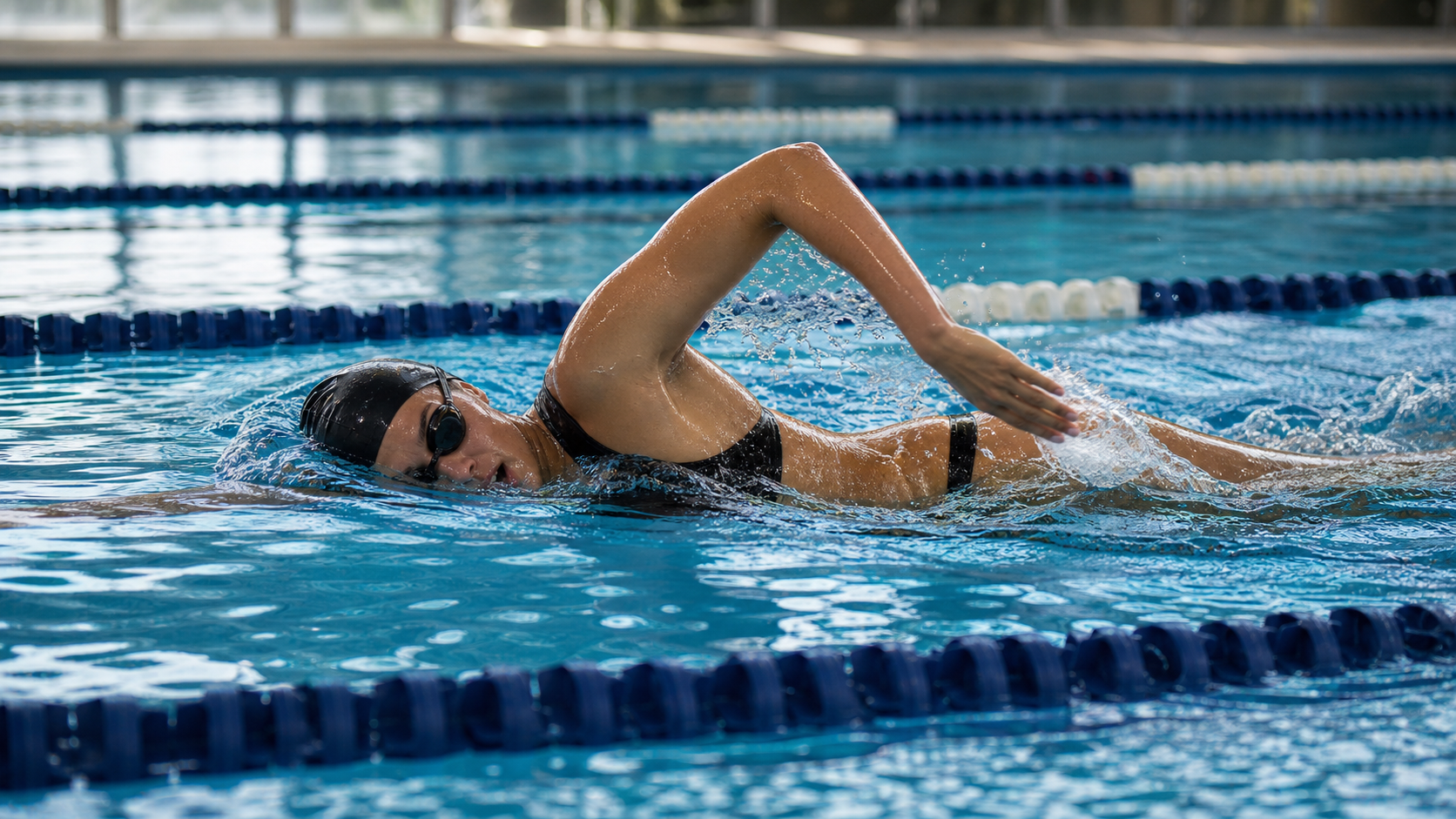
Rotational movement: Freestyle requires the body to rotate 30–45 degrees to each side to coordinate with the arm pull, heavily engaging the oblique muscles; breaststroke’s whip-kick and leg recovery demand strong support from the deep abdominal stabilizers.
Breath control: Swimming breath must be synchronized with rhythm, and during this process the diaphragm works in tandem with the deep core muscles — over time strengthening both breathing efficiency and core stability.
Core Training Effects of Different Strokes
| Stroke | Primary Core Muscles Trained | Training Intensity | Technical Difficulty |
|---|---|---|---|
| Freestyle | Obliques, transverse abdominis | ★★★★ | Medium |
| Butterfly | Whole core, erector spinae | ★★★★★ | High |
| Breaststroke | Lower abdomen, hip flexors | ★★★ | Low |
| Backstroke | Erector spinae, transverse abdominis | ★★★★ | Medium |
Butterfly delivers the strongest core-training effect — the whole-body wave motion requires coordinated contraction throughout the entire spine — but it comes with high technical difficulty, so it’s best attempted once you have a solid swimming foundation. Freestyle offers the best balance between efficiency and core engagement.
Swim Training Methods Targeting Core Toning
Side Kicking
Lie on your side in the water (like a side-lying variant of backstroke), one arm extended past your ear, the other resting along your side, and kick with both legs to propel forward. This movement forces the obliques to work continuously to stabilize the body, making it the best supplementary drill for freestyle core training. Try adding 4×25 meters of side kicking to each session.
In-Water Core Stability Drills with a Kickboard
Using a kickboard, try the following:
- Push kickboard forward: Hold the kickboard straight out in front with both hands and propel yourself using only your kick, forcing your abdomen to stay braced to keep your body horizontal
- Prone plank on kickboards: Standing at the pool edge, press one kickboard down into the water with each hand and try to float your body up, holding the position for 20–30 seconds
Interval Sprint Training
High-intensity short-distance sprints effectively stimulate abdominal fat burning:
Suggested set:
- 8×25 meters all-out sprint, 30 seconds rest between reps
- Heart rate should reach at least 85% of max heart rate
- Pair with a 400-meter easy swim as warm-up and cool-down
The Real Effect of Swimming on Your Waistline
Long-term swimmers tend to share a common physique: elongated shoulder-back lines, a relatively slim waist, and a tight but not overly bulky abdomen. This “swimmer’s build” isn’t a coincidence — it’s the natural result of the sport’s characteristics:
- Swimming is a moderate-to-high-intensity aerobic activity that helps lower overall body fat percentage, including abdominal fat
- Core stability training tightens the abdominal muscles, so even without fat loss, waist circumference can shrink
- Swimming doesn’t cause excessive muscle bulk (unlike weightlifting), so you won’t end up with a “thicker waist after swimming”
One thing to watch for: appetite after swimming tends to be stronger than after land-based exercise (the cold water environment makes the body burn more calories to maintain core temperature), so without dietary control, the drop in body fat percentage may be slower than expected.
The Best Combination: Swimming Plus Land-Based Core Training
Swimming alone can improve your core, but if you want faster results in waist and abdominal toning, pair it with the following land-based exercises:
- Plank: 3 sets of 30–60 seconds each, targeting deep stability of the transverse abdominis
- Dead Bug: The best move for activating the transverse abdominis — do 3×10 reps before swimming
- Bird Dog: Strengthens coordinated stability between the core and back — do 3×10 reps after each swim session
Practical Tips
- Don’t just count distance — feel your core engage: Remind yourself to “brace your abdomen” during every swim to make the movement more deliberate
- Butterfly doesn’t need to be fast: A slow butterfly trains the core just as effectively as a fast one, and the technique is easier to control
- Side kicking is the most overlooked core weapon: Spend just 5 minutes per session on it — the results are remarkable
- Film your swimming: Use a waterproof phone mount to record your stroke and check whether your core is actually engaged (is your body horizontal?)
Conclusion
Swimming is a sport that keeps your core continuously “in use.” Unlike land training, which requires specifically designed core exercises, swimming naturally weaves core engagement into every pull, kick, and breath. Swim consistently, and your waistline will change in its own distinctive way — not the sharply carved lines of a bodybuilder, but a balanced, toned, and vibrant kind of healthy beauty.
Related Reading
- Core Training for Swimmers: How Land-Based Core Strengthening Directly Improves Streamlined Body Position in Water
- Core Muscle Training for Swimming: The Science Behind Propulsion in Water
- The Swimming Core: Why Anti-Rotation Matters More Than Flexion
- Muscular Adaptation in Swimming: Prioritizing Development of the Lats, Deltoids, and Core
靠單車減肥35公斤 心得分享與整理
7 年前
西進武嶺 免費訓練分析服務 Intervals | 練不夠還是練過頭?你哪一種類型選手?AI模型告訴你! | 備戰神器 | 公路車 訓練 | CT Yeh
4 年前
[教學] Premiere 影片 手震 修正 教學 防抖 單眼 影像 GoPro 穩定 Video Stabilization
8 年前
一日北高/長距離團騎 常見問題補充篇 / 組團或跟團的眉角 / 壯車友容易被瘦車友慢性拉爆 / 原來屁股痛可能是這個原因...? / 風場配速法 / 公路車 / CT Yeh
2 年前
一起升級!海鷗盃LSD團練...JJSC Zone2招待 騎到手抖 / 公路車 / CT Yeh
1 天前
實景訓練台) 彰化經典百K 高強度喵團 90分鐘 跟著一起練功 2019 Indoor workout Changhua Classic 100 Taiwan
7 年前
#公路車 #Fitting 靠人工智慧APP 幫你調整單車
6 年前
一日北高常見問題大集合 | 攻略 | 路線 | 訓練 | 補給 | 自行車 單車 | 一日雙城 | 雙塔 | TWB北高360 | 屁股痛
6 年前