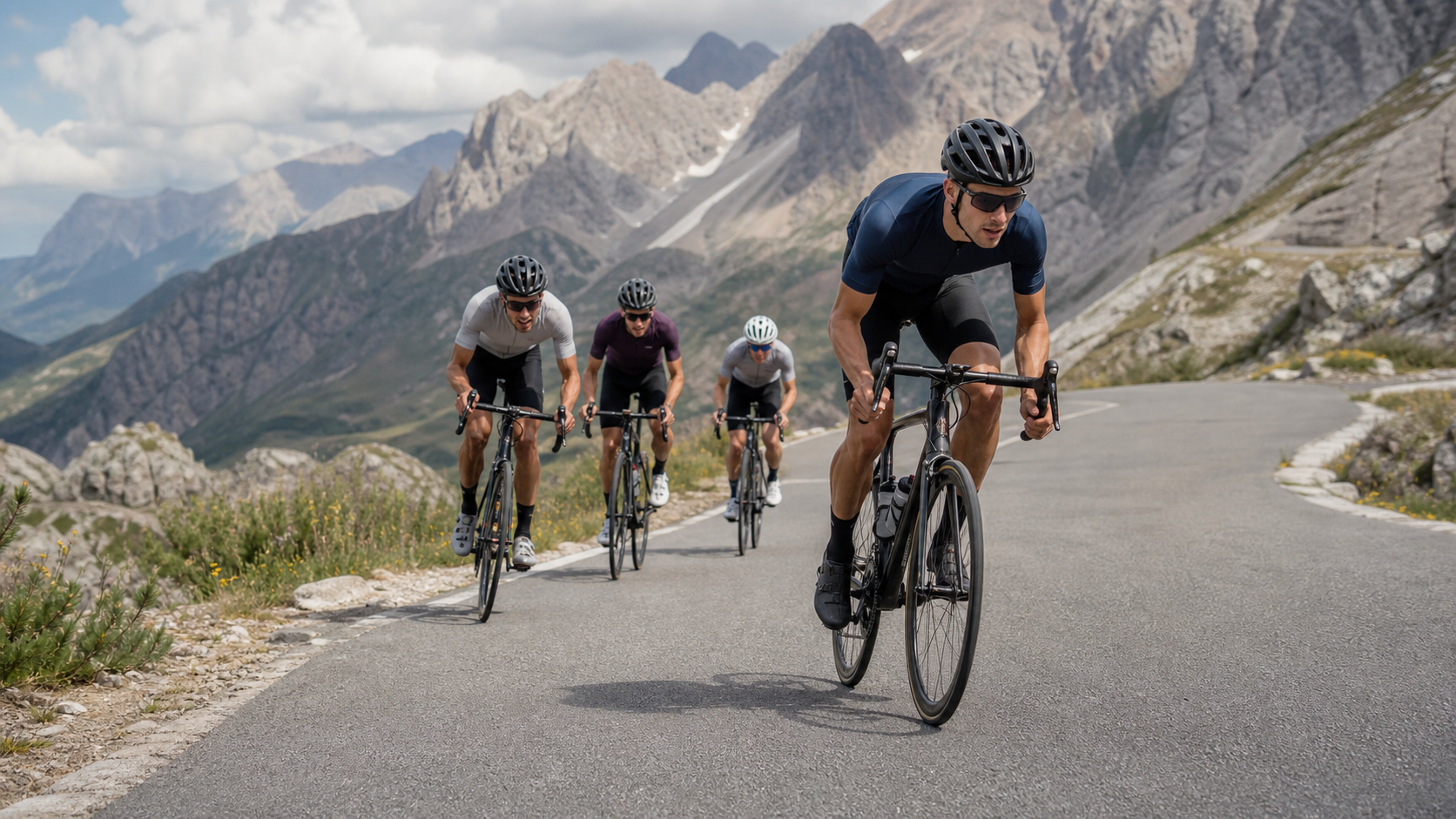
Introduction
The biggest difference between a climbing race and training climbs is the presence of other competitors. An unfamiliar surge, an unexpected attack—both can disrupt your carefully planned pacing strategy. Conversely, riders who know how to use tactics can often trade lower physical exertion for better results. This article analyzes the three core strategies in climbing races: following, overtaking, and energy conservation, helping you make smarter decisions in your next climbing event.
The Basic Tactical Framework of Climbing Races
Any climbing race can be divided into three phases:
| Phase | Distance Ratio | Primary Task | Common Mistake |
|---|---|---|---|
| Early | 0–30% | Positioning, following the group | Attacking too early, burning too much energy in the front section |
| Middle | 30–70% | Holding position, observing opponents | Being dragged into the pace by an opponent’s surge |
| Late | 70–100% | Executing tactics, going all-out | Saving too much, missing the chance to overtake at the end |
Strategy 1: Following (Drafting & Following)
The Physics of Energy Savings from Drafting
Even at lower speeds on climbs, riding behind the rider ahead can save 5–10% of aerodynamic drag (20–30% on flat roads). The further forward you are in the group, the less drag you save, but the greater your positional flexibility; the further back you are, the more wind you save, but once the group accelerates, the cost of keeping up is higher.
When to Choose Following
- When your legs are not as strong as the leaders: Hold your position with minimal energy expenditure, waiting for a chance to strike in the later stages
- When you are unfamiliar with the road: Follow riders who know the route, avoiding being caught off guard at sudden gradient increases
- During the early and middle parts of the race: Save energy and observe opponents’ strengths and weaknesses
- On windy mountain sections: Drafting with a tailwind can save even more energy
Technical Points for Following
- Maintain a 1–2 meter gap from the rider ahead (at lower climbing speeds, the gap can be slightly smaller)
- Pay attention to the rider ahead’s cadence and rhythm changes, and prepare to shift gears in advance
- Don’t stare at the rear wheel of the rider ahead; keep an eye on the road conditions ahead as well
- When following through sharp corners, open up a bit more distance to avoid collisions
Strategy 2: Overtaking (Attacking & Overtaking)
Choosing the Timing of an Attack
The most effective climbing attacks usually occur at the following moments:
Terrain Utilization:
- Before a section where the gradient suddenly increases: Accelerate early, building a lead before opponents can react
- Straight acceleration sections after a corner: With clear sightlines, opponents find it psychologically harder to follow
- 200–500 meters before the summit: This is where energy differences are greatest and the decisive moment of the race
Opponent Weaknesses:
- When you observe an opponent’s cadence becoming unstable (erratic speeding up and slowing down)
- When an opponent’s gear-shifting increases, indicating they are nearing their limit
- When an opponent’s breathing becomes noticeably heavier or their bike swaying increases
Your Own Condition:
- Right after refueling, when blood sugar has just rebounded
- After passing the hardest steep section, when you feel you have more left in the tank relative to your opponents
- In the final 10–15 minutes, when you confirm you have enough reserve for a full-power finish
Execution Techniques for an Attack
A successful climbing attack requires:
- A quick shift to a harder gear + an explosive acceleration out of the saddle, sustaining it for 15–30 seconds to open a gap
- After building a 5–10 second lead, ease off slightly but do not drop back to your previous speed
- Do not look back (turning your head disrupts balance); use your bike computer to monitor speed and power to gauge whether you are being caught
- If an opponent follows, you can launch a second attack or wait for a better moment
Faux Attack
An advanced tactic: use a “fake surge” to force opponents to expend energy to follow, then drop back to a steady pace after they accelerate. If opponents burn significant energy to keep up, their power will naturally drop a few minutes later, and that is when you launch the real attack.
Strategy 3: Energy Conservation
“Hidden” Conservation
Without opponents knowing, appear to follow the group while actually using 5–10% less power than they are:
- Slightly reduce output while protected by the group’s draft
- Avoid forcing your way to the front on non-critical sections
- Time your refueling early, not waiting until you are hungry to eat
When Not to Conserve
Energy conservation is not a cure-all. The following situations require you to actively push:
- When the group suddenly accelerates, and failing to follow would leave you isolated and without support
- When less than 10% of the distance remains, you must give everything
- When an opponent is clearly breaking away—if they open up more than 30 seconds, it is nearly impossible to catch them
Tactical Characteristics of Local Taiwanese Races
Common tactical analysis of several well-known climbing races in Taiwan:
- Topco Challenge Wuling: Ultra-long distance (56 km), group tactics for the first 2/3, with the race only decided in the final 1/3; aid stations are critical timing points
- Taiwan KOM: Highly professional in nature; amateur riders should focus on finishing rather than trying to match professional riders’ pace early on
- Yangjin Climbing Race: Short-distance sprint, requiring high-intensity output throughout, leaving almost no room for tactics—purely a contest of W/kg
- NeverStop Series: Multi-stage points format with complex strategy, requiring a balanced energy allocation across each stage
Practical Advice
- Study the location of key climb sections on the course before the race, and set target attack points in advance
- Check the start list for strong riders and learn their jersey colors in the starting area
- Don’t let the collective “race excitement” in the early section drag you away from your pacing
- A power meter is the most important tactical tool in a climbing race, letting you know your and your opponents’ “true energy expenditure”
- After the race, record your full power curve and analyze which sections had the most reasonable energy allocation
Conclusion
Climbing races are a dual contest of fitness and strategy. Even if your W/kg is not the highest, through precise drafting, well-timed attacks, and sensible energy conservation, you can still overtake stronger opponents on the course. Strategy is a learnable skill—accumulate experience from every race, and your climbing race wisdom will become your ultimate competitive advantage.
Related Reading
- Race Climbing: Judging When to Stay with the Group vs. Going Solo
- Companion Strategies in Climbing Races: Judging When to Draft, Gap, and Ride Alone
- Complete Climbing Race Pacing Strategy: Power Management from Start to Finish
- Power Strategy for Climbing Races: Power Distribution and Pacing on Uneven Climb Sections
公路車 爬坡 破PR 紀錄 小技巧 分享
6 年前
戰略) Zwift Race 如何咬在第一集團 如何評估自己要開多少推力 (請開1.5倍速看)
7 年前
西進武嶺 免費訓練分析服務 Intervals | 練不夠還是練過頭?你哪一種類型選手?AI模型告訴你! | 備戰神器 | 公路車 訓練 | CT Yeh
4 年前
崇越盃武嶺冠軍高手 賽前JJSC 群峰會精華!對應大數據分析,會有落差嗎?/ feat. JJSC中部公路車約騎 /公路車 / CT Yeh
2 年前
一日北高/長距離團騎 常見問題補充篇 / 組團或跟團的眉角 / 壯車友容易被瘦車友慢性拉爆 / 原來屁股痛可能是這個原因...? / 風場配速法 / 公路車 / CT Yeh
2 年前
CT 喇低賽) 武嶺牽車 才是王道 西進牽車四小時內秘訣 攝手位置 如何判斷 防抽筋小秘訣
7 年前
#公路車 #西進武嶺 配速配瓦實驗 坡度分析 四小時內攻略 建大盃 NeverStop #西進武嶺攻略
6 年前
西進武嶺 自製新版AI配速表產生器 x 賽前攻略 抱佛腳! 沒有功率計也可以產生配速表嗎?有什麼其他眉角賽前要注意的呢? | 西進武嶺 / 東進武嶺 KOM 攻略 | 公路車 | CT Yeh
4 年前