Introduction
Among all exercise physiology tests, blood lactate testing is considered one of the most precise methods for setting individualized training zones. Lactate is a byproduct of anaerobic glucose breakdown. During low-intensity exercise, lactate production and clearance remain balanced; as intensity increases, lactate begins to accumulate, revealing two key “inflection points”: the lactate threshold (LT1) and the maximal lactate steady state (LT2 / MLSS). These two points correspond directly to the boundaries between aerobic and anaerobic training and serve as the physiological basis for establishing training zones.
The Physiological Significance of Blood Lactate
The Three Segments of the Lactate Curve
The relationship between blood lactate concentration (mmol/L) and exercise intensity forms a characteristic J-shaped curve:
| Lactate Concentration | Physiological State | Corresponding Training Zone |
|---|---|---|
| 0.5–1.5 mmol/L | Almost purely aerobic metabolism | Zone 1–2, recovery/aerobic base |
| 1.5–2.0 mmol/L | Near LT1 threshold | Upper Zone 2, aerobic threshold |
| 2.0–4.0 mmol/L | Steady lactate metabolism | Zone 3–4, tempo/threshold training |
| Around 4.0 mmol/L | LT2 (MLSS) | Upper Zone 4, FTP correspondence point |
| > 4.0 mmol/L | Rapid lactate accumulation | Zone 5–6, anaerobic |
The Difference Between LT1 and LT2
LT1 (First Lactate Threshold): The point where lactate begins to rise above resting levels and deviate from baseline, typically corresponding to a blood lactate concentration of approximately 1.5–2.0 mmol/L. Below LT1 is the “easy” zone, where the body relies primarily on aerobic metabolism and prolonged efforts are sustainable without issue. This intensity corresponds to Zone 2 (aerobic endurance) in most training systems.
LT2 (Second Lactate Threshold) / MLSS (Maximal Lactate Steady State): The highest intensity at which lactate can be maintained at a steady state, generally corresponding to a blood lactate concentration of 3.5–4.5 mmol/L. Beyond LT2, lactate begins to accumulate rapidly and cannot be sustained for extended periods. In terms of power, LT2 closely corresponds to FTP, with one-hour maximal power typically falling near LT2.
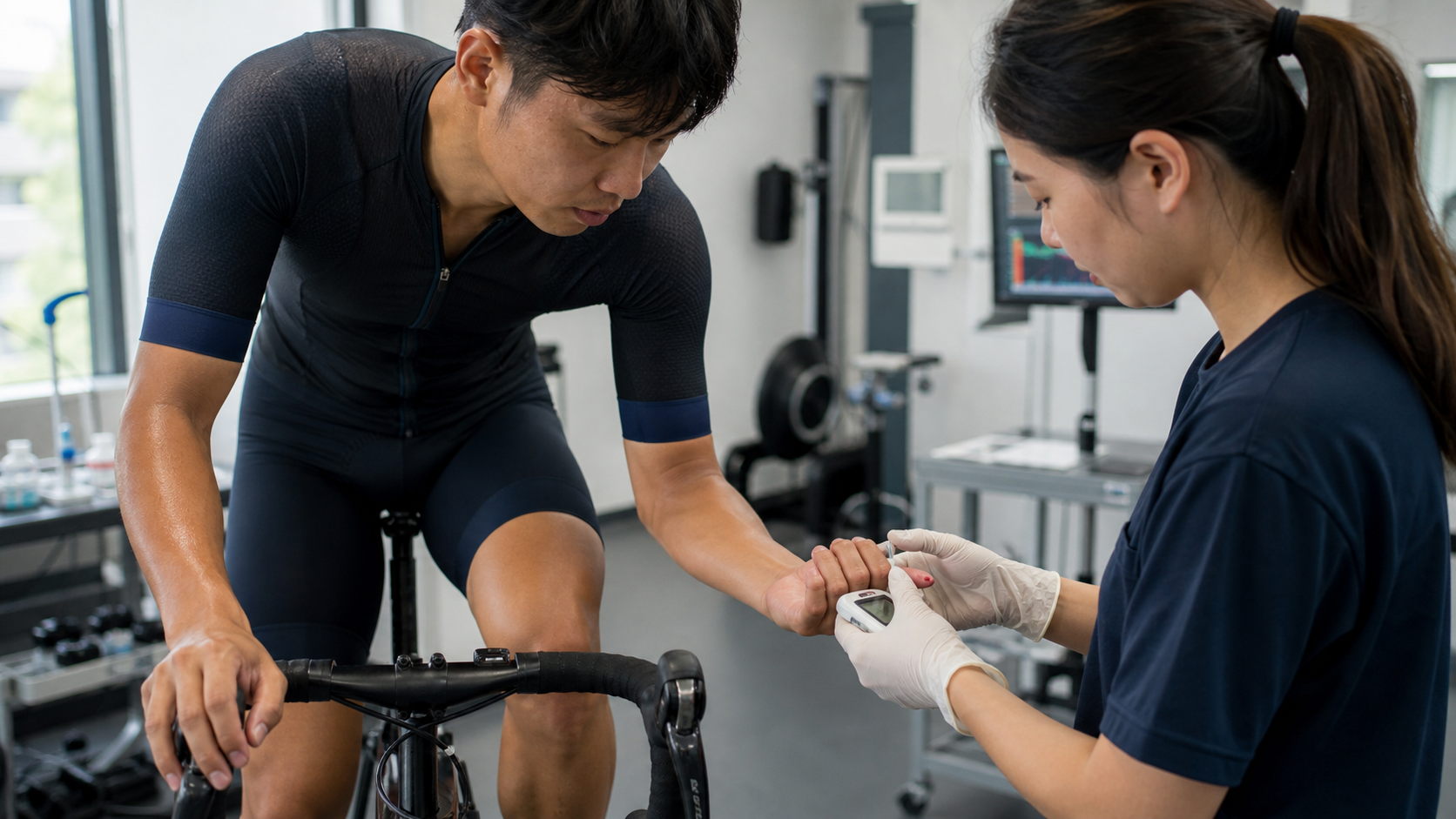
The Practical Blood Lactate Testing Protocol
Testing Steps
- Preparation: Avoid high-intensity training for 24 hours before the test, fast for 2–3 hours, and prepare a lactate analyzer (e.g., Lactate Plus, Edge)
- Warm-up: 5–10 minutes of low-intensity pedaling
- Progressive load: Ride 4–5 minutes per stage, with blood sampling at the end of each stage (usually from the earlobe or fingertip), increasing power by 25–40 W per stage
- Blood analysis: Read blood lactate concentration (mmol/L) immediately
- Continue until exhaustion or lactate exceeds 8 mmol/L
- Plot the lactate curve: Use power on the x-axis and lactate on the y-axis to identify the inflection points of LT1 and LT2
Testing Cost Considerations
| Method | Estimated Cost | Feasibility |
|---|---|---|
| University exercise science laboratory | NT$1,500–3,500 per test | Some universities open to the public |
| Private sports medicine clinic | NT$3,000–8,000 per test | Taipei, Taichung, and other major cities |
| Purchasing a personal lactate analyzer (Lactate Plus) | Approximately NT$15,000–20,000 (device) | For long-term athletes who purchase their own |
| Test strip cost | Approximately NT$100–200 per strip | Each test requires approximately 6–10 strips |
How to Set Training Zones from Lactate Data
Step 1: Identify the power corresponding to LT1 and LT2
Assume the test results are as follows:
- Power at LT1: 180 W (lactate 2.0 mmol/L)
- Power at LT2: 265 W (lactate 4.2 mmol/L)
Step 2: Define training zones using LT1 and LT2 as boundaries
| Training Zone | Power Range | Objective |
|---|---|---|
| Zone 1 (Recovery) | < 150 W | Active recovery |
| Zone 2 (Aerobic base) | 150–180 W | Below LT1, primarily aerobic metabolism |
| Zone 3 (Tempo) | 180–230 W | Between LT1–LT2, steady lactate metabolism |
| Zone 4 (Threshold) | 230–265 W | Near LT2, strengthening threshold capacity |
| Zone 5 (VO2max) | > 265 W | Above LT2, anaerobic training |
Differences Between Lactate Testing and FTP Testing
- Accuracy: Lactate testing directly measures physiological response; FTP testing is an indirect estimate
- Cost: FTP testing is nearly free (requires only a power meter); lactate testing is more expensive
- Repeatability: FTP can be self-tested every 6–8 weeks; lactate testing is recommended every 3–6 months
- Zone basis: Lactate testing can distinguish LT1 from LT2, making the boundaries of Zone 2 and Zone 4 clearer; FTP can only determine the Zone 4/5 boundary
Practical Recommendations
- LT1 is the golden boundary for Zone 2 training: In recent years, “polarized training” has emphasized large volumes of Zone 2 (below LT1). Knowing the power at LT1 precisely ensures that your LSD sessions don’t inadvertently drift into Zone 3 (steady lactate metabolism zone, which offers less training benefit than pure aerobic Zone 2).
- LT2 ≈ FTP, but not exactly equal: Individual differences exist; some athletes have an FTP corresponding to 3.5 mmol/L of lactate, while others sit at 5.0 mmol/L. This is a normal range of metabolic individual variation.
- Be mindful of heat accumulation when testing in Taiwan’s summer: In high-temperature environments, elevated heart rate shifts the power–lactate curve to the left. Testing in the early morning or in an air-conditioned indoor environment is recommended.
- LT2 power will rise after training improvements: After effective training, the power corresponding to the same lactate concentration (e.g., 4 mmol/L) increases. This is the core meaning of “tracking progress through lactate testing.”
- Avoid fatigue before testing: Lactate testing must be performed in a well-rested state. Avoid high-intensity training for two days prior; otherwise, the lactate curve will shift left, underestimating your true LT1/LT2 power.
Conclusion
Although blood lactate testing is more complex and expensive than FTP testing, it provides the most direct and most individualized basis for setting training zones. For amateur cyclists, undergoing one lactate test per year, combined with regular FTP monitoring, constitutes the most complete training science tracking protocol. By understanding the lactate curve, you will be able to control training intensity with greater precision—ensuring Zone 2 truly falls within the aerobic metabolism range, threshold training lands precisely near LT2, and every watt of training delivers maximum benefit.
Related Reading
- Lactate Threshold Training: How to Find Your Critical Cycling Pace
- Lactate Threshold Testing Methods: Accuracy Comparison Between Laboratory and Field Tests
- Portable Lactate Analyzers: Practical Operation and Training Applications for Running Lactate Threshold Testing
- Ventilatory Threshold and Lactate Threshold: Similar but Not Identical Physiological Boundaries
西進武嶺 免費訓練分析服務 Intervals | 練不夠還是練過頭?你哪一種類型選手?AI模型告訴你! | 備戰神器 | 公路車 訓練 | CT Yeh
4 年前
#公路車 #Vo2Max #最大攝氧量 測驗 體驗 | 心肺測試
6 年前
2021 96聯賽 桃園市長盃 4K多視角實況 當天選手瓦數/推力比/均速/時間 即時數據分析 | 公路車 | CT Yeh
5 年前
崇越盃武嶺冠軍高手 賽前JJSC 群峰會精華!對應大數據分析,會有落差嗎?/ feat. JJSC中部公路車約騎 /公路車 / CT Yeh
2 年前
單車AI教練!全新 ChatGPT4o 幫你分析訓練成果!排武嶺課表,分析騎車姿勢! 太神了! / 公路車 / CT Yeh / feat. 緯緯
2 年前
一個測試有沒有認真練車的方法😂 #公路車
10 個月前
#公路車 #Fitting 靠人工智慧APP 幫你調整單車
6 年前
一起升級!海鷗盃LSD團練...JJSC Zone2招待 騎到手抖 / 公路車 / CT Yeh
1 天前