Introduction
“I have a race coming up and I’m short on time—can I skip the warm-up?” This is one of the most common questions in the running community, and the answer is: No. Skipping the warm-up not only increases your risk of injury, but it also makes the first few kilometers especially painful—because muscles in a cold, stiff state are highly inefficient.
Another common misconception is that “warming up means static stretching.” Research shows that performing static stretching (holding a stretch without moving) before exercise can actually temporarily reduce muscle strength and power. The correct sequence should be: dynamic warm-up before running, static stretching after running.
Why Warm-Up and Cool-Down Are So Important
Physiological Purpose of the Warm-Up
- Raise muscle temperature: For every 1°C increase in temperature, muscle contraction speed and efficiency improve by about 13%
- Increase joint synovial fluid: Reduces the “dry” feeling in the knees and hips
- Activate neuromuscular connections: Wires up the “circuit” from the brain to the muscles
- Gradually elevate heart rate: Avoids the heart suddenly switching from rest to high intensity
Physiological Purpose of the Cool-Down
- Help flush out metabolic waste: Accelerates the removal of metabolic byproducts such as lactate
- Prevent blood from pooling in the lower limbs: Stopping abruptly can cause blood to pool in the legs, leading to mild dizziness
- Stretch while warm: Muscles are most pliable when warm, making it the best time to improve flexibility
5-Minute Dynamic Warm-Up Routine (Pre-Run)
Perform each of the following movements for 30 to 45 seconds, totaling about 5 minutes.
| Movement | Duration | Target Area | Key Points |
|---|---|---|---|
| Slow walking in place | 45 sec | Full-body activation | Start with a slow walk to let your heart rate rise gradually |
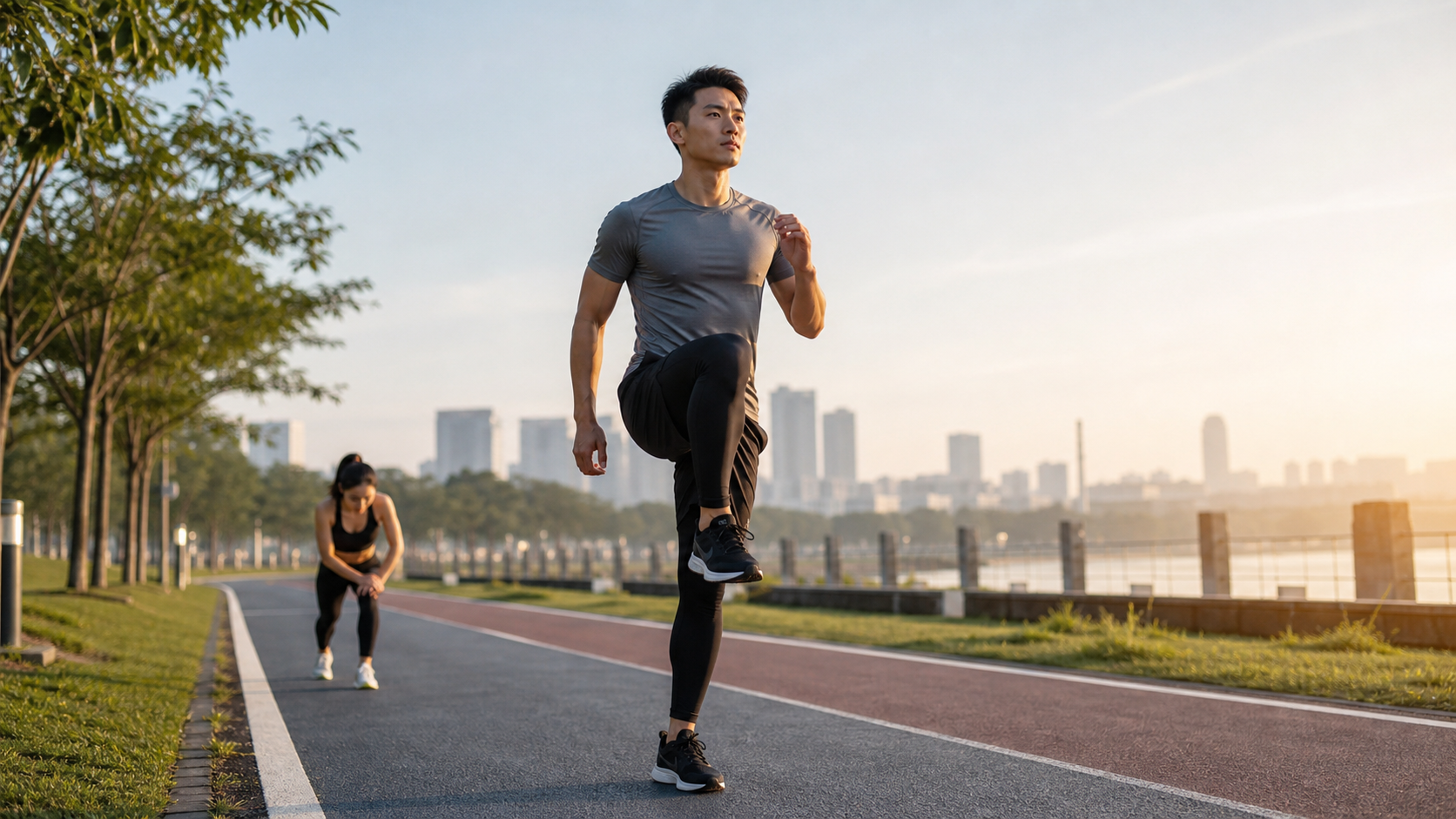
| High-knee walking | 30 sec | Hip flexors, core | Swing arms in opposition |
| Heel-to-glute walking | 30 sec | Quadriceps, knees | Keep your upper body upright |
| Side shuffles (lateral movement) | 30 sec/direction | Gluteus medius, inner thighs | Land lightly with knees slightly bent |
| Forward walking lunges | 30 sec | Hip flexors, glutes | Front knee should not extend past the toes |
| Big arm circles (forward + backward) | 20 sec/direction | Shoulders, upper back | Make the range of motion as large as possible |
| Jogging in place (gradually speeding up) | 60 sec | Full-body integration | Pick up the pace slightly in the final 30 seconds |
Notes for Cold Weather
During Taiwan’s winter (December to February), temperatures in the north can sometimes drop below 10°C. In such conditions, it is recommended to extend the warm-up to 8 to 10 minutes. Pay special attention to:
- Add 30 seconds each of wrist rotations and ankle rotations
- Repeat the lunge movement for an extra round
- Extend “jogging in place” to 2 minutes
5-Minute Static Stretching Routine (Post-Run)
After a run, your muscles are warm—this is the ideal time to stretch. Hold each movement for 20 to 30 seconds, stopping at a mild feeling of tightness, not pain.
6 Essential Cool-Down Stretches
1. Standing Quadriceps Stretch
Stand on one leg, bend the other leg backward, and hold the ankle with your hand, gently pulling it toward the glutes. You should feel a stretch in the front of the thigh. Hold for 20 seconds per side.
2. Standing Calf (Gastrocnemius) Stretch
Face a wall with one foot stepped back, keeping the back heel fully on the ground, and lean your body forward. You should feel a clear stretch along the back of the lower leg. Hold for 25 seconds per side.
3. Lunge Hip Flexor Stretch
Bend the front knee to 90 degrees, lower the back knee to the ground, keep your upper body upright, and gently push the hips forward. You should feel a stretch in the groin area of the rear leg. Hold for 25 seconds per side.
4. Standing IT Band Stretch
Stand with your feet crossed (target leg in the back), and lean your torso to the side and forward. You should feel a stretch along the outer thigh down to the knee. Hold for 20 seconds per side.
5. Seated Piriformis Stretch (Simplified Pigeon Pose)
Sit on the ground, bend one leg and place its ankle on the opposite knee, then slowly lean your body forward. You should feel a deep stretch in the glutes. Hold for 30 seconds per side.
6. Seated or Standing Spinal Twist
Sitting with both legs extended, place one hand on the outside of the opposite knee and slowly rotate backward. Hold for 15 seconds per side.
Practical Tips
- Treat the warm-up as part of the run, not an extra burden: Start your timing from the warm-up—it makes it easier to stick with mentally.
- Start with just 5 minutes: Rather than learning a complex full routine, master 3 to 4 simple movements and do them consistently.
- Don’t sit down immediately after running: Walk for 3 to 5 minutes after finishing to let your heart rate gradually drop, then proceed to static stretching.
- Taiwan’s climate is humid—watch out for slippery surfaces: When doing floor stretches, it’s recommended to bring a small foldable yoga mat.
Conclusion
Warm-up and cool-down together take only 10 minutes, yet they can significantly reduce injury risk and make every run feel better. Build this habit, and your running career will last for the long haul.
Related Reading
- The Right Way to Warm Up Before a Run: Replacing Static Stretching with Dynamic Warm-Up
- Prevention Over Cure: A 10-Minute Pre-Run Warm-Up Routine for Every Week
- Warm-Up Design for Speed Training: The Correct Sequence of Dynamic Stretching and Progressive Acceleration
- Warm-Up and Injury Prevention: A Comparison of the Latest Research on Dynamic Warm-Up vs. Static Stretching with Practical Recommendations
FTL 與 SYB 車隊專訪 西進武嶺 實用攻略分享! 2小時 如何練?!你不知道的眉角!新手準備武嶺必看 EP1 | 實力派女車友 | 精華版 | 公路車 | CTYeh
4 年前
Live) 備戰2019彰化經典百K 賽前攻略 (已完賽請看新影片
7 年前
一日北高/長距離團騎 常見問題補充篇 / 組團或跟團的眉角 / 壯車友容易被瘦車友慢性拉爆 / 原來屁股痛可能是這個原因...? / 風場配速法 / 公路車 / CT Yeh
2 年前
實景訓練台) 彰化經典百K 高強度喵團 90分鐘 跟著一起練功 2019 Indoor workout Changhua Classic 100 Taiwan
7 年前
西進武嶺 免費訓練分析服務 Intervals | 練不夠還是練過頭?你哪一種類型選手?AI模型告訴你! | 備戰神器 | 公路車 訓練 | CT Yeh
4 年前
CT 喇低賽) 武嶺牽車 才是王道 西進牽車四小時內秘訣 攝手位置 如何判斷 防抽筋小秘訣
7 年前
西進武嶺 自製新版AI配速表產生器 x 賽前攻略 抱佛腳! 沒有功率計也可以產生配速表嗎?有什麼其他眉角賽前要注意的呢? | 西進武嶺 / 東進武嶺 KOM 攻略 | 公路車 | CT Yeh
4 年前
一起升級!海鷗盃LSD團練...JJSC Zone2招待 騎到手抖 / 公路車 / CT Yeh
1 天前