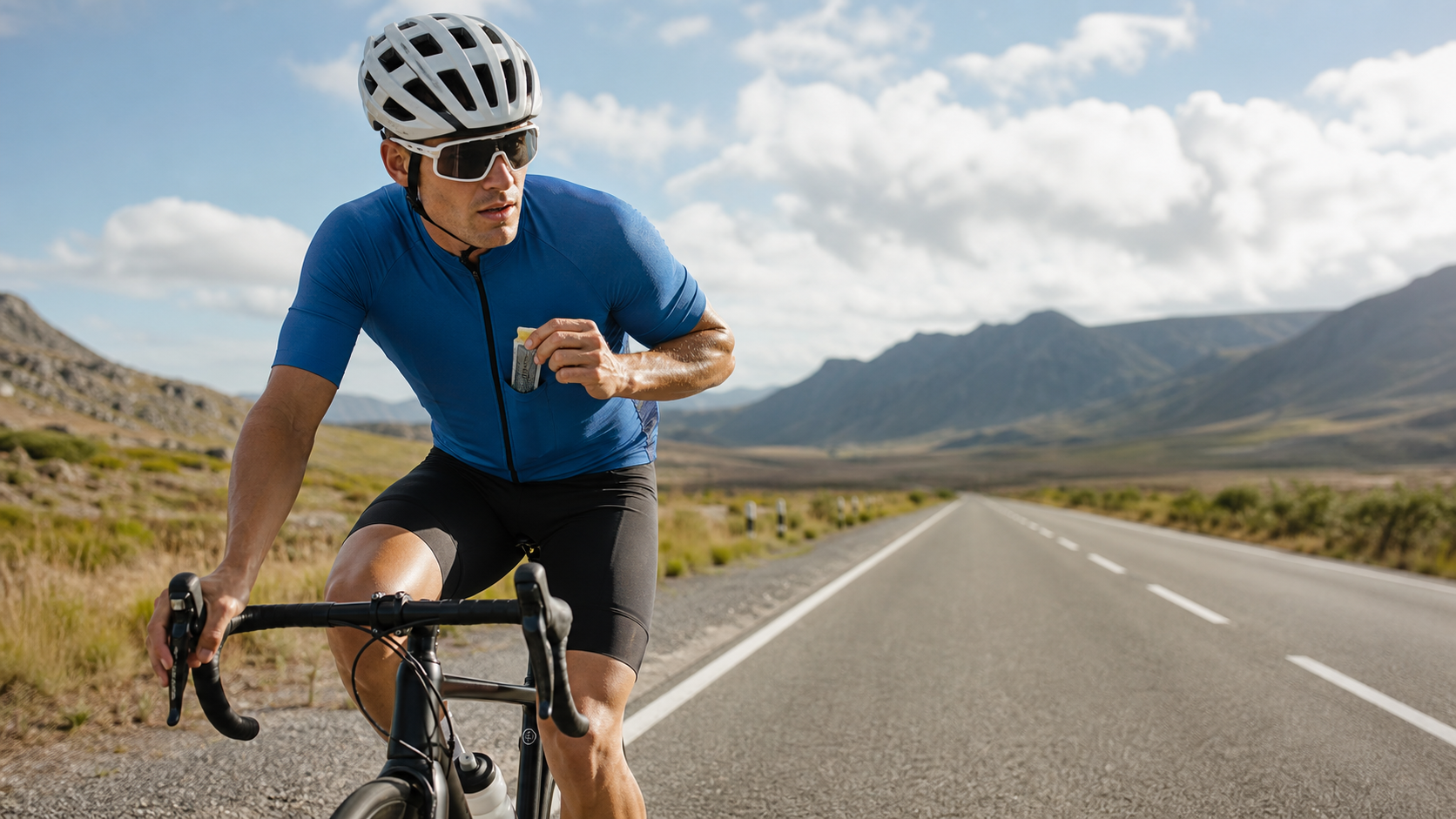
Introduction
Have you ever suddenly felt your legs give out and your head go foggy in the third hour of a long ride? This is the state of glycogen depletion commonly known as “bonking.” Both your muscles and brain are crying out for fuel, and your speed collapses from 30 km/h to below 20 km/h. The problem isn’t a lack of effort—it’s a poorly executed carbohydrate strategy.
For long-distance training or events lasting more than 90 minutes, your carbohydrate intake approach will directly determine the quality of your finish. This article starts from exercise physiology and walks you through building a scientific long-distance fueling strategy.
The Exercise Physiology Basics of Carbohydrates
How Much Glycogen Can the Body Store?
The glycogen stored in human muscles and the liver is limited:
| Storage Site | Estimated Storage (g) | Usable Energy (kcal) |
|---|---|---|
| Muscle glycogen | 350–500 g | 1400–2000 kcal |
| Liver glycogen | 80–100 g | 320–400 kcal |
| Blood glucose | ~5 g | ~20 kcal |
| Total | ~500 g | ~1800 kcal |
Take a rider weighing 70 kg producing 200W as an example: they burn roughly 720–800 kcal per hour, meaning relying purely on stored glycogen, they’ll bottom out in at most 2–2.5 hours.
Why Must You “Eat While Riding” Instead of Just Pre-Loading?
Some believe “just eat a big meal before heading out,” but research shows that even with full carbohydrate loading before an event, exogenous (consumed) carbohydrates become essential for maintaining intensity after riding for more than 2 hours. The reason is that the muscles’ oxidation efficiency of exogenous carbs can effectively “spare” remaining glycogen stores, allowing you to sustain higher power output in the latter half.
How Many Carbohydrates Should You Consume Per Hour?
Traditional Recommendations vs. Modern Gut-Training Research
- Traditional recommendation: 60 g per hour (roughly the carb content of one energy bar)
- Modern research upper limit: A well-trained gut can handle 80–120 g per hour
This breakthrough comes from research on “multiple transportable carbohydrates” (MTC). Traditional thinking held that the intestine’s SGLT-1 transporter could only move 1 g of glucose per minute, capping absorption at about 60 g/hr. But when glucose + fructose are consumed together, because fructose uses a different transporter (GLUT5), total absorption can rise to 90–120 g/hr.
Recommended Intake by Training Level
| Riding Intensity and Duration | Recommended Carb Intake Per Hour |
|---|---|
| Easy intensity (< 2 hours) | 0–30 g; rinsing the mouth with carb solution to stimulate the CNS is sufficient |
| Moderate intensity (2–3 hours) | 60 g/hr (single carbohydrate is sufficient) |
| High intensity (> 3 hours) | 80–90 g/hr (glucose + fructose at 2:1) |
| Ultra-long distance (> 5 hours) | 90–120 g/hr (after adequate gut training) |
The Golden Ratio of Glucose to Fructose
Research has repeatedly confirmed that a glucose:fructose = 2:1 ratio achieves the best balance between absorption efficiency and gastrointestinal tolerance. Many energy gels and sports drinks on the market already use this formula (such as combinations containing maltodextrin + fructose).
Reference carb content of common fueling products in Taiwan:
- One 500ml sports drink (e.g.,舒跑): approximately 25–30 g carbs
- One energy gel (approx. 30–35ml): 20–25 g carbs
- One energy bar (40–50g): 25–35 g carbs
- One rice ball (approx. 120g): 30–40 g carbs
- One banana (medium): approximately 25 g carbs
Gut Training: Getting Your Stomach to Accept High Carb Intake
When many riders try an 80–90 g/hr fueling strategy, the first problem they hit is gastrointestinal distress—bloating, nausea, and abdominal cramps. This is because the gut’s digestive enzymes (particularly sucrase and lactase) can be trained to increase in capacity.
Gut training recommendations:
- Fuel during rides at least 2–3 times per week; don’t only eat on race day
- Start at 60 g/hr and increase by 10–15 g every two weeks to let the gut gradually adapt
- Long training rides (3+ hours) are the best time for gut training
- Choose a multiple-transportable-carbohydrate formula rather than pure glucose to reduce the burden on a single transporter
Practical Tips
- Design a fueling schedule: Fuel every 20–30 minutes; smaller, more frequent doses are better absorbed and avoid sharp blood sugar swings.
- Don’t wait until you’re hungry: Begin fueling once you’ve been riding for more than 45 minutes; don’t wait until you feel depleted to play catch-up.
- Combine solid + liquid: For long distances, pair solid foods (rice balls, energy bars) with sports drinks to spread the load on your gut.
- Don’t try anything new on race day: Do your gut training during regular workouts; on race day, use only fueling products you’re familiar with.
- Calculate your carb deficit: Riding at 25 km/h at moderate intensity for 4 hours requires roughly 240–360 g of exogenous carbs; prepare enough fuel in advance.
Conclusion
Carbohydrate strategy isn’t intuition—it’s a skill that requires practice. Every long training ride is an opportunity for gut training. Fuel the right amount at the right time, and your performance in the latter half will be dramatically different. Starting today, make a fueling plan an essential part of every long-distance training ride, teach your body to “eat while riding,” and you’ll be able to perform at your best on race day.
Related Reading
- Fueling Strategy for Long-Distance Rides: How Many Carbohydrates Per Hour?
- Energy Fueling Plan for Long-Distance Cycling: The Science of Hourly Intake
- The Complete Guide to Cycling Fueling: Energy and Hydration Management for Long Rides
- Energy Fueling Schedule for Long Rides: Practical Carb Intake Per Hour
一日北高常見問題大集合 | 攻略 | 路線 | 訓練 | 補給 | 自行車 單車 | 一日雙城 | 雙塔 | TWB北高360 | 屁股痛
6 年前
單車 一日北高 ( 雙城 ) 肥宅雙人瘋狂行 紀錄片 REACTO
10 年前
靠單車減肥35公斤 心得分享與整理
7 年前
一日北高前的高裝檢 | 北高 360 | 挑戰11小時的裝備 | 一日雙塔 | 補給
6 年前
CT暗黑廚房) 車友必備 宇宙無敵鮮蚵湯 幫助訓練恢復 天然食補 好市多 超肥鮮蚵 破PR
7 年前
一日北高/長距離團騎 常見問題補充篇 / 組團或跟團的眉角 / 壯車友容易被瘦車友慢性拉爆 / 原來屁股痛可能是這個原因...? / 風場配速法 / 公路車 / CT Yeh
2 年前
一日北高 11小時 賽後心得分享篇 | TWB北高360 | 一日雙城 | 單車 | 公路車
6 年前
西進武嶺 免費訓練分析服務 Intervals | 練不夠還是練過頭?你哪一種類型選手?AI模型告訴你! | 備戰神器 | 公路車 訓練 | CT Yeh
4 年前