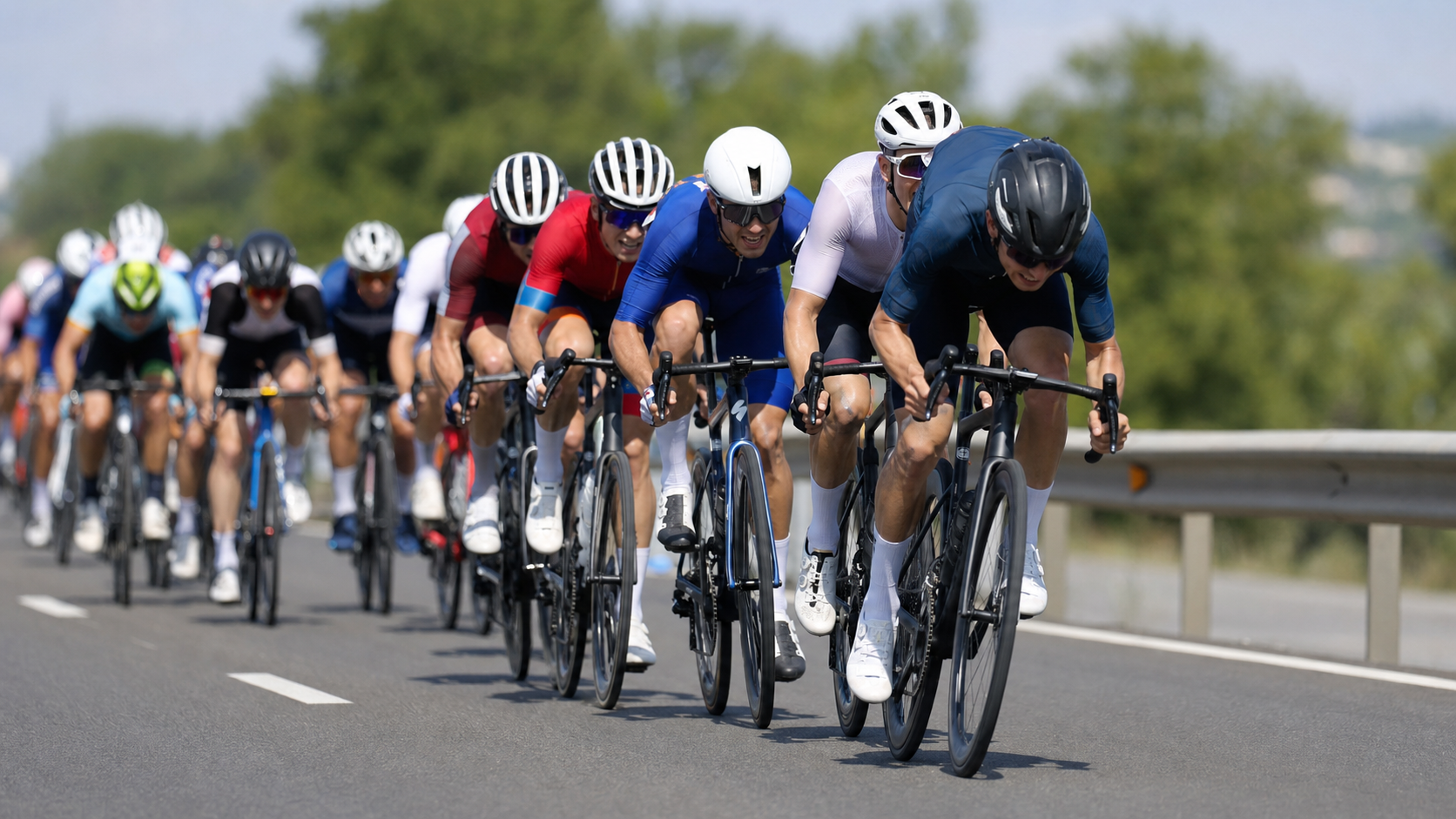
Introduction
In peloton racing, the final sprint is often won not by the strongest rider, but by the smartest one. In the tightly packed chaos of dozens of riders, tactical positioning, drafting timing, and the judgment of when to launch often matter more than raw wattage output. The growing number of amateur group races and criteriums in Taiwan gives riders the opportunity to put these strategies into practice.
The Science and Strategy of Drafting
Quantifying the Energy Savings
Riding behind the rider in front can significantly reduce aerodynamic drag:
| Position | Estimated Energy Savings | Best Use Case |
|---|---|---|
| Close follow (within 1 bike length) | 25–30% | Core of the pack, high speed on flats |
| Tail follow (2–3 bike lengths) | 15–20% | Edge of the pack, descents |
| Echelon (crosswind) | 10–20% | Diagonal formation in crosswind conditions |
| Riding solo | 0% | Solo breakaway, time trial |
Drafting Strategy for the Final 2 Kilometers
With 2 km to go, speeds typically reach 45–50 km/h, and the energy saved by drafting translates directly into sprint power. The ideal approach is:
- Stay in the front 20% of the pack to avoid getting boxed in
- Don’t take long pulls at the front (wasting energy to shelter others)
- Follow closely but maintain enough reaction distance (at least half a bike length)
- Assess your rivals and identify who poses the biggest threat
Five Key Moments for Position Control
1. Final 5 km: Move into the Front
Many riders wait until the last kilometer to try to move up, but by then the pack has already formed a “train” structure, leaving almost no room to slot in. You should start actively moving up from 5 km out, finding gaps to work your way toward the front.
Tip: Use corners, climbs, or moments when the pace eases to move laterally, as the pack is less dense then and shifting position is easier.
2. Final 1 km: Secure Your Sprint Position
The goal is to be at the back of the lead-out train, or directly behind the sprinter, when the final kilometer begins. Position at this point almost decides the outcome of the sprint.
Ideal Position:
- Directly behind the strongest sprinter (second wheel)
- Or at the tail end of the lead-out train (third to fifth wheel)
3. Forming and Following the Lead-Out Train
Strong teams typically deploy “lead-out riders” to pace the final few kilometers in sequence, before the main sprinter launches. Amateur riders can hitch a ride on a strong team’s train and jump past them at the crucial moment.
Things to Note:
- Don’t pull ahead of the lead-out riders (you’ll burn your own energy)
- Keep your vision clear and anticipate when the sprinter will launch
- Be ready to counter-attack after a short distance
4. Judging the Launch Point
Launching too early is the most common mistake, especially into a headwind. Your energy drains rapidly after launching, making it easy for riders behind to overtake you.
| Condition | Recommended Launch Distance |
|---|---|
| Tailwind | 200–250m |
| No wind | 150–200m |
| Headwind | 100–150m |
| Uphill finish | 300–400m |
5. Launch Angle and Line Choice
When launching, choose the wider side of the road and take the “ideal racing line” through corners. If possible, recon the finish area before the race to understand the road conditions over the final 500m.
Common Tactical Mistakes and Countermeasures
Mistake 1: Sprinting Too Early
- Problem: Jumping from 500m out, running out of energy in the final stretch
- Solution: Train to feel your optimal sprint distance (can be tested with timed efforts)
Mistake 2: Getting Boxed In
- Problem: Squeezed by riders in front, behind, and on both sides, unable to launch
- Solution: Move toward the right side of the road (or left, depending on conditions) early to leave room for your launch
Mistake 3: Following the Wrong Rider
- Problem: Sitting on a weaker rider and missing the timing of the strongest sprinter
- Solution: Know your main rivals before the race and identify their jersey colors or bike models
Mistake 4: Ignoring the Wind
- Problem: Launching into a headwind and burning out quickly
- Solution: Check the wind direction before the race; in a headwind, launch later and stay on a wheel until the last moment
Practical Advice
- Gain experience in criteriums: Weekend criteriums across Taiwan are the best place to practice group sprint strategy, with many laps and plenty of sprint opportunities.
- Recon the finish beforehand: If possible, ride or inspect the final 500m of the course, noting corners, road width, and surface conditions.
- Watch pro race footage: YouTube has plenty of pro sprint videos—carefully analyze riders’ positioning and timing, especially the final 5 km.
- Practice sprints with training partners: Simulate sprints with 2–3 friends to experience drafting, launching, and being overtaken in real situations.
Conclusion
The group sprint is a comprehensive art blending fitness, technique, and tactical judgment. For most amateur riders, improving tactical awareness often brings faster gains in results than pure power training alone. By consciously practicing position control in every group ride, observing your rivals, and learning from each sprint, you will gradually build your own sprint instinct and write your own exciting chapter on Taiwan’s race courses.
Related Reading
- Group Riding in Road Races: Complete Guide to Positioning and Energy-Saving Strategies
- Drafting Techniques for Long Group Rides: Proper Following and Pulling to Save 20% of Your Energy
- The Science of Wind Resistance: Complete Analysis of Drafting and Group Riding Efficiency
- Tour de Taiwan Tactics Class: The Complete Art of Attack and Defense in Group Sprints
戰略) Zwift Race 如何咬在第一集團 如何評估自己要開多少推力 (請開1.5倍速看)
7 年前
2025 海鷗團體繞圈賽 / 前八強賽事精華!/ 環台賽等級拍攝 / 國手菁英隊伍較勁 / CT Yeh #公路車
8 個月前
CT 喇低賽) 武嶺牽車 才是王道 西進牽車四小時內秘訣 攝手位置 如何判斷 防抽筋小秘訣
7 年前
2026 輪霸西濱200K 挑戰VLOG / 第一集團 / 首次參加..經驗不足、膀胱不足 /死守6H內 / AI戰鬥力顯示系統 / 公路車 / CT Yeh
4 個月前
西進武嶺 自製新版AI配速表產生器 x 賽前攻略 抱佛腳! 沒有功率計也可以產生配速表嗎?有什麼其他眉角賽前要注意的呢? | 西進武嶺 / 東進武嶺 KOM 攻略 | 公路車 | CT Yeh
4 年前
風櫃嘴 | 全台最多大砲的單車路線 | 尋寶網攝影師告訴你怎麼擺拍起來才好看 | 熱門攝影地點巡禮
6 年前
風櫃嘴時間 預測西進武嶺時間?13000名車友統計數據分析告訴你 !
5 年前
備戰 戀戀197 賽前關門點分析 西濱團練 #公路車 4K高畫質
6 年前