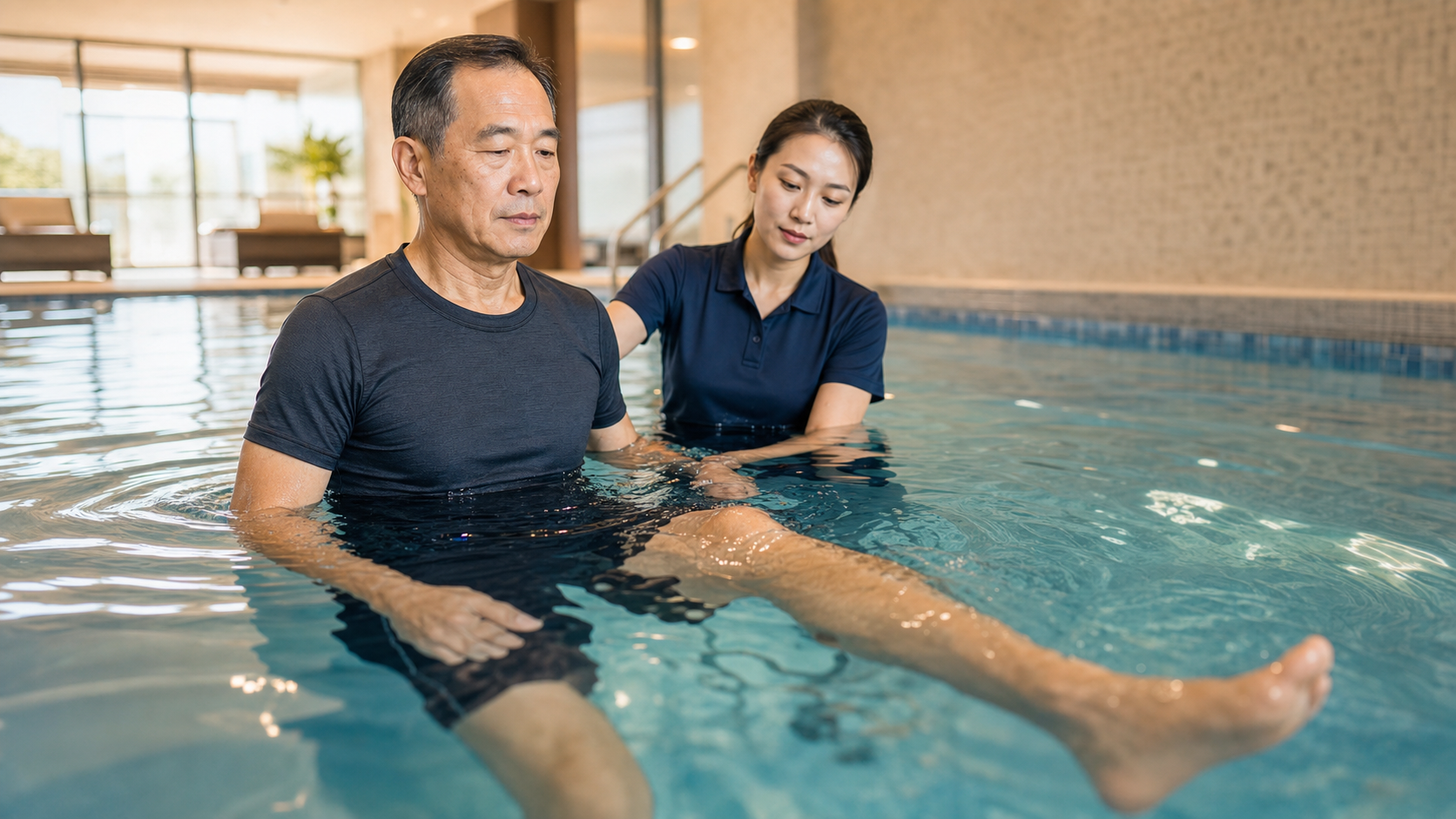
Introduction
Osteoarthritis (degenerative joint disease) is one of the most common issues among middle-aged and older athletes in Taiwan. According to statistics from the Ministry of Health and Welfare, approximately 15–25% of people over 65 in Taiwan have some degree of knee joint degeneration, and among marathon runners and triathletes, the cumulative impact of long-term training has gradually lowered the age at which joint degeneration begins. Many people’s first reaction upon learning they have joint degeneration is, “I can’t exercise anymore,” but this is a serious misconception. Water training is precisely the best way for people in this situation to rediscover the joy of exercise and rebuild their fitness.
The Relationship Between Osteoarthritis and Exercise
The Scientific Basis for “Not Moving Is More Harmful”
Patients with osteoarthritis who stop exercising often fall into a vicious cycle:
- Pain → Reduced activity
- Reduced activity → Peripheral muscle atrophy
- Muscle atrophy → Decreased joint stability
- Decreased joint stability → More pain and degeneration
Research shows that moderate, low-impact aerobic exercise can:
- Promote synovial fluid secretion and improve cartilage nutrition supply
- Strengthen peripheral muscles to share the load placed on joints
- Reduce systemic inflammatory markers (such as CRP, IL-6)
- Improve pain tolerance and psychological well-being
Why Is Water Training Especially Suitable?
| Water Environment Characteristics | Specific Benefits for Joints |
|---|---|
| Buoyancy reduces body weight by 70–90% | Greatly reduces joint loading, allowing training even during painful periods |
| Water resistance provides muscle training | Strengthens peripheral muscles without harming joints |
| Water pressure promotes circulation | Reduces swelling around joints |
| Multi-directional resistance | Provides multi-planar joint stability training, more comprehensive than machines |
| Warm water effect (if available) | Relaxes muscle tension and reduces pain perception |
Aquatic Rehabilitation Program for Osteoarthritis
Phase 1: Pain Relief Period (After the Acute Inflammatory Phase)
Goal: Restore joint range of motion and reduce swelling
- Water walking: Forward-backward and lateral walking, 15–20 minutes per session
- Water leg swings: Standing while holding the edge, gently swing one leg forward and backward in small ranges, emphasizing joint gliding rather than muscle strength
- Float-assisted floating: Fully unload the joints while performing gentle kicking movements
- Water temperature recommendation: 32–34°C warm water is optimal (if a warm-water pool is available)
Phase 2: Muscle Rebuilding Period
Goal: Strengthen the quadriceps, glutes, and calf muscles to improve joint stability
- Water squats: Use buoyancy for assistance, squatting to a depth that does not aggravate pain
- Water lunges: Forward lunges and lateral lunges to improve coordination across the hip, knee, and ankle joints
- Resistance frog kicks: Use a kickboard and perform breaststroke-style leg kicks to strengthen the quadriceps
- Water calf raises: Heel-raise training to strengthen the calves and ankle stability
- 10–15 repetitions per set, 2–3 sets per session
Phase 3: Functional Training Period
Goal: Restore daily activities and sports function
- Aqua jogging: Simulate running in deep water to prepare for returning to land-based activities
- Light water jumping: Use buoyancy for cushioning, starting with small jumps to train impact tolerance
- Swimming aerobics: 30–45 minutes of continuous aerobic swimming in freestyle or backstroke
- At this stage, land-based low-impact training (cycling, elliptical machine) can begin concurrently
Swimming Precautions for Different Joint Problems
- Knee joint degeneration: Avoid breaststroke kicking (increases valgus stress on the knee); freestyle and backstroke are the top choices
- Hip joint degeneration: Avoid excessive external rotation movements (such as the breaststroke whip kick); freestyle is the primary stroke
- Shoulder joint issues: Focus on kickboard-assisted lower-limb training; upper-limb training requires evaluation by a physical therapist
- Spinal issues (lumbar degeneration): Backstroke helps extend the spine, but avoid excessive twisting movements
Practical Recommendations
- Consult an orthopedist or physical therapist first: Confirm your current joint condition and rule out the acute inflammatory phase before starting water training.
- Look for aquatic rehabilitation programs: The physical therapy departments of many hospitals in Taiwan (such as National Taiwan University Hospital, Chang Gung Memorial Hospital, Mackay Memorial Hospital, etc.) offer hydrotherapy programs guided by therapists, providing greater safety.
- The importance of water shoes: Wear non-slip water shoes during water training to avoid slipping at poolside and to provide ankle support.
- Progress slowly: The intensity and duration of water training should increase gradually, with increments of no more than 10% at a time. If joint pain worsens after exercise and persists for more than 2 hours, reduce training intensity.
- Combine with land-based strength training: Water training is a foundation, but long-term joint protection still requires land-based strength training (such as leg press machines, clamshells, etc.) for optimal results.
Conclusion
Osteoarthritis is not the end of exercise—it is the starting point for changing how you exercise. Water training provides an environment where you can keep training within your pain tolerance, allowing joints to recover while peripheral muscles continue to grow stronger. For middle-aged and older sports enthusiasts in Taiwan, rebuilding fitness from the pool is the gentlest and most scientific path back to an active life.
Related Reading
- Swimming for Joint Protection: Swimming Recommendations for Osteoarthritis Patients
- Aquatic Exercise Prescriptions for Knee Osteoarthritis: Designing Buoyancy-Assisted Weight Reduction and Water Resistance Training
- Swimming and Joint Protection: The Best Choice for Low-Impact Exercise
- Swimming and Arthritis: The Best Choice for Low-Impact Exercise
[教學] Premiere 影片 手震 修正 教學 防抖 單眼 影像 GoPro 穩定 Video Stabilization
8 年前
西進武嶺 免費訓練分析服務 Intervals | 練不夠還是練過頭?你哪一種類型選手?AI模型告訴你! | 備戰神器 | 公路車 訓練 | CT Yeh
4 年前
Never Stop 西進武嶺 前後雙機 完整全程錄影 訓練台 實境
8 年前
靠單車減肥35公斤 心得分享與整理
7 年前
滑雪新手們慘摔學習全紀錄(請開字幕),滑雪好好玩 | Snowboard + Ski | 岩原 スキー場 | 滑雪APP使用 | GoPro Max
6 年前
碟煞公路車 銑面器 !? 原來銑完差這麼多! 降低蹭碟機率! | TIME 公路車 保養小記錄 | CT Yeh
3 年前
一日北高常見問題大集合 | 攻略 | 路線 | 訓練 | 補給 | 自行車 單車 | 一日雙城 | 雙塔 | TWB北高360 | 屁股痛
6 年前
大禹嶺 到 武嶺牌樓 全程前後實況錄影 | 北進武嶺 | 東進武嶺 | KOM | 訓練台 | 坡度分析 | Taiwan KOM Last 10 km HARD | 公路車
6 年前