Introduction
Many Taiwanese runners, after completing a training session or race, often rush home or immediately start scrolling on their phones, skipping the cool-down entirely. However, neglecting post-run stretching not only causes muscles to tighten up more quickly in the short term but can also accumulate fatigue and increase the risk of injury over the long term. Performing static stretches when the heart rate has slowed and muscles are still warm yields far better results than pre-workout stretching. It is the easiest and most cost-effective maintenance method in the recovery process.
Why Stretch After Running?
During a run, muscles repeatedly contract and shorten, while lactic acid and metabolic waste products accumulate. Upon finishing, muscle fibers are in a state of “tightened fatigue.” Performing static stretches at this time can:
- Help muscles gradually return to their resting length, reducing stiffness the next day
- Promote blood circulation to accelerate the removal of metabolic waste
- Reduce the likelihood of muscle spasms and nighttime cramps
- Maintain joint range of motion, preventing compensatory movements caused by repetitive running
The optimal timing for static stretching is “within 10 minutes after exercise,” when muscle temperature is highest and extensibility is best. Each stretch should be held for 30–60 seconds, repeated for 2–3 sets.
Stretching Instructions for Each Body Part
Calves (Gastrocnemius and Soleus)
The calves are one of the muscle groups that bear the most impact during running. They are divided into the more lateral gastrocnemius (crossing the knee joint) and the deeper soleus (not crossing the knee joint); both need to be stretched separately.
Gastrocnemius Stretch (Straight Knee)
- Stand facing a wall, hands gripping the wall
- Straighten the back leg with the heel on the ground, and bend the front knee
- Lean the body slightly forward to feel the tightness in the calf of the back leg
Soleus Stretch (Bent Knee)
- Same position as above, but slightly bend the knee of the back leg
- Sink the hips backward to feel a deeper tightness
Front Thigh (Quadriceps)
After running downhill or on long distances, the quadriceps are often severely fatigued.
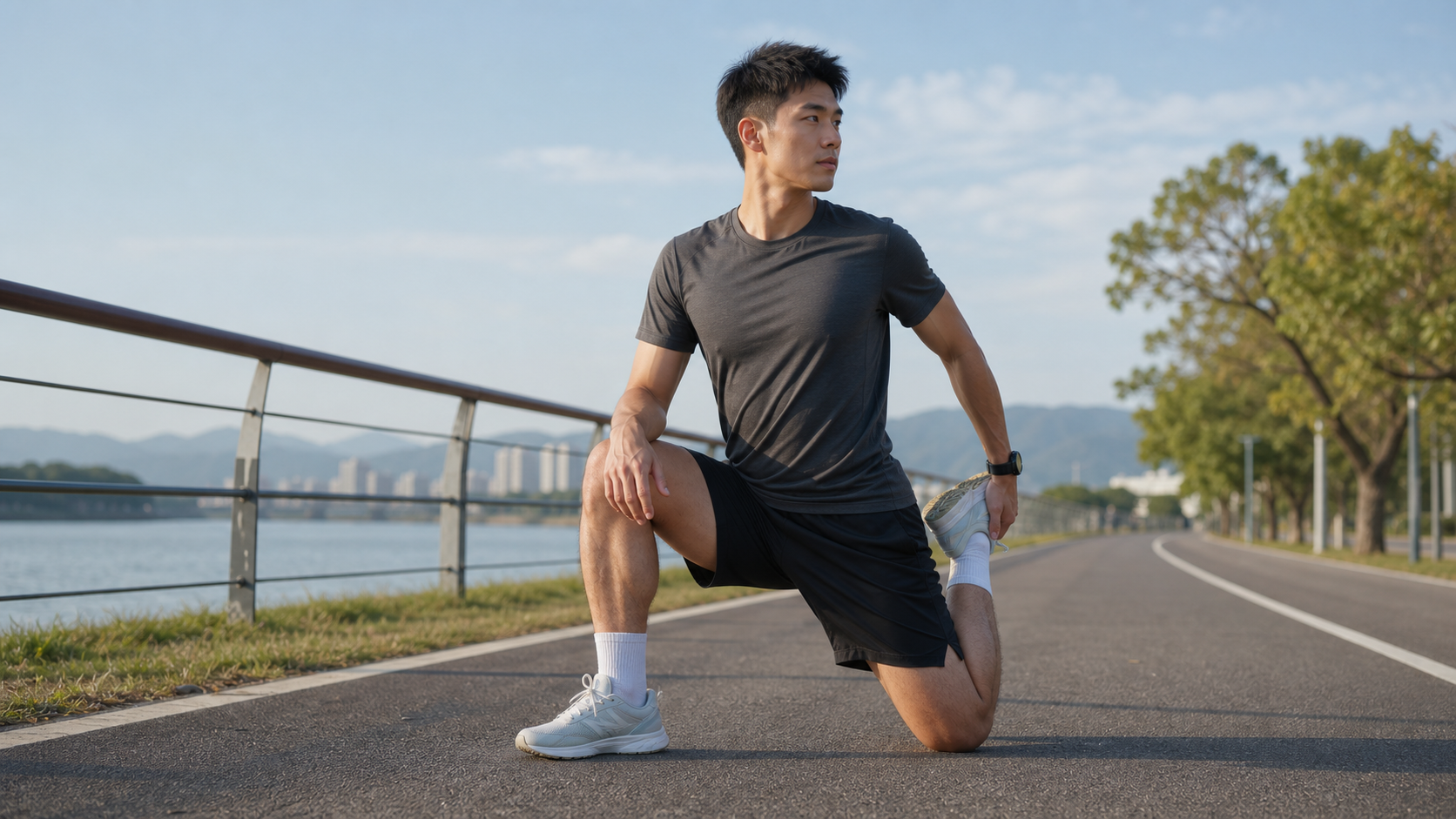
- Stand on one leg, bend the knee of the other leg, and pull the heel toward the buttocks
- Hold the ankle with the same-side hand, keeping the knee pointing down (do not let it flare outward)
- If balance is insufficient, hold onto a wall or use a door frame for assistance
Back Thigh (Hamstrings)
- Sit on the ground, straighten one leg, and place the sole of the other foot against the inner thigh
- Keep the back straight and lean the body forward toward the straight leg
- Feel the extension in the back of the thigh, avoiding compensation by hunching the back
Iliotibial Band (IT Band)
Stretching the IT band can reduce friction pressure on the outer knee and lower the risk of accumulating ITBS.
- Stand, crossing the left leg behind the right leg
- Push the body to the left with the right hand, feeling tightness on the outer right hip
- Repeat on the other side
Table of Recommended Stretch Duration and Frequency by Body Part
| Body Part | Primary Target Muscle | Recommended Duration | Sets |
|---|---|---|---|
| Calves (Straight Knee) | Gastrocnemius | 30–45 seconds | 2–3 sets |
| Calves (Bent Knee) | Soleus | 30–45 seconds | 2–3 sets |
| Front Thigh | Quadriceps | 30–60 seconds | 2 sets |
| Back Thigh | Hamstrings | 45–60 seconds | 2–3 sets |
| Iliotibial Band | IT Band / Gluteus Medius | 30–45 seconds | 2 sets |
Common Mistakes and Precautions
- Bouncing Stretching: Static stretching should “slowly push to the point of tightness and hold,” not repeatedly bounce. Bouncing triggers the stretch reflex, which can make muscles tighter.
- Holding Breath: Maintain natural breathing during stretching, and slightly deepen the stretch on the exhale.
- Stretching Only One Side: Symmetry between both sides is very important; perform equal time on both left and right.
- Pain Sensation: “Tightness” is normal; if “sharp pain or burning sensation” occurs, stop immediately.
Practical Suggestions
To make cool-down stretching a habit, it is recommended to keep a yoga mat in your running shoe bag, or directly use low walls and railings in a park. If time is limited, prioritize stretching the calves and IT band, as these are the areas most prone to tightness and most frequently causing subsequent injuries for Taiwanese runners. After long-distance races (such as half-marathons or full marathons), double the stretching time, and combine it with light walking or a hot bath for better results.
Conclusion
Post-run static stretching does not require special equipment; it only takes 10–15 minutes. Treating your body well after every training session allows you to start the next one in better condition. Treat cool-down stretching as the final step of the running routine, not an optional extra. Accumulating this habit will save you much rehabilitation time in the long term.
Related Reading
- Post-run Static Stretching SOP: Effective Only When Stretching the Right Places at the Right Time
- Running Calve Stretching Sequence: 3-Stage Plan of Dynamic Pre-run, Static Post-run, and Deep Next-Day
- Post-Run Stretching: Timing Selection Between Dynamic vs. Static
- Post-Run Cool-down and Stretching: Complete 15-Minute Routine
一日北高/長距離團騎 常見問題補充篇 / 組團或跟團的眉角 / 壯車友容易被瘦車友慢性拉爆 / 原來屁股痛可能是這個原因...? / 風場配速法 / 公路車 / CT Yeh
2 年前
白沙屯媽祖進香在家走!UREVO 坡度自調走步機 / 可連接訓練遊戲APP MyWhoosh / 邊看直播邊走起來 / CT Yeh
11 個月前
FTL 與 SYB 車隊專訪 西進武嶺 實用攻略分享! 2小時 如何練?!你不知道的眉角!新手準備武嶺必看 EP1 | 實力派女車友 | 精華版 | 公路車 | CTYeh
4 年前
Live) 備戰2019彰化經典百K 賽前攻略 (已完賽請看新影片
7 年前
實景訓練台) 彰化經典百K 高強度喵團 90分鐘 跟著一起練功 2019 Indoor workout Changhua Classic 100 Taiwan
7 年前
iPhone內建一秒變長腿🤣 車友必備#cycling
2 年前
大禹嶺 到 武嶺牌樓 全程前後實況錄影 | 北進武嶺 | 東進武嶺 | KOM | 訓練台 | 坡度分析 | Taiwan KOM Last 10 km HARD | 公路車
6 年前
CT 喇低賽) 武嶺牽車 才是王道 西進牽車四小時內秘訣 攝手位置 如何判斷 防抽筋小秘訣
7 年前