Introduction
For most well-trained swimmers, a standard 1.5 km open-water swim doesn’t require a special fueling plan. However, when the race distance stretches to 5 km, 10 km, or even farther, energy management becomes just as important as technique. Open-water swimming fueling has a fundamental challenge: you can’t grab food from an aid station and eat on the run like a runner, nor can you carry a fuel bag on your body and access it anytime like a cyclist. Every fueling opportunity means you need to temporarily stop moving forward, float on the surface, quickly complete your intake, and then resume swimming as soon as possible. This unique situation demands a highly refined fueling strategy.
Physiological Demands of Open-Water Fueling
Although swimming doesn’t cause heavy sweating in hot conditions like running does, the caloric expenditure of long-distance swimming is equally substantial, especially in cold water, where the body burns extra calories to maintain core temperature.
General estimate: a 70 kg swimmer swimming at moderate intensity for one hour burns approximately 500–700 kcal. If the race distance takes 2–3 hours to complete, without supplemental fueling, the body’s glycogen stores (typically 1,500–2,000 kcal) may become significantly depleted in the latter stages, affecting your ability to maintain pace in the second half of the race.
Regarding electrolytes, although the swimming environment is cooler, prolonged muscle contractions still deplete minerals such as sodium, potassium, and magnesium, which can trigger cramps—something that requires particular attention in cold-water events.
| Race Distance | Estimated Finish Time | Fueling Needed | Recommended Fueling Stops |
|---|---|---|---|
| 1.5 km | 20–35 min | Usually not needed | 0 times |
| 3 km | 40–70 min | Depends on the individual | 0–1 times |
| 5 km | 70–120 min | Recommended | 1–2 times |
| 10 km | 120–240 min | Mandatory | 3–5 times |
| 25 km and above | 5+ hours | Highly refined plan | Based on training plan |
Fueling Methods and Food Choices
Open-water fueling is primarily carried out through the following methods:
Feeding platform: Some long-distance races set up floating platforms along the course where swimmers can briefly rest and take on fuel. This is the fueling method closest to a normal eating environment, but the stop time is usually counted in seconds, so you need to prepare food in a form that can be consumed quickly in advance.
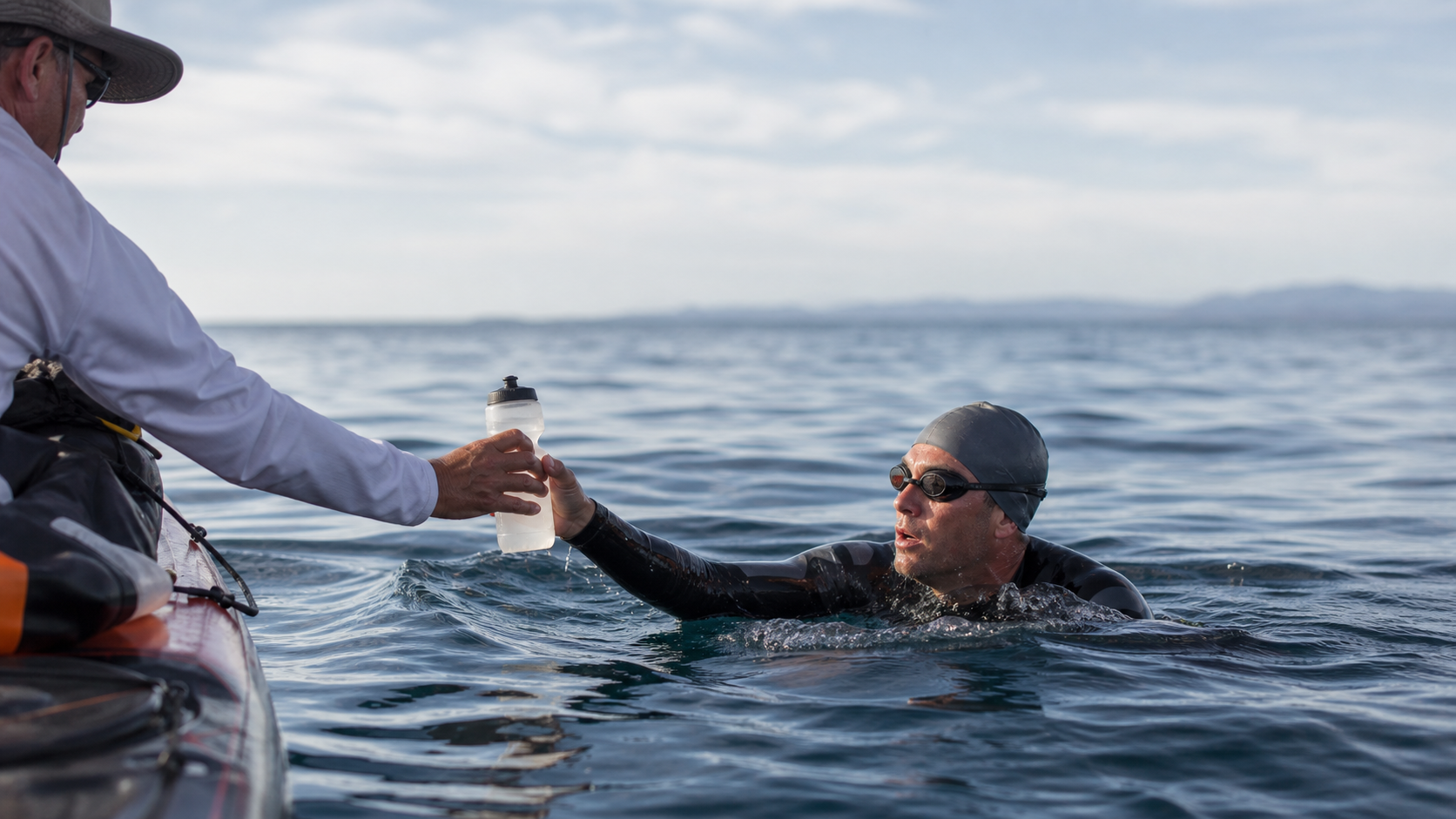
Kayak feeding: If race rules permit, a swimmer’s support crew can follow in a small kayak and hand over fuel at designated points. Fuel is typically placed in a long-handled cup or clipped to a rig so the swimmer can grab it with one hand.
Waist fuel pouch: A very small number of swimmers use specially designed waterproof fuel pouches strapped around the waist, typically used for ultra-long-distance events (such as English Channel crossings). This is rarely seen in Taiwanese races.
Food choices suitable for open-water fueling:
- Energy gels: The most convenient option—small packaging, easy to tear open, and quick to digest; however, note that with some brands, saltwater can get into your mouth when biting open the package in the water, so practice the tearing motion before the race.
- Diluted sports drinks: When fueling at a platform or kayak, sports drinks diluted to 50% concentration offer a balance of electrolytes and sugar, avoiding gastrointestinal discomfort caused by overly high concentrations.
- Banana pieces: A natural source of potassium and sugar, but they need to be cut into small pieces in advance and placed in an easily accessible container. They are a favorite among many swimmers in long-duration events.
- Gummy candies or fruit chews: Easy to bite, resistant to absorbing water and deforming, and provide quick glucose—a fueling choice also commonly used by many triathletes.
Building Fueling Habits in Training
Fueling technique needs to be practiced repeatedly in training, not tried for the first time on race day:
- Incorporate fueling simulations into long training sessions: In every practice session exceeding 90 minutes, schedule at least one fueling stop simulation to practice body position control and time management while floating and eating.
- Test gastrointestinal reactions to different foods: Everyone’s digestive system has different tolerance levels for foods. You must confirm in training before race day that your chosen fuel won’t cause nausea or stomach cramps.
- Record how you feel after fueling: Which fuel gives you more power in the latter stages? Which one makes you feel heavy or nauseous? This data is the foundation of a personalized fueling plan.
Practical Tips
- Steady your breathing before fueling: Before approaching each fueling point, take a few deep breaths to slightly lower your heart rate. This improves gastrointestinal absorption efficiency during eating and reduces the risk of choking.
- Don’t wait until you’re hungry to fuel: If you fuel only after blood sugar drops, your body needs 10–15 minutes to feel the energy rebound. Fuel proactively at planned time points rather than waiting for hunger to appear.
- Ease off for 5 minutes after fueling: Give your digestive system some buffer time after each fueling stop, avoiding an immediate all-out sprint that could cause stomach discomfort.
- Watch out for swallowing seawater: In rough conditions, it’s easy to swallow seawater while eating. Choose calmer water or wait until after a wave crest passes before performing the fueling action.
Conclusion
Completing a long-distance open-water swim depends not only on technique and endurance, but also on intelligent energy management. Every successful fueling stop is power you bank for the second half of your race while fatigued. Treat your fueling plan as part of your training, rehearse it repeatedly both on land and in the water, and make it your most reliable support system on race day.
Related Reading
- Open-Water Fueling Strategies: Energy Supplementation for Long-Distance Sea Swims
- Fueling Strategies for Long-Distance Swimming: Differences Between Pool Fueling and Open-Water Fueling
- Long-Distance Open-Water Fueling: Practical Strategies for Energy Gels and Salt Tablets
- Fueling Strategies for Long-Distance Swim Races: Energy Preparation for 1500m and Beyond
CT暗黑廚房) 車友必備 宇宙無敵鮮蚵湯 幫助訓練恢復 天然食補 好市多 超肥鮮蚵 破PR
7 年前
靠單車減肥35公斤 心得分享與整理
7 年前
西進武嶺 免費訓練分析服務 Intervals | 練不夠還是練過頭?你哪一種類型選手?AI模型告訴你! | 備戰神器 | 公路車 訓練 | CT Yeh
4 年前
FTL 與 SYB 車隊專訪 西進武嶺 實用攻略分享! 2小時 如何練?!你不知道的眉角!新手準備武嶺必看 EP1 | 實力派女車友 | 精華版 | 公路車 | CTYeh
4 年前
一日北高前的高裝檢 | 北高 360 | 挑戰11小時的裝備 | 一日雙塔 | 補給
6 年前
西進武嶺 自製新版AI配速表產生器 x 賽前攻略 抱佛腳! 沒有功率計也可以產生配速表嗎?有什麼其他眉角賽前要注意的呢? | 西進武嶺 / 東進武嶺 KOM 攻略 | 公路車 | CT Yeh
4 年前
水金九不厭五分 10度寒流冷到不願停!feat. 卡卡 / 公路車 / CT Yeh
6 個月前
2019 夏季KOM 5小 完賽心得 準備攻略 東進武嶺 夏季登山王之路 Taiwan KOM Challenge
7 年前