In-Depth Review: Indoor Bike Trainers — Direct-Drive vs Wheel-On Ride Feel, Noise, and Training Benefits Compared
Introduction
Taiwan’s summer typhoons, winter northeast monsoons, and days of relentless plum rain often derail outdoor riding plans. Indoor trainers let cyclists maintain training continuity indoors, and when paired with smart platforms like Zwift and TrainerRoad, the benefits of indoor training now rival those of riding outside. However, trainers on the market range in price from a few thousand to tens of thousands of NT dollars, and the underlying technology splits into two main categories: direct-drive and wheel-on (resistance) trainers. This article compares the two in depth across four dimensions: ride feel, noise, accuracy, and value for money.
Direct-Drive Trainers: The Pinnacle of Accuracy and Immersion
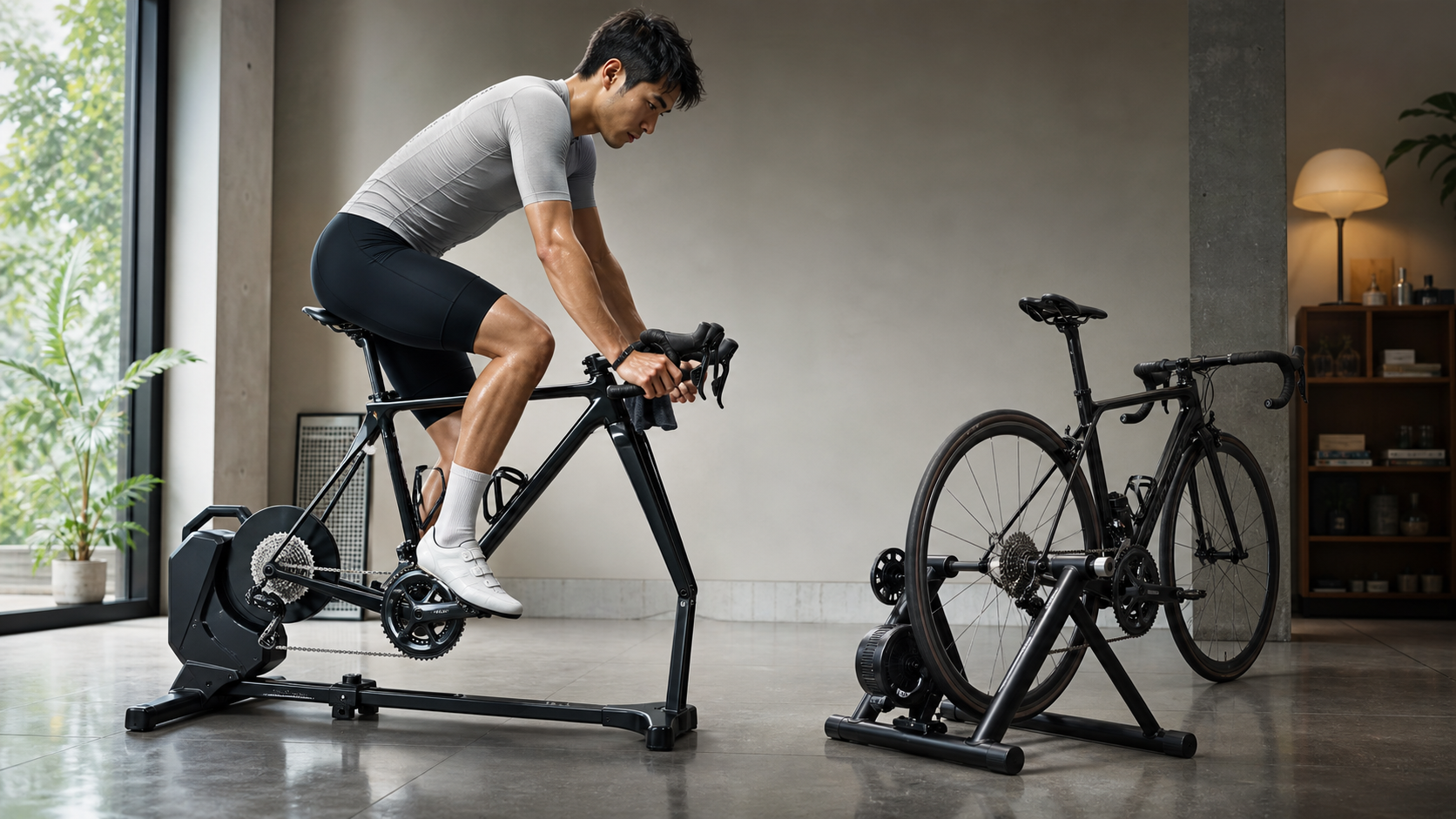
A direct-drive trainer (also called a smart trainer) replaces the rear wheel entirely — after removing the rear wheel, the rear axle mounts directly onto the trainer’s flywheel unit. Drive force is transmitted directly during pedaling, with no losses from tire friction.
Key advantages:
- Extremely high power accuracy: Most flagship models have an error margin within ±1–2%, on par with high-end power meters
- Realistic resistance simulation: Climbing feel, acceleration inertia, and reduced descent resistance can all be simulated convincingly, with gradient simulation reaching 20%+ when paired with Zwift
- Relatively low noise: With no tire-to-roller contact, the main noise source is chain drivetrain, typically under 60–70 dB
- No tire wear: The rear wheel never touches a roller, saving on the cost of trainer-specific tires
Key limitations:
- Higher price: Entry-level direct-drive trainers (such as the Wahoo Kickr Core) cost roughly NT$18,000–22,000, while flagship models can exceed NT$35,000
- More involved setup: Requires compatibility with your cassette specification (HG, XD, XDR, Campagnolo, etc. must be confirmed), and first-time setup typically takes 15–30 minutes for beginners
- Larger size and weight: Most models weigh 15–22 kg, requiring more storage space
Wheel-On Trainers: The Affordable Choice for Beginners
A wheel-on trainer keeps the rear wheel in place, pressing it against a resistance roller as it spins — a more traditional design that remains the mainstream choice for beginner riders and those on a limited budget.
Comparison of resistance types:
| Resistance Type | Mechanism | Noise | Controllability | Suggested Price |
|---|---|---|---|---|
| Magnetic resistance | Manual adjustment | Medium (65–75 dB) | Low | NT$2,000–5,000 |
| Fluid resistance | Fixed resistance curve | Low (55–65 dB) | None | NT$3,000–8,000 |
| Smart resistance (interactive) | App-controlled | Medium | High | NT$8,000–15,000 |
Key advantages:
- Entry-level pricing is accessible, making it easy to test out your own indoor training habits
- Quick setup — no need to remove the rear wheel, taking about 2–5 minutes to complete
- Lightweight (5–8 kg), easy to move and store
- Works with any bicycle regardless of rear wheel specification
Key limitations:
- Tire wear: Prolonged friction between roller and tire causes noticeable wear each month; a dedicated hard-compound trainer tire (around NT$500–800) is recommended
- Slippage issues: Uneven pressure on the rear wheel can cause slipping, affecting the consistency of training data
- Lower power accuracy: Smart models have an error margin of roughly ±3–5%, while non-smart models cannot output power data at all
- Louder noise: The friction sound between tire and roller can be a source of complaints from neighbors in apartment settings
Real-World Noise Analysis
Noise is the top consideration for apartment-dwelling cyclists in Taiwan when choosing a trainer. Below are reference decibel ranges under real-world use (measured 1 meter from the trainer):
- Flagship direct-drive models (e.g., Wahoo Kickr): Approximately 60–65 dB (comparable to normal conversation volume)
- Entry-level direct-drive models (e.g., Elite Suito): Approximately 62–68 dB
- Smart wheel-on models (e.g., Tacx Flow Smart): Approximately 70–78 dB
- Magnetic wheel-on models: Approximately 72–80 dB (including tire resonance)
Noise reduction tips:
- Placing a thick rubber mat under the trainer (dedicated trainer mats cost around NT$500–1,000) can reduce vibration transfer to the floor
- Avoid using the trainer directly on hard tile; carpeted areas or wood flooring tend to work better
- For nighttime training, direct-drive trainers are recommended whenever possible, along with controlling your cadence to keep overall noise down
Smart Training Integration
The core value of modern trainers lies not just in providing resistance, but in their integration with training platforms. Flagship direct-drive models typically support both ANT+ FE-C and Bluetooth protocols, allowing simultaneous connection to platforms like Zwift, Garmin, and Wahoo ELEMNT for gradient simulation (ERG mode). Smart wheel-on models are increasingly supporting these protocols too, but their gradient response time is usually 1–3 seconds slower than direct-drive units.
Practical Recommendations
- Apartment dwellers should prioritize direct-drive trainers: The noise difference is one of the most significant advantages of direct-drive units, and the money saved on trainer tires over time can partially offset the price gap.
- Training more than 3 times a week? Go direct-drive: With extended use, the advantages of accuracy and low wear become increasingly apparent.
- Try building the indoor training habit before upgrading: If you’re not yet sure you can stick with indoor training, start with a wheel-on trainer to test the waters, then upgrade to direct-drive once the habit sticks.
- Set up a cooling fan: Indoor riding lacks natural airflow, so it’s recommended to use at least one direct-facing fan (NT$800–1,500) to avoid overheating that hurts training quality.
- Check your cassette specification first: Before buying a direct-drive trainer, confirm the cassette specification of your existing wheelset — some trainers require an additional freehub adapter (around NT$500–1,500).
Conclusion
Choosing between direct-drive and wheel-on trainers essentially comes down to a return-on-investment trade-off: direct-drive trainers have a higher upfront cost but deliver a significantly better long-term experience, while wheel-on trainers have a low barrier to entry, making them ideal for riders just starting out with indoor training. Taiwanese cyclists with a steady weekly indoor training plan are advised to invest directly in an entry-level direct-drive trainer, paired with Zwift or TrainerRoad, to maximize the benefits of indoor training.
Related Reading
ThinkRider 智騎 XXPRO 訓練台,高階機種功能 只要 1/3價格!? 實測功率對比、噪音實測 / 公路車 / CT Yeh
1 年前
訓練台體驗) 2019台北自行車展 三大家 訓練台體驗 Tacx Neo Flux 2 Xepdo Apx Wahoo Kickr
7 年前
邁金 T500 訓練台開箱!有下坡輔助、路感模擬、不用插電、直驅電機 !兩萬級距頂規享受新選擇!/ 公路車 / 室內訓練 / CT Yeh
1 年前
Fitting訓練兩用功率車 ! Thinkrider ST900 完整實測!/ 坡度升降 / 鄰居測試/ smart bike/公路車/ CT Yeh
2 年前
智騎 X5 Neo 不到15000的價格就入手 智能訓練台! 阻力反應/功率精準度/Zwift Rouvy相容度 全面實測 | 公路車 | CT Yeh
4 年前
鉅齒紋輪組!? ControlTech MEG-T50 EVO 碳纖維幅條輪組/ 功率對比實驗 / 公路車 / CT Yeh
2 年前
元宇宙單車運動!智騎 X7 Pro 智能訓練台 ThinkRider 居家線上練功
5 年前
智騎 ThinkRider X7 Pro第五代訓練台!開箱深入實測!噪音/路感/功率靈敏大升級!高性價比 / 公路車 / CT Yeh
2 年前