Introduction
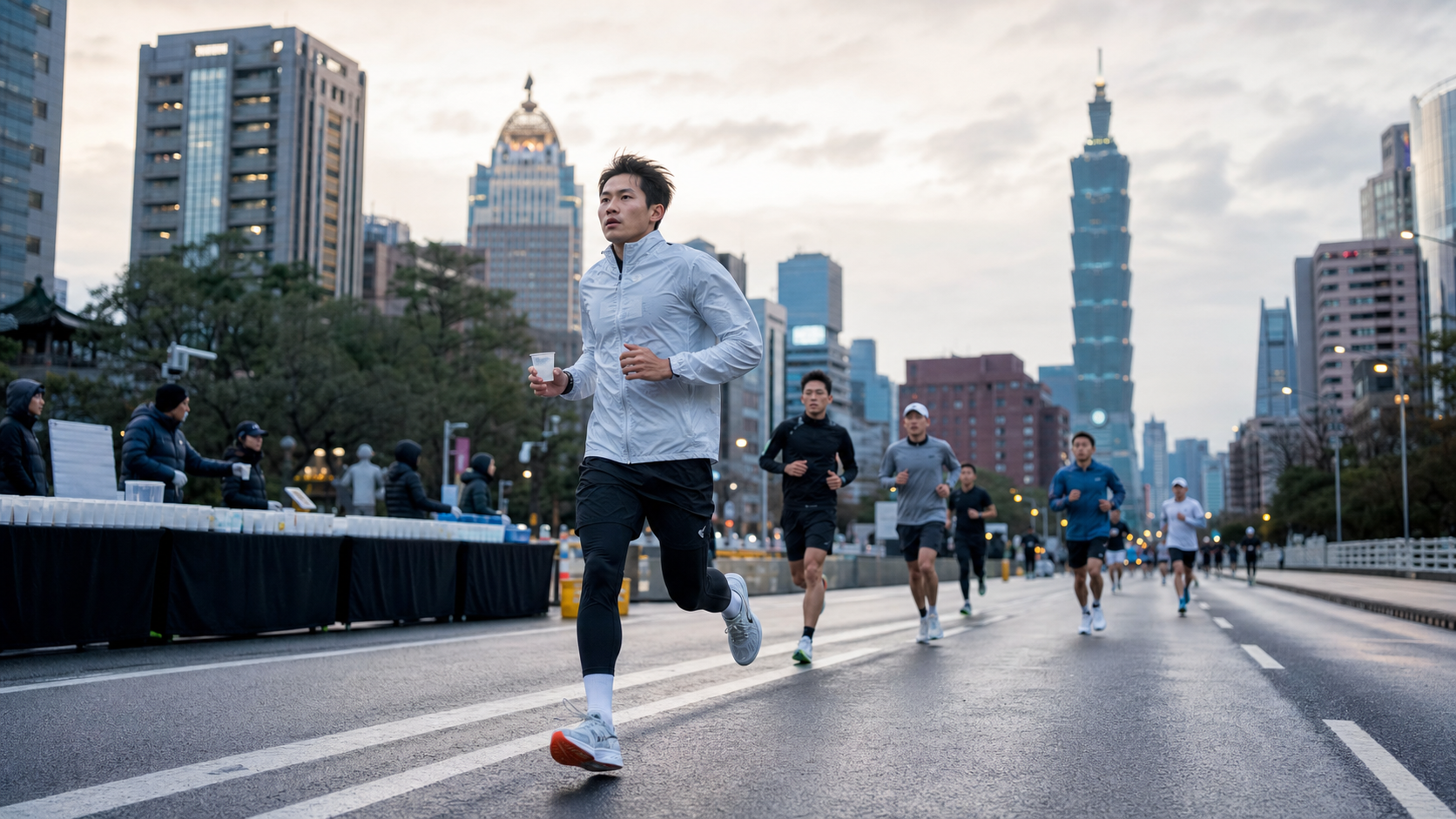
The Taipei Marathon is held grandly in Taipei City every December. The full 42.195 km course starts from the City Hall Plaza, passes through prime sections such as Ren’ai Road, Xinyi Road, and Dunhua North and South Roads, and finally returns to the City Hall Plaza. Since the course mainly runs on flat asphalt roads through the urban area, many runners see it as a great opportunity to chase a PB. However, flat does not mean easy—urban noise, crowd density, and the winter northerly winds are all challenges that cannot be ignored.
Course Characteristics Analysis
The elevation changes of the Taipei Marathon are quite gentle, with a cumulative climb of no more than 150 meters and an overall gradient close to zero. The only notable undulations appear on the bridge sections crossing the Keelung River (around the 22–25 km mark) and a slight downhill near the Ren’ai Road roundabout. The course loops around the city center in a large circle, so runners never venture into remote areas. Spectator support and cheering accompany the entire route, which greatly helps mental endurance.
Key Course Sections
| Kilometer | Section | Features and Notes |
|---|---|---|
| 0–5 km | Xinyi District, Ren’ai Road | Dense crowds; avoid starting too fast |
| 10–15 km | Dunhua South Road, Daan Forest Park | Open views; a section for maintaining a steady pace |
| 20–25 km | Zhongshan North Road, bridge sections | Slight uphill; control your breathing |
| 30–35 km | Under Jianguo Viaduct, Fuxing South Road | Mental wall zone; refueling is especially important |
| 38–42 km | Return to Xinyi District | Crowds increase again; use the energy to accelerate |
Pacing Advice
The weather for the Taipei Marathon is usually between 10–18°C, which is ideal for long-distance running. However, Taipei in December occasionally experiences northeast monsoons, and the straight sections along Ren’ai Road or Keelung Road can form “wind tunnels.” Running into the wind lowers the perceived temperature and increases energy expenditure.
Pacing recommendations are as follows:
- First half (0–21 km): Maintain 105% of your target pace (5% slower); don’t get swept up by the crowd.
- Middle section (21–30 km): Return to your target pace and assess whether your overall condition is good.
- Later section (30–38 km): If you have energy to spare, you can speed up by 2–3 seconds/km; if fatigued, don’t push too hard—just maintain a steady pace.
- Final 4 km (38–42 km): Gradually accelerate; crowd support is strongest here, making it ideal for a sprint finish.
Aid Station Locations and Strategy
The Taipei Marathon sets up aid stations approximately every 2.5 km, alternating between water stations and sports drink stations. Main energy supplies (bananas, electrolyte packs) are typically concentrated around the 20 km and 30 km marks.
Key aid station locations worth remembering:
- 10 km aid station: Take a sports drink here and adjust your rhythm.
- 20 km aid station: Halfway point; be sure to eat a banana or energy gel.
- 30 km aid station: Just before the wall; be sure to replenish salt tablets and energy gels—do not skip this one.
- 37 km aid station: The last major aid point; top up on fluids and prepare for the sprint.
Runners carrying their own energy gels are advised to take one at the 15, 25, and 33 km marks, paired with water from the stations, to avoid gastrointestinal discomfort.
Practical Tips
- Familiarize yourself with the course in advance: A week before the race, use Google Street View or go for an easy run on-site to familiarize yourself with the road conditions of key sections.
- Start in your designated corral—don’t force your way to the front: Choose your corral based on your ability to avoid being pulled into too fast a pace in the first 5 km.
- Carry a lightweight windbreaker: Wear it after warming up and while entering the starting area; discard it after the gun goes off if needed (the organizers collect them for donation).
- Slow down at corners: The Xinyi Planning District has many intersections; sharp turns can easily cause ankle sprains, so slow down in advance.
- Stretching area after the race: There is ample space around the finish plaza; 15 minutes of static stretching after the race is very important for recovery.
Conclusion
With its flat course and cool winter weather, the Taipei Marathon is one of the best opportunities for runners in Taiwan to break their personal records. As long as you maintain pacing discipline, make good use of the aid stations, and prepare well before the race, every runner can write their own impressive result on the streets of Taipei. Whether it’s your first finish or you’re chasing a Sub-4, the Taipei Marathon deserves serious preparation.
Related Reading
- Complete Taipei Marathon Guide: Route, Aid Stations, and Pacing Strategy
- Complete Taipei Marathon Guide: Route Analysis and Pacing Strategy
- Complete Taipei Marathon Guide: Registration, Route Analysis, and Pacing Strategy
- Taipei Marathon Route Analysis: Elevation Changes and Pacing Adjustment Strategy
爬坡ITT實境)台中 魔王 松鼠坡 首航 6:12 大肚山 大三元 科福路
8 年前
台北闊瀨陡坡 騎旅 / 日本單車雜誌編輯車友臨時加入!/ 髮香才是最強的 / feat. 北迴歸線小隊 / 公路車 CT Yeh
6 個月前
半日 小台灣 極限單車路線挑戰實錄
7 年前
台灣登山王之路 KOM 全程參賽4K臨空錄影 PART1 穿越峽谷地形! #東進武嶺 太魯閣 / 燕子口 / 天祥 / 西寶 PART1 (公路車 / CT Yeh)
3 年前
一日北高前的高裝檢 | 北高 360 | 挑戰11小時的裝備 | 一日雙塔 | 補給
6 年前
Live) 備戰2019彰化經典百K 賽前攻略 (已完賽請看新影片
7 年前
單車 一日北高 ( 雙城 ) 肥宅雙人瘋狂行 紀錄片 REACTO
10 年前
車隊介紹) 台北 一年開團365天 車隊 Apollo Ride 晨騎 好選擇 ( 陽明山 風櫃嘴 冷水坑 平等里 聖人 關渡 大稻埕 ) 找人騎車
7 年前