Introduction
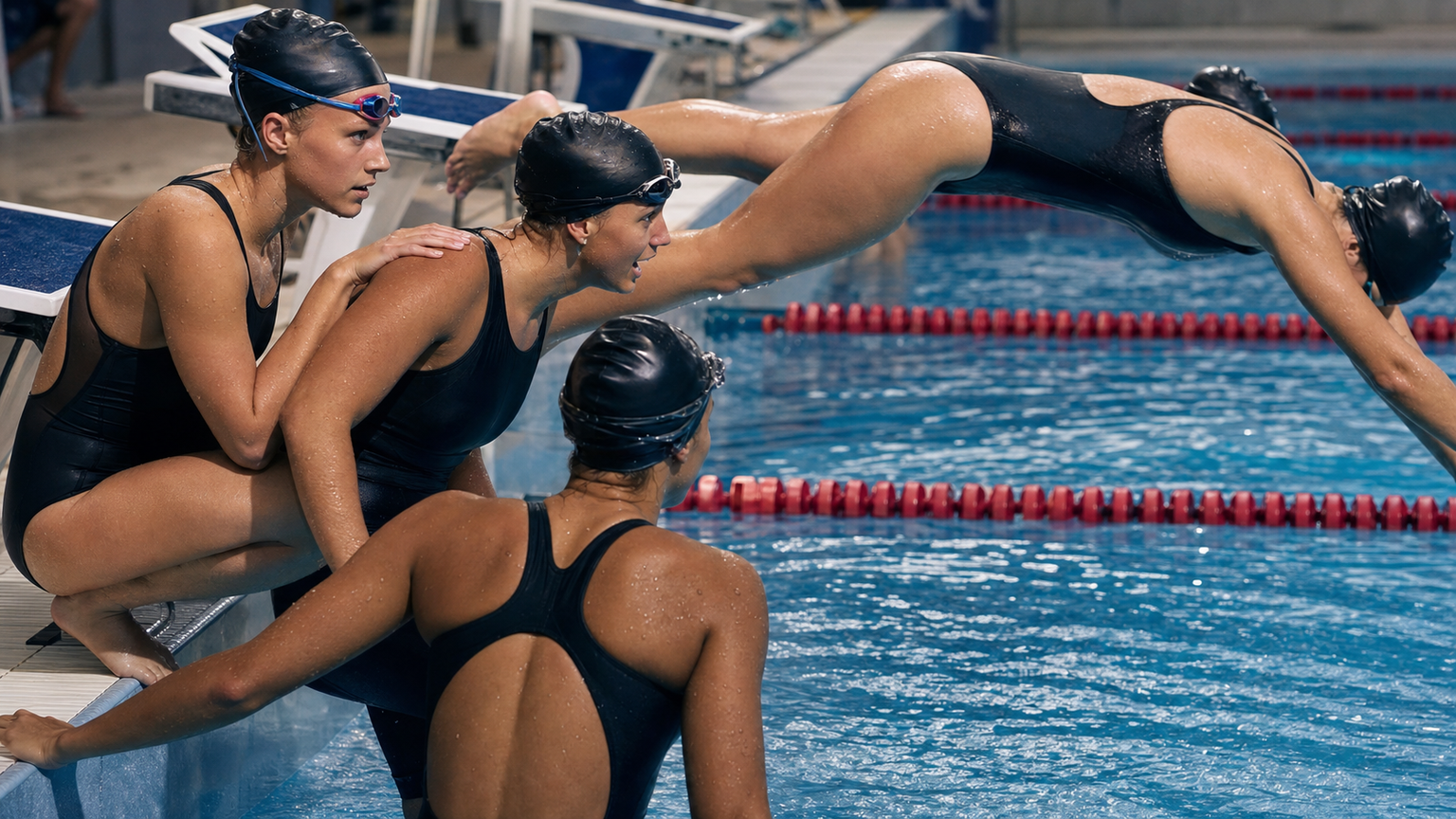
Swimming is primarily an individual sport, but the four-person relay events (4×50, 4×100, 4×200) bring a distinctly different psychological experience for athletes. In individual events, you are only responsible for yourself; but in a relay, every stroke you take carries the effort and trust of your teammates. This collective sense of responsibility is both the greatest source of psychological pressure and the most powerful source of motivation in relay racing.
This article explores the unique psychological dynamics of relay events and how to build strong team cohesion so that the combined strength of four individuals is not just additive, but multiplicative.
The Psychological Uniqueness of Relay Racing
| Aspect | Individual Events | Relay Events |
|---|---|---|
| Scope of Responsibility | Only yourself | Yourself and your teammates |
| Impact of Mistakes | Affects only your own result | Affects the entire team’s result |
| Source of Motivation | Personal honor and goals | Personal + collective sense of honor |
| Nature of Pressure | Can be self-managed | Requires coping with uncertainty about others’ performance |
| Emotional Contagion | Self-isolation | Easily influenced by the previous leg’s performance |
Research shows that relay swimmers generally swim faster times than in individual events, a phenomenon known as the “Köhler Effect”—in collective tasks, individuals tend to exert more effort than when performing the same task alone. However, this effect only holds when team members share genuine trust and cohesion.
The Main Psychological Challenges in Relay Racing
First-leg pressure: The first-leg swimmer bears the pressure of “building an advantage for the team”; if the start goes poorly, they may fall into the guilt of “letting everyone down.”
Passive waiting in the middle legs: Athletes waiting for their turn must manage their attention and emotional state, avoiding excessive nervousness on deck or unnecessary emotional swings from watching the race.
Focus shift at the exchange: Transitioning from “watching your teammate” to “immediately swimming your own race” requires an instantaneous shift of attention; if unsuccessful, you may enter the water carrying the previous leg’s emotions (whether positive or negative).
The psychological burden of the anchor leg: The final leg is usually assigned to the strongest swimmer, but the thought that “the whole team’s expectations rest on me” can create additional anxiety.
Strategies for Building Team Cohesion
Collective goal setting: Relay teams should set goals together using “we” as the subject, such as “our goal is to break the minute mark,” rather than each of the four swimmers having independent goals. A shared goal is the foundation of cohesion.
Mental reinforcement training for exchanges: Practice focusing attention on your own technical cue words in the 3 to 5 seconds before the exchange, rather than analyzing whether the previous leg performed well or poorly. Every exchange in practice should be paired with mental shift training.
Establishing shared rituals: Relay teams can develop collective rituals unique to the team, such as specific hand gestures, specific phrases, or specific music before a race. These shared symbols reinforce the psychological identity of “we are one.”
Collective protocol for handling mistakes: When a leg makes a mistake, the team should have a pre-discussed response: “No matter what the previous leg did, when I hit the water, I swim my best leg.” This protocol prevents the spread of mistake-related emotions.
The Psychological Function of the Team Captain Role
The relay captain is not just the most technically skilled swimmer, but also the manager of the team’s psychological climate:
- Actively maintaining a positive team atmosphere while waiting (avoiding the anxiety contagion of silence)
- Checking each teammate’s mental state before the race and offering individual encouragement when needed
- Providing visual support (eye contact, gestures) to teammates waiting on deck during the race
- After the race, regardless of the outcome, checking each teammate’s emotional state before discussing results
Practical Recommendations
- Regularly conduct “trust-building” activities for the relay team: Not just training in the water, but also developing personal understanding and trust among teammates on land
- Train together as a full team, rather than forming the relay only after individual training: Give the relay combination sufficient shared training experience
- Conduct collective relay reviews after races: After each competition, the four swimmers discuss the strengths and weaknesses of the exchanges together, without comparing individual results
- Respect individual differences: Some swimmers are energized by the responsibility of a relay, while others are so overwhelmed by pressure that they underperform; coaches need to understand each swimmer’s characteristics when assigning legs
Conclusion
The relay is one of the events in swimming that best embodies the spirit of sport. Four individuals converge their separate efforts into a shared goal, and what is passed on in the water at the exchange is not just speed, but trust, responsibility, and emotion. When a relay team’s psychological cohesion reaches true synergy, that collective energy often enables all four swimmers to produce their best performances.
Related Reading
- Swimming Relay Races: Split Strategy and Exchange Technique for Four-Person Relays
- Mental Preparation for Time Trials in Swimming: Pacing Control When Starting Alone
- Team Strategy in Medley Relays: Competitive Considerations for Order Arrangement and Exchange Technique
- The Psychological Dynamics of Team Running: The Mechanism Behind Improved Performance When Running with Companions
新屋團體繞圈賽 | 眾多菁英好手賽道奔馳 | 千瓦女子軍團 | 無敵交管狂獲好評 明年你一定不能錯過 | #公路車
5 年前
2026 輪霸西濱200K 挑戰VLOG / 第一集團 / 首次參加..經驗不足、膀胱不足 /死守6H內 / AI戰鬥力顯示系統 / 公路車 / CT Yeh
4 個月前
福隆鐵人團練隨拍
8 年前
戰略) Zwift Race 如何咬在第一集團 如何評估自己要開多少推力 (請開1.5倍速看)
7 年前
一日北高/長距離團騎 常見問題補充篇 / 組團或跟團的眉角 / 壯車友容易被瘦車友慢性拉爆 / 原來屁股痛可能是這個原因...? / 風場配速法 / 公路車 / CT Yeh
2 年前
一起升級!海鷗盃LSD團練...JJSC Zone2招待 騎到手抖 / 公路車 / CT Yeh
2 天前
CT 喇低賽) 武嶺牽車 才是王道 西進牽車四小時內秘訣 攝手位置 如何判斷 防抽筋小秘訣
7 年前
2023桃園團體繞圈賽/環台賽等級拍攝/賽事精華/ 10人一隊缺一不可!50隊廝殺大場面 / 第三屆 海鷗繞圈賽 /公路車/CT Yeh
2 年前