Aid Station Technique for Runners: Drinking Water and Taking Energy Gels Without Breaking Stride
Introduction
The marathon aid station is a critical point in the race, but it is also one of the easiest places to lose time. A runner who is unpracticed at aid stations may waste 20-30 seconds at each one, and with 10 aid stations over the full course, that adds up to a 3-5 minute difference. Worse still, poor fueling that causes stomach discomfort or low blood sugar can throw off the rhythm of the entire race.
The Basic Aid Station Move: Drinking Without Stopping
Most people’s instinct at an aid station is to “stop, finish drinking, then go,” but for runners targeting a finish time under 5 hours, learning to drink without stopping can save significant time.
The Paper Cup Drinking Technique (Three Steps)
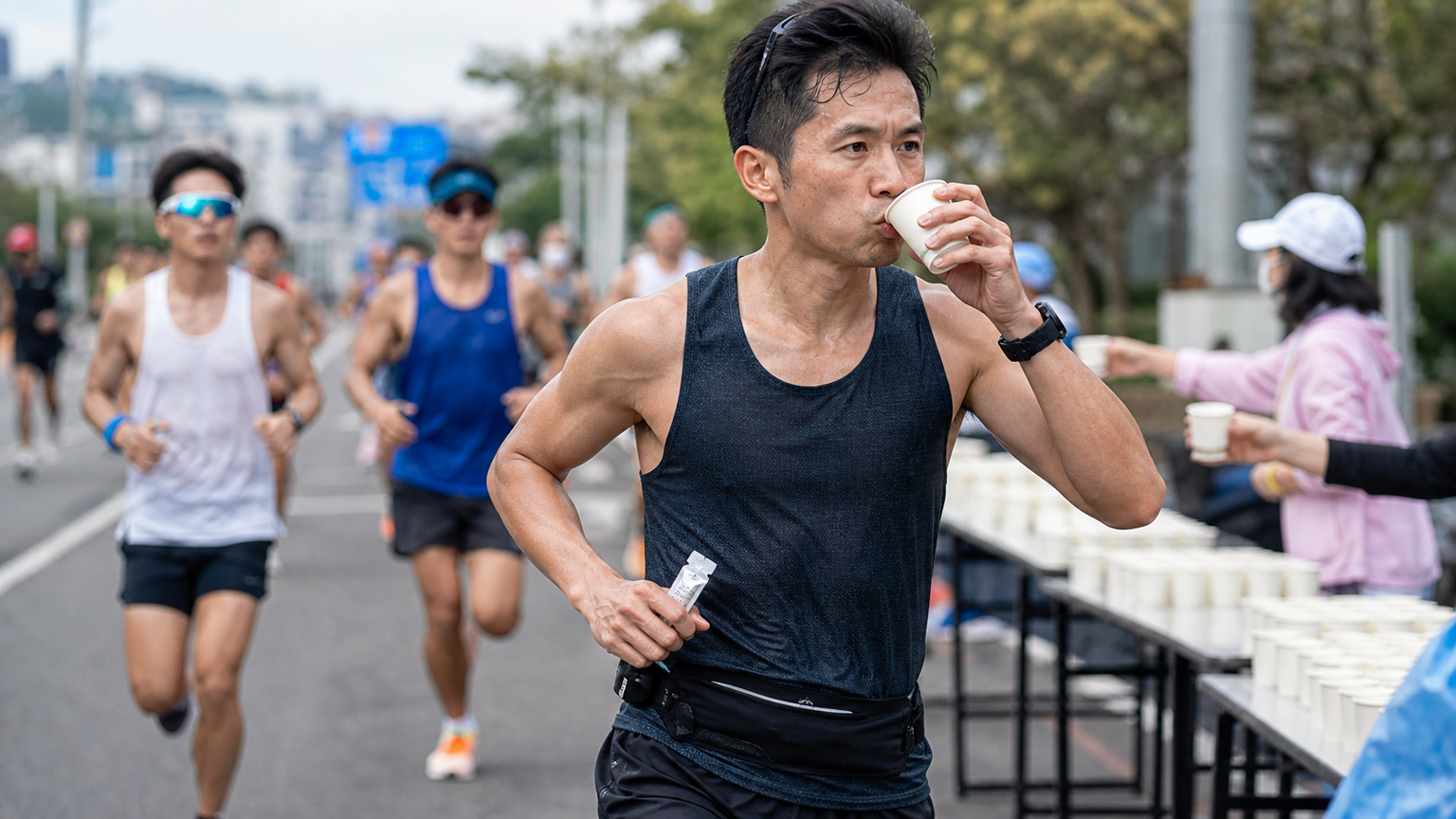
- Pinch the rim into a V shape: The moment you take the cup from a volunteer, use your thumb and index finger to pinch the rim into a long, narrow V-shaped groove, preventing water from splashing while you run.
- Tilt your head slightly, bring your mouth to the cup: While running, tilt your head slightly to one side so the V-shaped rim lines up with the corner of your mouth, and sip slowly in small amounts to avoid choking from gulping.
- Slow down slightly, but don’t stop: Ease your pace slightly for 3-5 steps before taking the cup (dropping to an easy-run pace), then gradually accelerate back to your target pace after drinking.
Practice method: Simulate the aid station motion during training runs — practice drinking while running using a handheld water bottle or a convenience-store coffee cup, until the motion feels smooth.
Aid Station Types and Corresponding Strategies
Understanding what each aid station offers lets you make the right fueling decisions:
| Aid Station Type | Typically Offers | Recommended Strategy |
|---|---|---|
| Water station (every 2.5 km) | Water | Stop at every one, slow slightly and drink |
| Sports drink station (every 5 km) | Sports drink | Replenish electrolytes, especially after 20-30 km |
| Major aid station (10, 20, 30 km) | Water + sports drink + bananas + energy gel | Full fueling; be sure to eat solid food after 30 km |
| First aid station | Medical staff, ice packs | Stop immediately and report any discomfort |
Energy Gel Fueling Strategy
Energy gel is the most common supplement used in marathons, but if used incorrectly it can cause stomach discomfort or backfire.
When to Take Energy Gels
Timing should be adjusted for body weight and intensity, but a general pacing reference for full marathon runners is:
- 15 km mark: First gel. Muscle glycogen is still plentiful at this point, so the goal is to fuel early and maintain performance in the later stages.
- 25 km mark: Second gel. This is a critical preventive dose before approaching the “wall” zone (around 30 km).
- 32-33 km mark: Third gel. This is emergency fueling after hitting the wall — take it immediately if your legs already feel heavy.
- Last 5 km (optional): If you have a caffeine energy gel, you can use it in the final 5 km to boost nervous system alertness.
Correct Steps for Taking Energy Gels
- Practice the motion of tearing open the packet while running beforehand, so you’re not fumbling with it when your energy is already depleted during the race.
- Energy gel must be taken with water (at least 150-200 ml) — taking it alone is too concentrated and can easily cause stomach discomfort.
- Squeeze it into your mouth slowly rather than swallowing it all at once; taking it in 2-3 portions is easier to digest.
- Immediately after taking the gel, drink a cup of water at the aid station to wash it down.
Combining Your Own Gels with Race-Provided Fueling
Aid stations at Taiwanese marathons typically provide some energy supplies, but runners should not rely on race fueling entirely, because:
- The brand provided may differ from what you use in training, and trying a new brand on race day can risk stomach discomfort.
- The energy gels at aid stations can run out quickly in a crowd.
Recommendation: Carry at least 3 packets of the energy gel brand you’re used to, and treat race-provided bananas, salt tablets, etc. as supplementary rather than your primary source.
Protecting Your Gut at Aid Stations
Aid stations are a common trigger point for running-related GI issues:
- Avoid drinking too fast: Gulping water quickly can cause a side stitch.
- Don’t eat too much solid food at aid stations: One banana is enough — large amounts of solid food are hard to digest during high-intensity exercise.
- Avoid ice-cold water in cold weather: Choose room-temperature water, as cold water can irritate the gut and trigger cramping.
- Runners with a sensitive stomach: Use isotonic sports drinks rather than highly concentrated energy drinks, and test your tolerance for different fueling products during training.
Practical Tips
- Simulate fueling during training: Bring energy gel on every long run to practice the fueling motion you’ll use on race day.
- Know the aid station locations: Study the course map before the race and mark the major aid stations, planning in advance where you’ll take your energy gels.
- Time your fueling while running: If pacing by time rather than distance, take in energy (equivalent to one gel) roughly every 45-60 minutes.
- Carry your own salt tablets: Taiwan’s summer heat or long race durations can cause heavy sweating and electrolyte loss, so personal salt tablets are a good insurance strategy.
- Maintain your cadence before and after fueling: Be aware of how your cadence changes around aid stations, and deliberately maintain your rhythm to avoid wasting energy re-accelerating.
Conclusion
Aid station technique may seem like a small detail, but it is a microcosm of overall marathon efficiency. A smooth drinking motion, the correct rhythm for energy gel intake, and strategies to protect your gut can turn every aid station into a point that adds to your performance rather than breaking your rhythm. Practice it, get familiar with it, execute it — and turn aid station technique into your body’s instinctive reflex.
Related Reading
- Marathon Aid Station Strategy: The Art of Balancing Water, Sports Drinks, and Energy Gels
- Food Choices at Running Aid Stations: Making Energy Gel No Longer Your Only Option
- Marathon Aid Station Strategy: When to Drink Water, When to Take Energy Gels
- Running Aid Station Strategy: The Decision Principles for When to Drink Water vs. Sports Drink
CT暗黑廚房) 車友必備 宇宙無敵鮮蚵湯 幫助訓練恢復 天然食補 好市多 超肥鮮蚵 破PR
7 年前
一日北高前的高裝檢 | 北高 360 | 挑戰11小時的裝備 | 一日雙塔 | 補給
6 年前
Live) 備戰2019彰化經典百K 賽前攻略 (已完賽請看新影片
7 年前
西進武嶺 免費訓練分析服務 Intervals | 練不夠還是練過頭?你哪一種類型選手?AI模型告訴你! | 備戰神器 | 公路車 訓練 | CT Yeh
4 年前
一日北高/長距離團騎 常見問題補充篇 / 組團或跟團的眉角 / 壯車友容易被瘦車友慢性拉爆 / 原來屁股痛可能是這個原因...? / 風場配速法 / 公路車 / CT Yeh
2 年前
西進武嶺 自製新版AI配速表產生器 x 賽前攻略 抱佛腳! 沒有功率計也可以產生配速表嗎?有什麼其他眉角賽前要注意的呢? | 西進武嶺 / 東進武嶺 KOM 攻略 | 公路車 | CT Yeh
4 年前
單車 一日北高 ( 雙城 ) 肥宅雙人瘋狂行 紀錄片 REACTO
10 年前
白沙屯媽祖進香在家走!UREVO 坡度自調走步機 / 可連接訓練遊戲APP MyWhoosh / 邊看直播邊走起來 / CT Yeh
11 個月前