Introduction
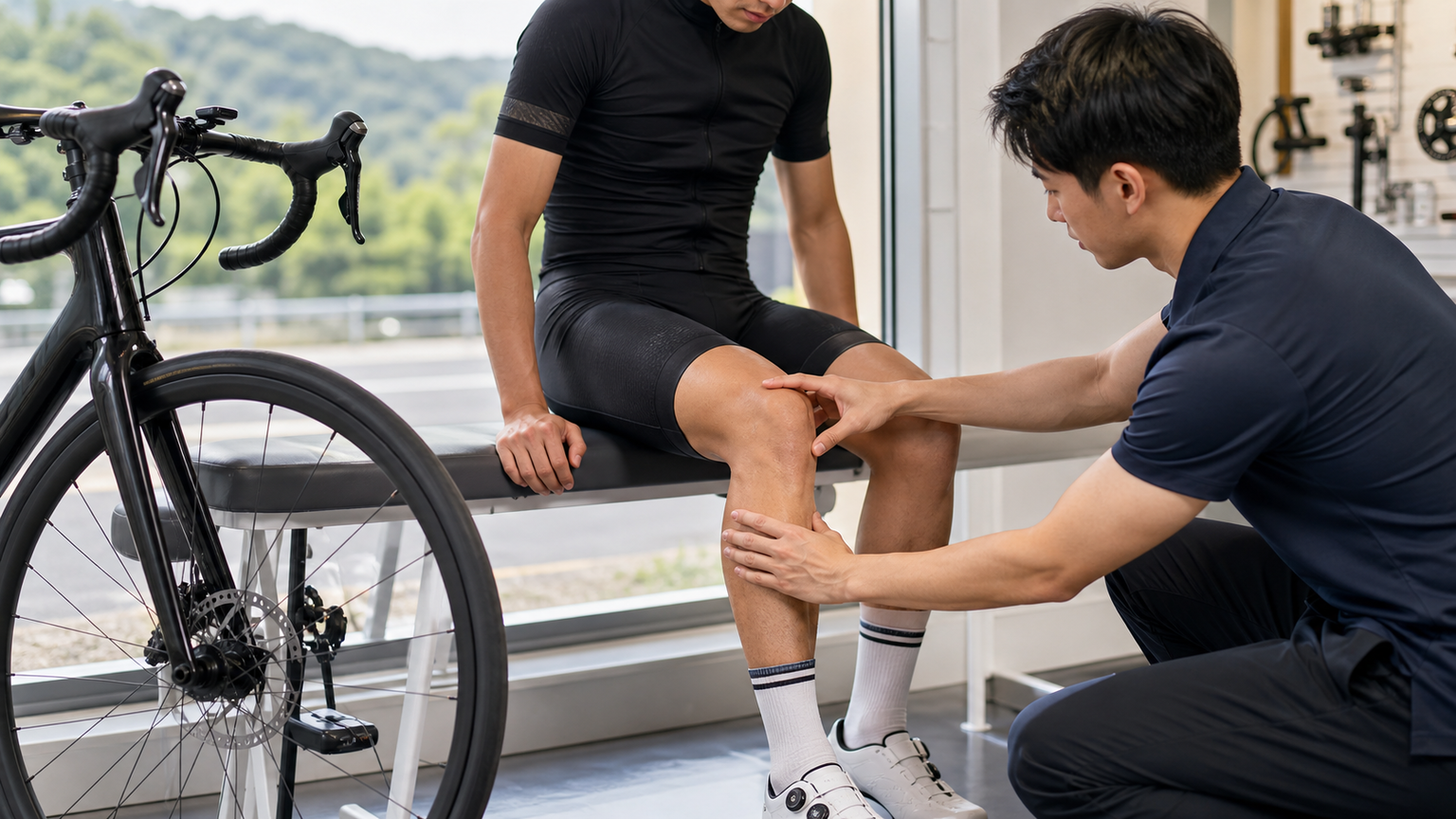
Knee pain is a problem that nearly every cyclist has encountered during training. According to sports medicine research, knee injuries account for a significant proportion of cycling-related injuries, but the good news is that most knee pain stems from improper bike fit or training errors, rather than true structural damage. Correctly identifying the location and nature of the pain is the first step toward recovery.
How to Distinguish Three Common Types of Knee Pain
Knee pain in cyclists can be broadly divided into three main types, each with distinct pain locations, triggering movements, and causes:
| Pain Type | Pain Location | Common Triggering Movements | Main Causes |
|---|---|---|---|
| Anterior knee pain (Patellofemoral Pain Syndrome) | Front of or around the kneecap | Climbing, high-gear pedaling | Saddle too low, cleat pedal axis misalignment |
| Posterior knee pain (Hamstring insertion pain) | Hollow area at the back of the knee | Prolonged high cadence | Saddle too high, saddle positioned too far back |
| Iliotibial band friction syndrome | Outside of the knee | After approximately 30–60 minutes of riding | Saddle too high, weak hip abductors |
Anterior Knee Pain: Patellofemoral Pain Syndrome
Anterior knee pain is commonly known as “cyclist’s knee,” with pain concentrated directly in front of or on both sides of the kneecap. When the saddle is set too low, the knee bends at an excessive angle with each pedal stroke, multiplying the pressure between the patella (kneecap) and the femur. Over time, this leads to cartilage wear and inflammation.
Treatment approach:
- Raise the saddle height to an appropriate position (maintaining approximately 25–35 degrees of knee flexion at the bottom of the pedal stroke)
- Reduce training intensity, pause climbing and high-gear training
- Strengthen the quadriceps, particularly the vastus medialis oblique (VMO)
- Confirm that the cleat float angle matches your individual foot structure
Posterior Knee Pain: Excessive Hamstring Stretching
Posterior knee pain typically presents as a pulling sensation or dull ache at the back of the knee, primarily caused by the saddle being set too high. When the saddle is too high, the rider must hyperextend the knee joint at the bottom of the pedal stroke, placing excessive tension on the hamstrings (posterior thigh muscles) and the popliteus muscle.
Treatment approach:
- Lower the saddle height by 3–5 mm, making adjustments incrementally
- Check whether the saddle fore-aft position is too far back
- Perform static hamstring stretches, holding each for 30 seconds
- Avoid prolonged continuous riding during the early stages of training
Iliotibial Band Friction Syndrome
The iliotibial (IT) band is a thick band of fascia extending from the hip to the outside of the knee. When a cyclist experiences a burning or stabbing sensation on the outside of the knee after riding for a period of time, it is often caused by the IT band repeatedly rubbing against the lateral femoral condyle at the outside of the knee.
Treatment approach:
- Use a foam roller to release the outer thigh, 60–90 seconds per session
- Strengthen the gluteus medius with side-lying leg raises and lateral band walks
- If the saddle is too high, lower it, and also check for a knees-out pedaling habit
- Apply ice to reduce inflammation during the acute phase, and avoid riding until the pain subsides
Practical Advice
- Prevention is better than cure: Perform 10 minutes of stretching for the front and back of the thighs and the IT band after every training session
- Progress training volume gradually: Increase weekly riding distance by no more than 10%, avoiding sudden large jumps in training load
- Conduct regular self-assessments: If pain in the same location persists for more than two weeks, seek professional evaluation from a sports medicine physician or physical therapist
- Prioritize bike fit: In Taiwan, many bike shops offer Bike Fitting services; it is recommended to have this recalibrated annually or after any change in body shape
Conclusion
Although knee pain is frustrating, it is often our body’s way of signaling that bike fit adjustments are needed or that strength training should be intensified. Understanding the differences between the three types of pain helps riders take the correct action early, shortening recovery time and making cycling a long-term lifestyle to be enjoyed. If the pain persists without improvement, be sure to consult a professional physician, and never continue training through the pain, as this may lead to irreversible cartilage damage.
Related Reading
- The Complete Guide to Knee Protection for Cyclists: Common Injuries and Prevention Strategies
- Knee Pain While Cycling: Differential Diagnosis and Management of Anterior, Posterior, and Lateral Knee Pain
- Don’t Tolerate Knee Pain: Prevention and Treatment of Common Knee Injuries in Cyclists
- The Complete Guide to Cycling Knee Pain: Causes and Management of Anterior, Posterior, and Lateral Knee Pain
一日北高常見問題大集合 | 攻略 | 路線 | 訓練 | 補給 | 自行車 單車 | 一日雙城 | 雙塔 | TWB北高360 | 屁股痛
6 年前
靠單車減肥35公斤 心得分享與整理
7 年前
一日北高/長距離團騎 常見問題補充篇 / 組團或跟團的眉角 / 壯車友容易被瘦車友慢性拉爆 / 原來屁股痛可能是這個原因...? / 風場配速法 / 公路車 / CT Yeh
2 年前
下次拍照前要查清楚啦🤣 #cycling
7 個月前
Canyon 公路車斷把手 五年老車特規還能修嗎? 維修保養全記錄 feat. 501單車監理站 | 公路車 | CT Yeh
4 年前
高雄綠園道鐵路自行車道 / 外地人能輕鬆駕馭 還是整路崩潰? / 2025 全線開通 春節實地探索一次!(附GPS連結)/ 公路車 / CT Yeh
1 年前
#公路車 #Fitting 靠人工智慧APP 幫你調整單車
6 年前
超開放的自行車錶!可以玩遊戲裝APP!?/ SRAM合併的 Hammerhead Karoo深入開箱!/ 即時爬坡偵測 / 全球導航地圖 / Garmin Bryton / CT Yeh
1 年前