Introduction
The forward-leaning riding posture of cyclists, while aerodynamic, places prolonged static load on the lumbar spine. Research shows that lower back pain has a notably high prevalence among road cyclists, particularly after increases in training volume or participation in long-distance events for the first time. However, back pain is not an inevitable result of the forward-leaning posture—insufficient core strength and improper bike fit are the real culprits.
How Riding Posture Affects the Spine
In the forward-leaning road cycling position, the mechanical load on the spine differs significantly from the upright daily posture:
| Spinal Region | Common Issues While Riding | Causes |
|---|---|---|
| Cervical Spine (C4–C7) | Hyperextension of the neck from looking up at the road ahead | Handlebars too low, top tube too long |
| Thoracic Spine (T4–T10) | Hunched back and rounded shoulders, restricted chest expansion | Weak core, insufficient flexibility |
| Lumbar Spine (L4–S1) | Increased intervertebral disc pressure, chronic tension in the erector spinae | Saddle too low, posterior pelvic tilt |
The ideal lumbar posture while riding is maintaining a slight lordotic curve, rather than a completely flat or flexed back. When the core musculature (transversus abdominis, multifidus, pelvic floor muscles) can be effectively activated, it acts like a natural lumbar support to stabilize the spine, reducing the compensatory burden on the erector spinae.
The Role and Training of the Core Musculature
The so-called “core” is not just the six-pack (rectus abdominis); the deep stabilizing muscles are what truly protect the spine:
Deep Core Musculature
- Transversus Abdominis: The deepest muscle layer surrounding the abdomen; its contraction increases intra-abdominal pressure and stabilizes the lumbar spine
- Multifidus: Small muscles running along both sides of the spine, stabilizing each vertebral joint segment by segment
- Pelvic Floor Muscles: Work synergistically with the transversus abdominis to form the base of the core
Essential Core Exercises for Cyclists
The following exercises are recommended 3 times per week, 15–20 minutes per session:
- Dead Bug: Lying on your back, extending opposite arm and leg; trains deep abdominal muscles to coordinate limb movement while maintaining spinal stability
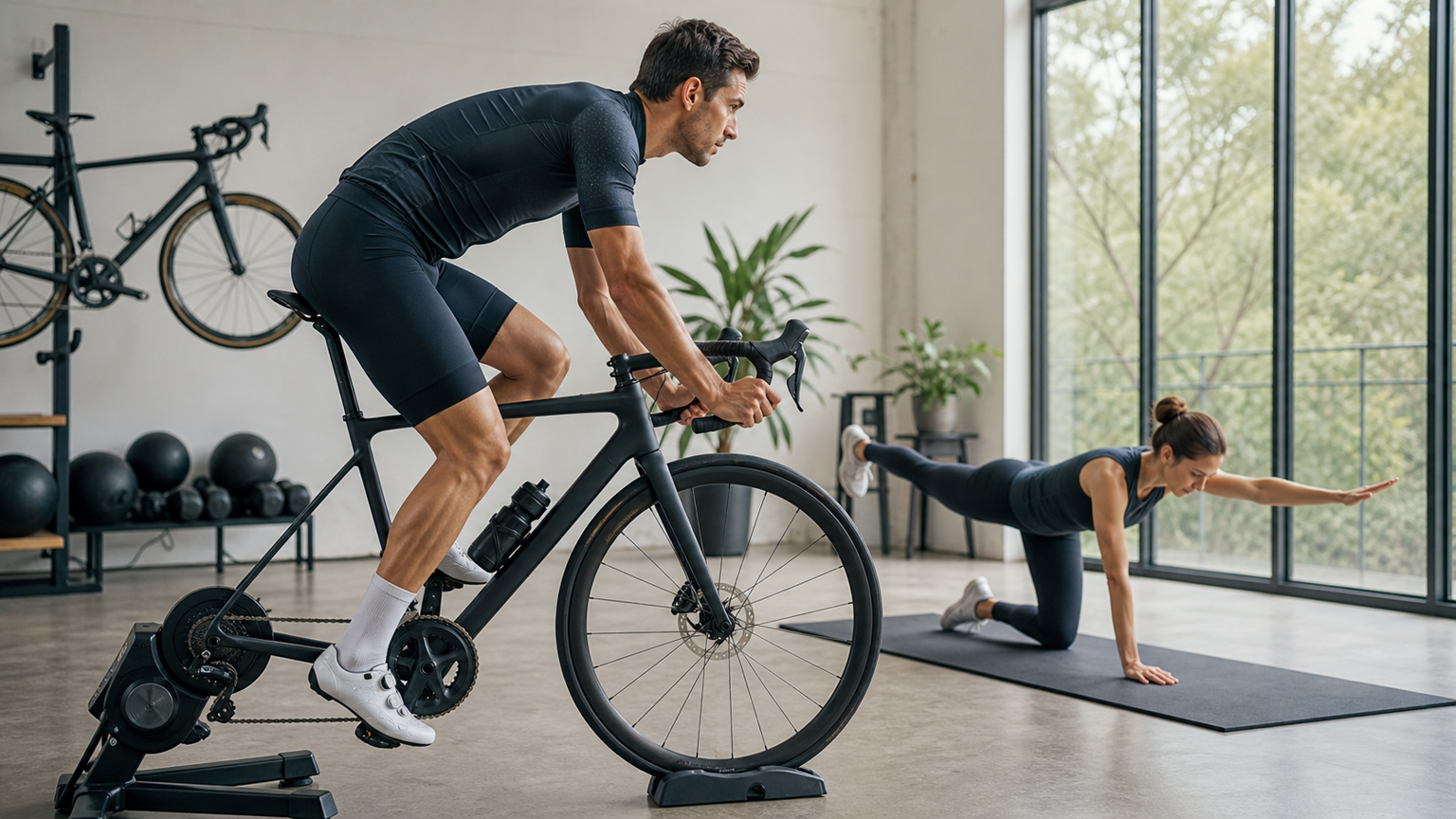
- Bird-Dog: On all fours, extending opposite arm and leg; strengthens coordination between the multifidus and gluteus maximus
- Side Plank: Trains the external obliques and gluteus medius, improving pelvic stability while riding
- Glute Bridge: Activates the gluteus maximus, reducing lumbar compensation and improving pedaling efficiency
Special note: Traditional sit-ups offer limited benefit for cyclists and, due to hip flexor compensation, may actually worsen lower back pain. It is recommended to replace them with the functional exercises above.
Bike Fit and Posture Adjustment
Core training must be paired with proper bike fit to be effective:
Handlebar Height and Reach
- For beginners or those with a history of back pain, the handlebars should be level with or slightly higher than the saddle to reduce the degree of forward lean
- If the handlebars are too low or the reach is too long (top tube plus stem total length), the rider must over-round the back to reach the bars—a primary source of back pain
Saddle Angle
- A saddle tilted nose-down forces the rider’s weight forward, requiring more lumbar strength to support the upper body—a hidden source of back pain
- It is recommended to keep the saddle level or with the nose slightly raised by 0.5–1 degree
Pedaling Technique
- Pedal in a “circular” motion rather than simply pressing down with the quadriceps; engaging the gluteus maximus and hamstrings helps distribute load away from the lumbar spine
Practical Recommendations
- Pre-ride Warm-up: Perform 5 minutes of hip flexor stretches and cat-cow spinal mobility work before departing to help the lumbar spine adapt to the forward-leaning posture
- Mid-ride Breaks: On long rides, get off the bike to stretch every 60–90 minutes, performing back extensions and side bends
- Post-ride Recovery: Immediately after riding, perform supine knee-to-chest, child’s pose, and lizard pose stretches to release lumbar pressure
- Avoid Sudden Increases in Climbing Volume: The forward lean intensifies with gradient; if the core is not prepared, back pain can easily be triggered
- Seek Medical Attention for Persistent Pain: If back pain is accompanied by leg numbness or tingling, it may involve nerve compression; seek prompt medical evaluation to rule out disc issues
Conclusion
Back pain from cycling is by no means unsolvable—it is the combined result of core strength, bike fit, and training methods. Consistent core training, along with proper bike adjustments, will allow you to ride freely on Taiwan’s beautiful mountain roads without being plagued by back pain. Incorporate back pain prevention into your daily training plan, and both your riding quality and endurance will improve significantly.
Related Reading
- Lower Back Pain While Cycling: Management Strategies for Core Strengthening and Posture Adjustment
- Lower Back Pain and Cycling: Cause Analysis, Posture Correction, and Long-term Solutions
- Shoulder Pain in Cycling: Muscle Strengthening Strategies for Prolonged Weight-bearing
- Back Problems in Cyclists: Lumbar Spine Protection and Riding Posture
一日北高/長距離團騎 常見問題補充篇 / 組團或跟團的眉角 / 壯車友容易被瘦車友慢性拉爆 / 原來屁股痛可能是這個原因...? / 風場配速法 / 公路車 / CT Yeh
2 年前
一日北高常見問題大集合 | 攻略 | 路線 | 訓練 | 補給 | 自行車 單車 | 一日雙城 | 雙塔 | TWB北高360 | 屁股痛
6 年前
CT 喇低賽) 單車 比賽總是沒照片? 攝影師的觀點大公開 姿勢就是力量! 請加速1.25倍收看
7 年前
碟煞公路車 銑面器 !? 原來銑完差這麼多! 降低蹭碟機率! | TIME 公路車 保養小記錄 | CT Yeh
3 年前
摔車後補裝備: 好市多新款單車安全帽& Specialized Romin 北高整路屁股都不痛的坐墊 | 一千元居然有MIPS | CT Yeh | 公路車
4 年前
Insta 360 One 超級防手震技術實測
7 年前
[教學] Premiere 影片 手震 修正 教學 防抖 單眼 影像 GoPro 穩定 Video Stabilization
8 年前
再快都跟的上!? 單車跟隨攝影機之王 HOVERAir X1 PROMAX 全面實測 / 唯一!8K畫質&自行車專用模式和跟蹤信標&前後避障 / DJI Neo 可參考/ 公路車 / CT Yeh
1 年前