Introduction
When a rider complains of a burning sensation in the sole of the foot, foot pain during rides, or heel swelling after riding, the setup of the cleats and pedal system is often the most overlooked cause. Unlike running, every pedal stroke on a bike transmits force through a rigid cycling shoe sole. Once the cleat position is off, 80-100 repetitive pedal strokes per minute will amplify a subtle load imbalance into a serious injury.
Classification and Causes of Foot Pain
| Type of Pain | Typical Location | Main Cause |
|---|---|---|
| Metatarsalgia | Transverse pain across the forefoot | Cleat positioned too far forward, excessive toe force during pedaling |
| Plantar fasciitis | Medial heel pain upon waking | Insufficient arch support, inadequate stretching after riding |
| Morton’s Neuroma | Burning numbness between the third and fourth toes | Shoes too tight, cleat positioned too far laterally, compressing the forefoot |
| Arch fatigue | A sense of the entire arch collapsing after long rides | Uncorrected flat feet, insufficient insole support |
Correct Adjustment of Cleat Position
Cleat position is the single most critical setting affecting foot health. Two main parameters must be considered when adjusting it:
Fore-Aft Position
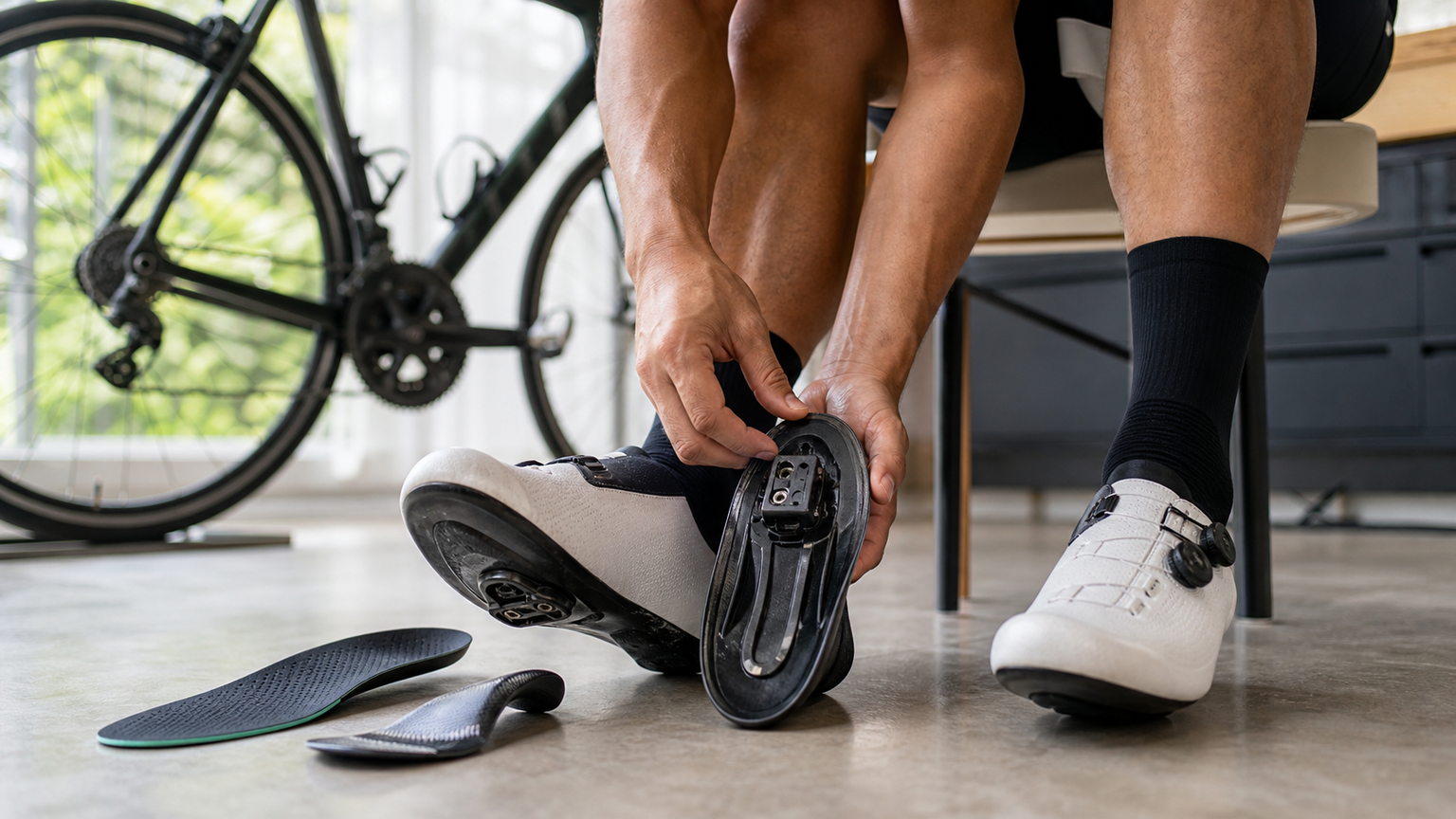
The cleat should be installed so that the first metatarsal head (the bony bump at the base of the big toe) aligns directly over the pedal axle. How to do it:
- Stand while wearing your cycling shoes and mark the location of the first metatarsal head on the side of your foot with a marker
- Transfer that mark to the corresponding position on the shoe sole
- Adjust the cleat so the marked point aligns with the pedal axle
The danger of a cleat that is too far forward: the pedal axle sits ahead of the metatarsal, shortening the lever arm during pedaling and concentrating pressure on the forefoot — the most common cause of metatarsalgia.
Applying cleat setback: for riders with a history of metatarsalgia or a high training volume, try moving the cleat slightly rearward (3-5 mm) so the pedal axle sits behind the metatarsal, spreading out forefoot pressure. This setup may slightly reduce pedaling efficiency.
Lateral Position and Float/Rotation
- Medial-lateral position: the cleat should allow the knee to track straight down during pedaling. If the knee habitually caves in or bows out, pair the cleat with a wedge shim or switch to a cleat with a different float angle
- Float: beginners are advised to choose cleats with a larger float angle (9 degrees), allowing the foot natural room to rotate and avoiding knee injury from being over-constrained
Choosing Arch Support and Insoles
The stock insoles that come with cycling shoes usually offer only basic cushioning and insufficient support for riders with arch issues (flat feet or high arches).
Arch Type and Recommendations
- Flat feet (low arch): the arch tends to collapse during pedaling, causing the foot to roll inward (overpronation), which in turn affects knee tracking. A custom insole with medial longitudinal arch support is recommended
- High arches: the contact area of the sole is small, and pressure concentrates on the forefoot and heel. A thicker cushioned insole with reinforced forefoot padding is recommended
Some podiatry clinics and sports medicine centers in Taiwan offer foot scanning and custom insole fabrication services. For riders with chronic foot pain, investing in a properly fitted insole is often more cost-effective than frequent treatment.
Daily Care to Prevent Foot Pain
- Post-ride sole rolling: roll a golf ball or fascia ball under the sole of the foot for 2-3 minutes to release the plantar fascia
- Calf stretching: static stretching of the gastrocnemius and soleus muscles after riding indirectly relieves tension in the plantar fascia
- Check shoe tightness: shoes that are too tight, especially in the forefoot, are a risk factor for neuroma — make sure your thumb can move freely at the toe box
Practical Recommendations
- After buying new cycling shoes or replacing cleats, shorten your first 3-5 rides (30-60 minutes each) to gradually let your body adapt to the new loading pattern
- If pain occurs on one side only while the other foot is normal, check whether the cleat position is symmetrical on both shoes
- Foot swelling after long rides (100 km or more) is normal; rinsing the feet with cold water can help reduce it faster
- The classic symptom of plantar fasciitis is “pain with the first step in the morning.” If this occurs, see a doctor for diagnosis and pause high-intensity training
Conclusion
Although foot pain manifests in the sole, its cause can often be traced back to cleat position and insufficient arch support. Taking the time to correctly set your cleat position and choosing a properly fitted insole is one of the most cost-effective investments you can make for riding comfort. For Taiwanese cyclists pursuing long-distance endurance rides, healthy feet are the foundation for completing every mileage challenge.
Related Reading
- Cleat Position Adjustment: Solutions for Fore-Aft, Lateral, and Rotational Angle Pain
- Cyclist Ankle Injuries: Ankle Problems Caused by Incorrect Cleat Angle
- Don’t Ignore Knee Pain: Preventing and Treating Common Cyclist Knee Injuries
- Achilles Tendon Issues in Cycling: How Pedaling Angle and Cleat Adjustment Affect the Achilles Tendon
#公路車 #Fitting 靠人工智慧APP 幫你調整單車
6 年前
碟煞公路車 銑面器 !? 原來銑完差這麼多! 降低蹭碟機率! | TIME 公路車 保養小記錄 | CT Yeh
3 年前
摔車後補裝備: 好市多新款單車安全帽& Specialized Romin 北高整路屁股都不痛的坐墊 | 一千元居然有MIPS | CT Yeh | 公路車
4 年前
高雄綠園道鐵路自行車道 / 外地人能輕鬆駕馭 還是整路崩潰? / 2025 全線開通 春節實地探索一次!(附GPS連結)/ 公路車 / CT Yeh
1 年前
靠單車減肥35公斤 心得分享與整理
7 年前
單車 一日北高 ( 雙城 ) 肥宅雙人瘋狂行 紀錄片 REACTO
10 年前
[教學] Premiere 影片 手震 修正 教學 防抖 單眼 影像 GoPro 穩定 Video Stabilization
8 年前
Canyon 公路車斷把手 五年老車特規還能修嗎? 維修保養全記錄 feat. 501單車監理站 | 公路車 | CT Yeh
4 年前