Post-Injury Recovery Training for Swimming: Adjusting Your Workout Plan During Shoulder Injury Recovery
Introduction
“Swimmer’s shoulder” is the most common injury among recreational and competitive swimmers, referring to swimming-related shoulder pain that encompasses rotator cuff inflammation, impingement syndrome, biceps tendinitis, and other conditions. In Taiwan, many swimming enthusiasts, after experiencing shoulder pain, either choose to push through the pain or stop training completely—neither of which is the optimal strategy.
The correct approach, under the guidance of a physician or physical therapist, is to engage in “modified training”: adjusting the workout to avoid aggravating the injury while maintaining overall fitness, and accelerating recovery through specific rehabilitation exercises.
Important Prerequisite: This article provides general guidelines only; actual injuries should be evaluated and diagnosed by a physician or physical therapist. Any condition with clear pain should be seen by a medical professional first—do not self-diagnose and continue training.
Common Causes of Swimmer’s Shoulder Injuries
Understanding the cause of the injury helps prevent recurrence after recovery:
Training Factors
- Sudden increase in training volume (exceeding the 10% rule)
- Over-pulling, especially with high stroke rate and short stroke length
- Excessive use of pull buoys (increasing shoulder load)
- Lifting the head too high when breathing, causing excessive shoulder rotation
Technical Factors
- Hand crossing the midline of the body upon entry (causing shoulder internal rotation)
- Flat body position without rotation during kicking (increasing shoulder rotation burden)
- Early hand exit from the water (reducing propulsive efficiency, increasing compensatory load)
Physical Factors
- Overly tight anterior shoulder muscles (pectorals, biceps) and weak posterior muscles (rhomboids, posterior deltoids)
- Insufficient core stability (weak core leads to shoulder compensation)
Staged Management of Shoulder Injury Recovery
Acute Phase (Days 0–7 Post-Injury)
The primary goal during this period is to control inflammation and allow tissue repair.
- Swimming: Stop completely. Regardless of how comfortable the water temperature is, getting in the water is not recommended.
- Land-based Activities: Gentle core training (movements that do not involve the shoulders) is permissible.
- Physical Therapy: Ice application, ultrasound therapy, low-intensity electrotherapy.
Subacute Phase (Weeks 1–3 Post-Injury)
Pain begins to subside, and light activity can be introduced.
Permitted Water Activities:
- Kickboard drills (both hands holding the board, no shoulder use): 500 to 800m, kicking throughout
- Supine back float: Let the shoulders relax in the water, feeling the buoyancy support
Movements to Avoid:
- Freestyle pulling (any stroke involving shoulder rotation)
- Butterfly (greatest impact on the shoulders)
- Paddles training
Recovery Phase (Weeks 3–6 Post-Injury)
After pain has largely subsided, gradually resume swimming movements while closely monitoring the shoulder’s response.
Progressive Return-to-Swim Plan:
| Phase | Recovery Content | Notes |
|---|---|---|
| Weeks 3–4 | Backstroke (minimal shoulder load) in 50–100m short sets | Stop immediately if pain occurs |
| Weeks 4–5 | Add breaststroke (avoid excessive shoulder rotation) | Only add arm pulls after kicking is solid |
| Weeks 5–6 | Easy freestyle (bilateral breathing, avoid breathing to the affected side) | Slow the pace to reduce shoulder load |
| Weeks 6–8 | Resume full freestyle, but keep volume at a low threshold | Assess shoulder condition after each session |
Rebuilding Phase (Weeks 6–12 Post-Injury)
Gradually return to normal training volume while continuing to strengthen shoulder stability.
Land-Based Rehabilitation Training Arrangement
During the shoulder injury period, land-based shoulder rehabilitation training is crucial:
Rotator Cuff Strengthening (3 times per week):
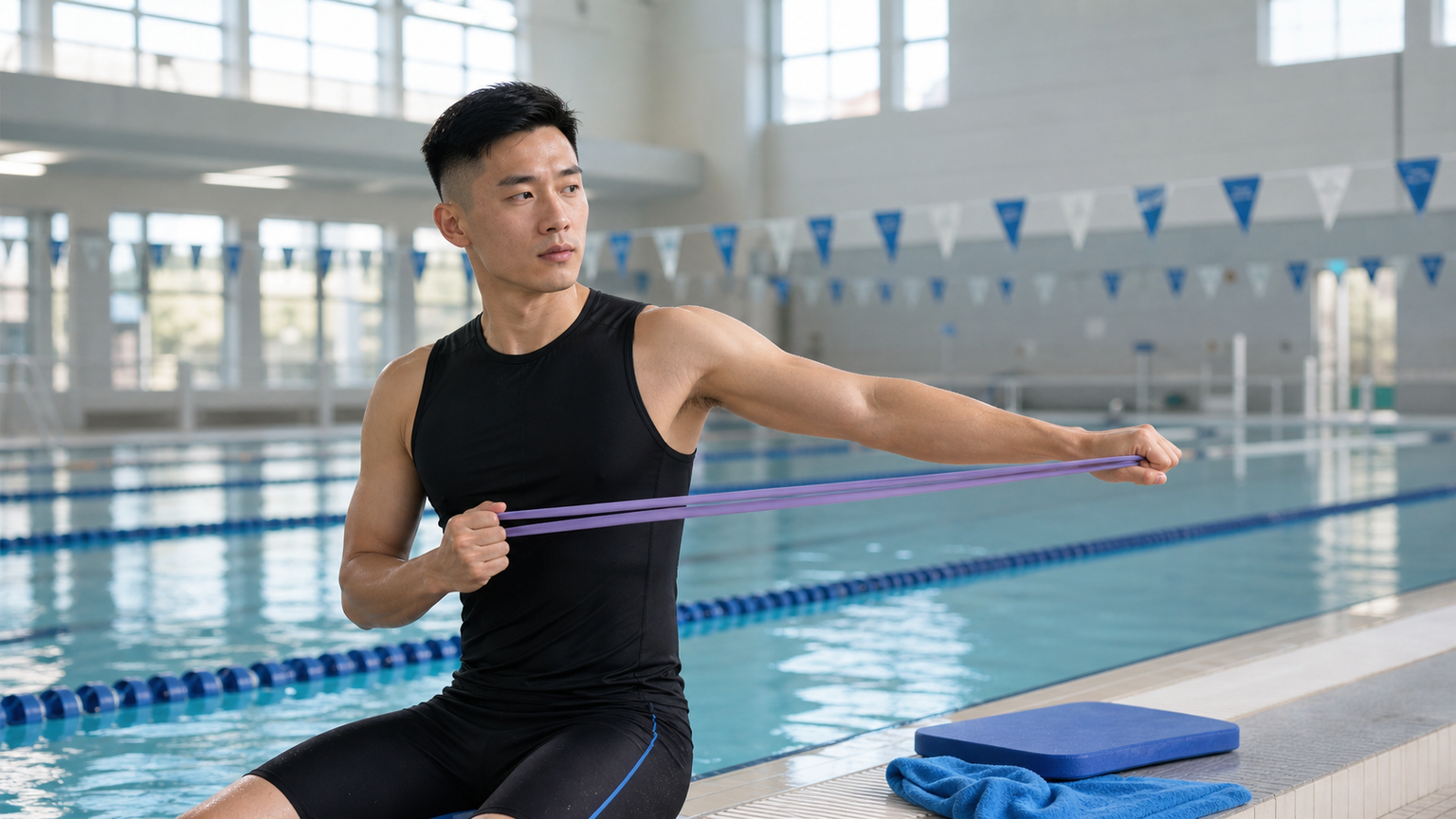
- Resistance band external rotation: 3 sets × 15 reps (lying or standing, elbow bent at 90 degrees)
- Resistance band shoulder stabilization: 3 sets × 12 reps
Scapular Stabilization Training:
- Y-T-W land drills (prone, raising arms to simulate different angles): 3 sets × 10 reps for each position
Pectoral Stretching:
Twice daily, doorway stretch or yoga “golfer’s” stretch, holding each for 30 to 45 seconds
Criteria for Returning to Full Training
Before resuming full training, confirm that the following conditions have all been met:
- No shoulder pain while swimming (both during training and for 24 hours after training)
- No significant difference in shoulder range of motion compared to the healthy side
- No compensatory movements in shoulder stability tests (arm raises, rotations)
- Completed at least 2 weeks of progressive light training without symptoms
Practical Advice
- Do not push through the acute phase: Many athletes fear falling behind and train through pain, turning a subacute injury into a chronic problem
- A physical therapist is your best partner: Swimmer’s shoulder rehabilitation should be led by a physical therapist, not self-guessed
- Correcting technical errors is fundamental to preventing recurrence: After recovery, have a coach review whether there are technical issues that contributed to the shoulder injury
- Core training should continue simultaneously: Maintaining core training during the shoulder injury period reduces shoulder compensation when returning to swimming
- Patience is the best medicine: Full recovery from a shoulder injury typically takes 6 to 12 weeks; rushing back only prolongs the overall recovery time
Conclusion
Shoulder injuries are a risk swimmers cannot completely avoid, but how you respond to the injury is what matters. Proper staged management, appropriate modified training, and coordinated land-based rehabilitation can allow most swimmer’s shoulder cases to fully recover within a reasonable timeframe—and return athletes to the water stronger than before the injury.
Related Reading
- Complete Analysis of Swimmer’s Shoulder: Causes, Diagnosis, and Prevention
- The Complete Diagnosis and Treatment Guide for Swimmer’s Shoulder
- Pediatric Swimming Shoulder Overuse Injuries: A Complete Guide to Identification, Prevention, and Rehabilitation
- Swimming Shoulder Injuries: Causes and Prevention of Swimmer’s Shoulder
[教學] Premiere 影片 手震 修正 教學 防抖 單眼 影像 GoPro 穩定 Video Stabilization
8 年前
一日北高/長距離團騎 常見問題補充篇 / 組團或跟團的眉角 / 壯車友容易被瘦車友慢性拉爆 / 原來屁股痛可能是這個原因...? / 風場配速法 / 公路車 / CT Yeh
2 年前
如何把 GoPro 影片 翻轉 批次 轉正?
6 年前
西進武嶺 免費訓練分析服務 Intervals | 練不夠還是練過頭?你哪一種類型選手?AI模型告訴你! | 備戰神器 | 公路車 訓練 | CT Yeh
4 年前
一日北高常見問題大集合 | 攻略 | 路線 | 訓練 | 補給 | 自行車 單車 | 一日雙城 | 雙塔 | TWB北高360 | 屁股痛
6 年前
抖肩舞 台灣x日本交流版 (台灣 vs 前橋) 赤城山登山賽 coincidance
8 年前
滑雪新手們慘摔學習全紀錄(請開字幕),滑雪好好玩 | Snowboard + Ski | 岩原 スキー場 | 滑雪APP使用 | GoPro Max
6 年前
一起升級!海鷗盃LSD團練...JJSC Zone2招待 騎到手抖 / 公路車 / CT Yeh
1 天前